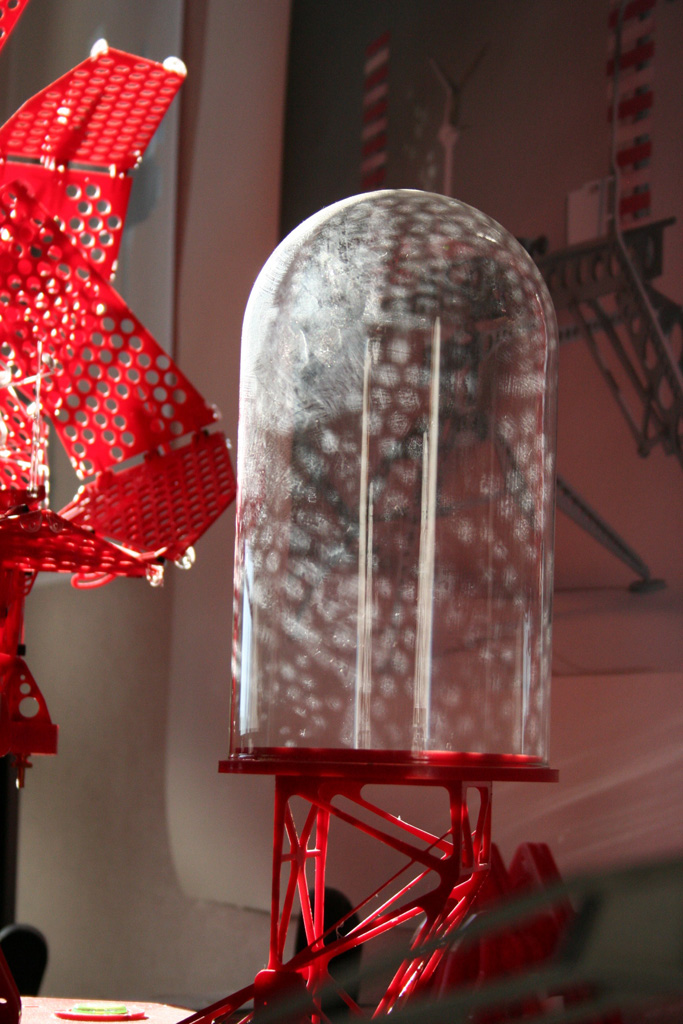
Instrument Five Shadows
Early morning sunlight landing on a version of Instrument Five, with a very dirty dome capturing the image from the surface that normally captures the image.
Instrument Five Shadows
Early morning sunlight landing on a version of Instrument Five, with a very dirty dome capturing the image from the surface that normally captures the image.

Instrument Eight under construction
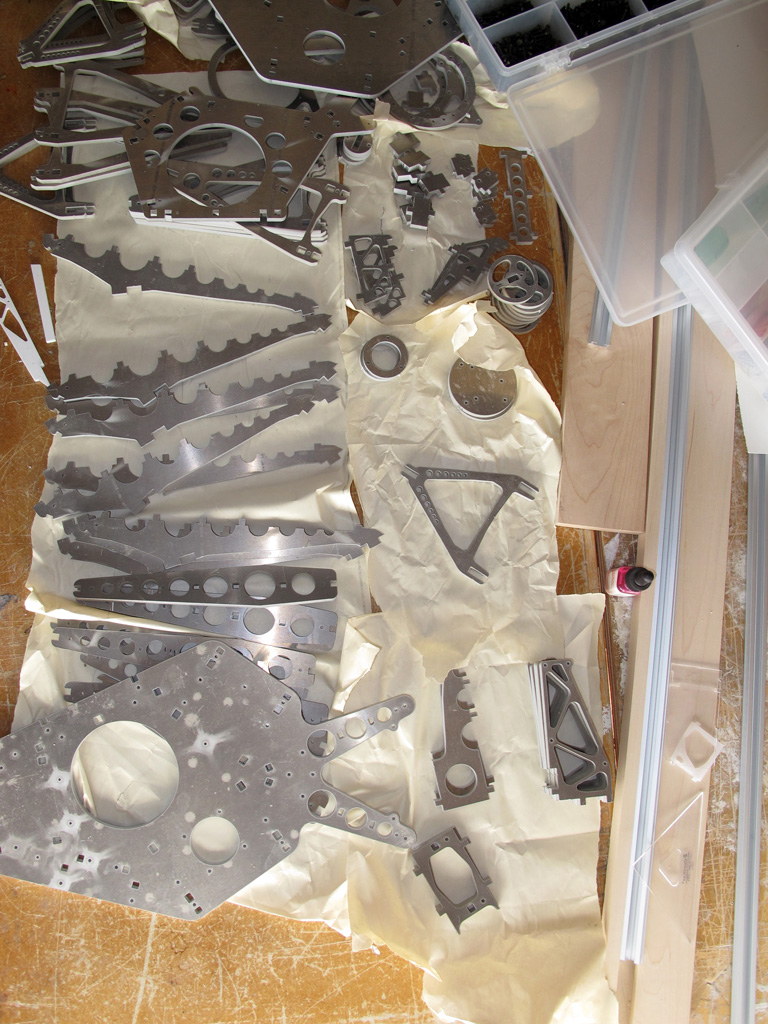
Instrument Eight components
A couple of pictures of components and sub-assemblies for the various versions of Instrument 8.
I managed to get the chassis for the first version together – see:
and am hoping to find time to get the others assembled soon. There is lots yet to resolve on the active parts – I will post some more on that when I get there.
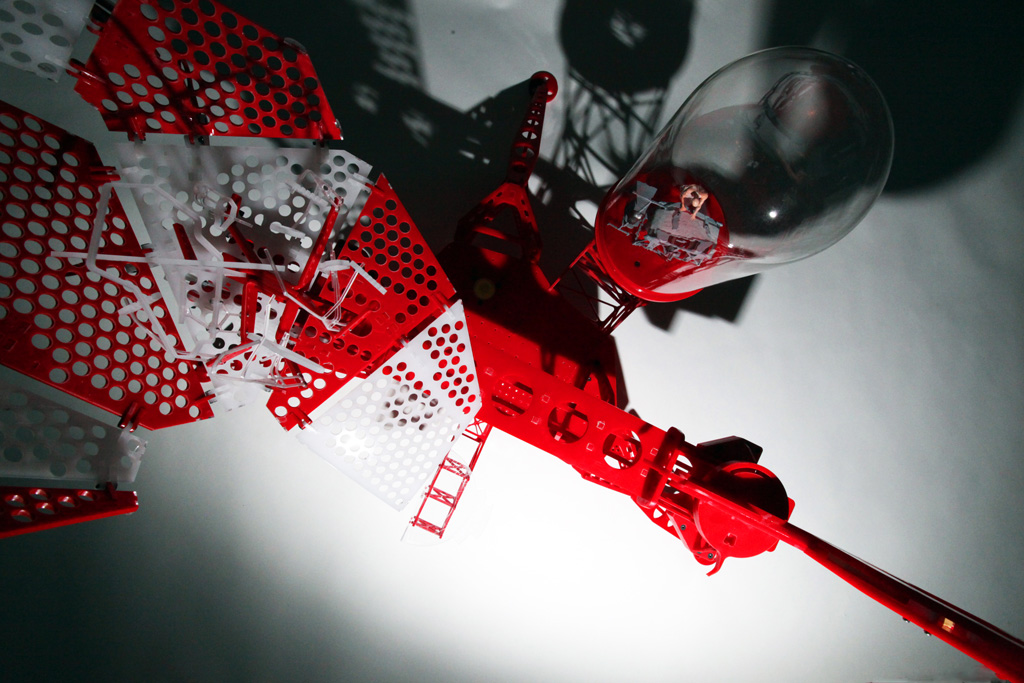
Instrument Five from above
A version of Instrument Five from above.

In the Attic
Some of the instruments in store in the attic.
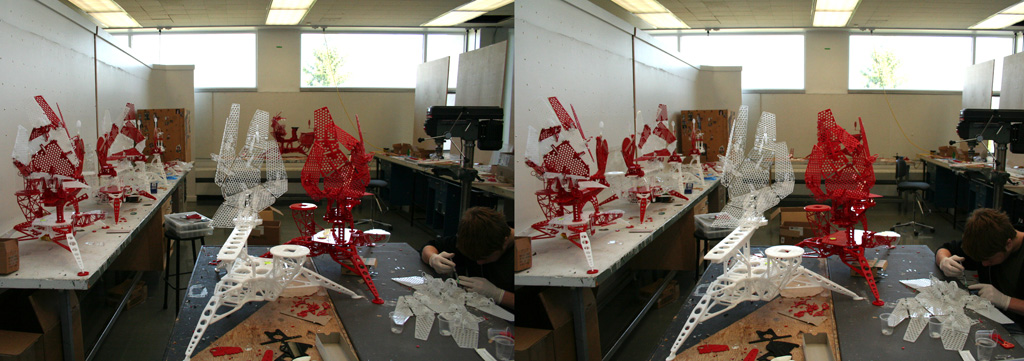
Instruments under construction
I have quite a bit more work to do before the new instruments are worth posting so here is a picture of Instruments Five and Six being assembled and Instruments Four being refitted. The white instrument in the middle foreground is an instrument four and the red one to its right is an instrument five. Behind them on the back worktop (in a studio that is normally used by students – this was taken in the summer before last) is Instrument Six. The instruments lined up on the left are mostly Instrument Fives with one Instrument Four. Several people have asked me how large the instruments are, so this gives some idea of the scale. Each one will fit in a one metre cube.
This is a stereoscopic pair, so if you go cross-eyed you should be able to resolve the scene in 3D, which makes it much clearer. If you are having difficulty resolving it make the image smaller on the screen.

Kitchen Table
This is a frame I welded up for a kitchen table, to include a gas cooker, with a number of surfaces that could either adjust for height, a shift between worktop and table height or anything in between, or swing out to fit a space in the room it was made for when there were fewer people and a more intimate table seemed appropriate. The various adjustable parts would transmit their condition to other pieces in the apartment, redrawing the space in realtime. It has a similar fascination to the sink (https://natchard.com/2011/09/16/drawing-sink/) and the full scale picture plane (https://natchard.com/2011/10/26/full-scale-picture-plane/) in trying to draw space at it happens rather than in advance. For quite bizarre reasons beyond my control I was unable to access the workshop during the time I had to work on the project and as my family’s patience wore out I installed a flat pack kitchen as an interim measure. We subsequently moved and so the project was never completed.
At the time this picture was taken the feet had not been added. Cupboards would have fitted between the frames.
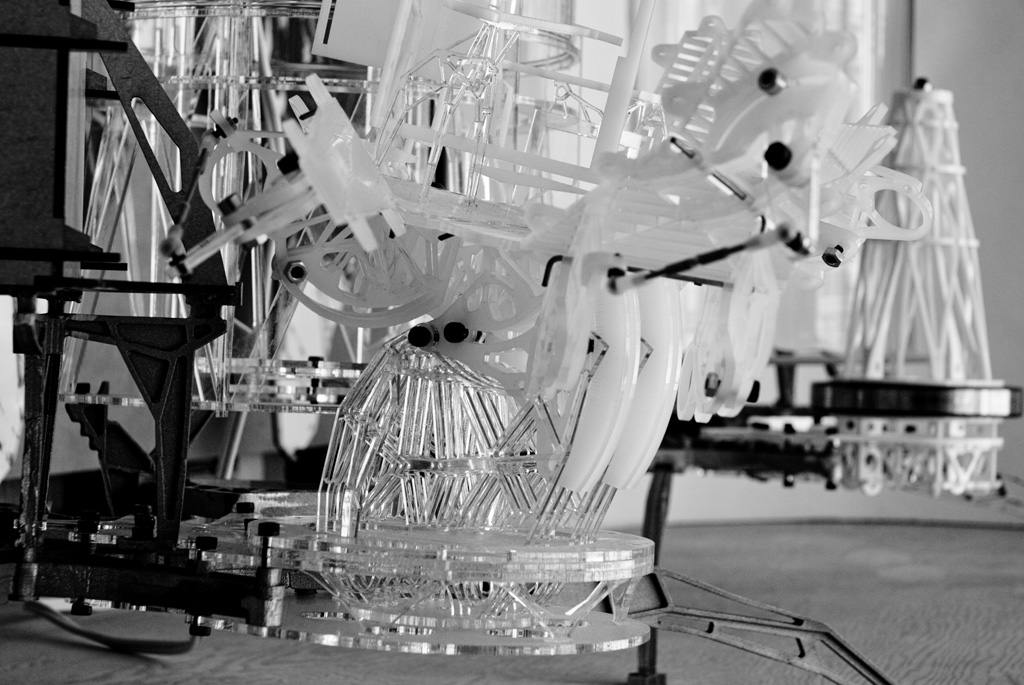
Instrument Three (photo: Frederik Petersen)
Here are a bunch of photographs that Frederik Petersen sent me that he took of a small exhibition about three years ago in the CAST building, so all the hanging plaster beams above the instrument and its drawings are by Mark West. In the picture above Instrument Three is in the foreground and the beginning of the subsequent instrument is behind it (see a few posts back).

Instrument Three (photo: Frederik Petersen)

Instrument Three (photo: Frederik Petersen)
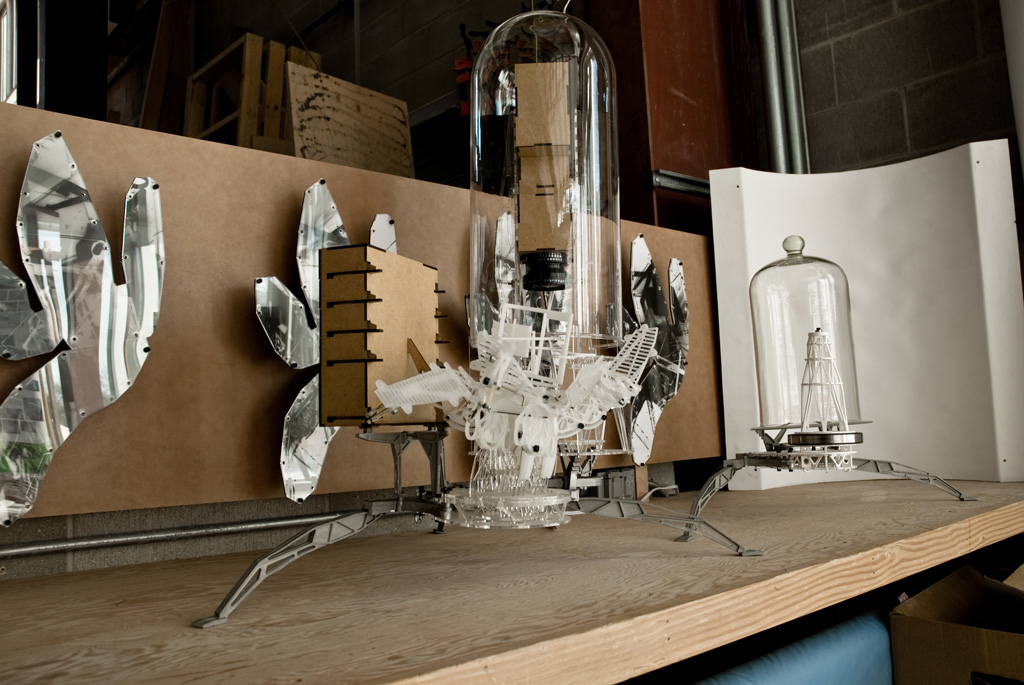
Instrument Three (photo: Frederik Petersen)
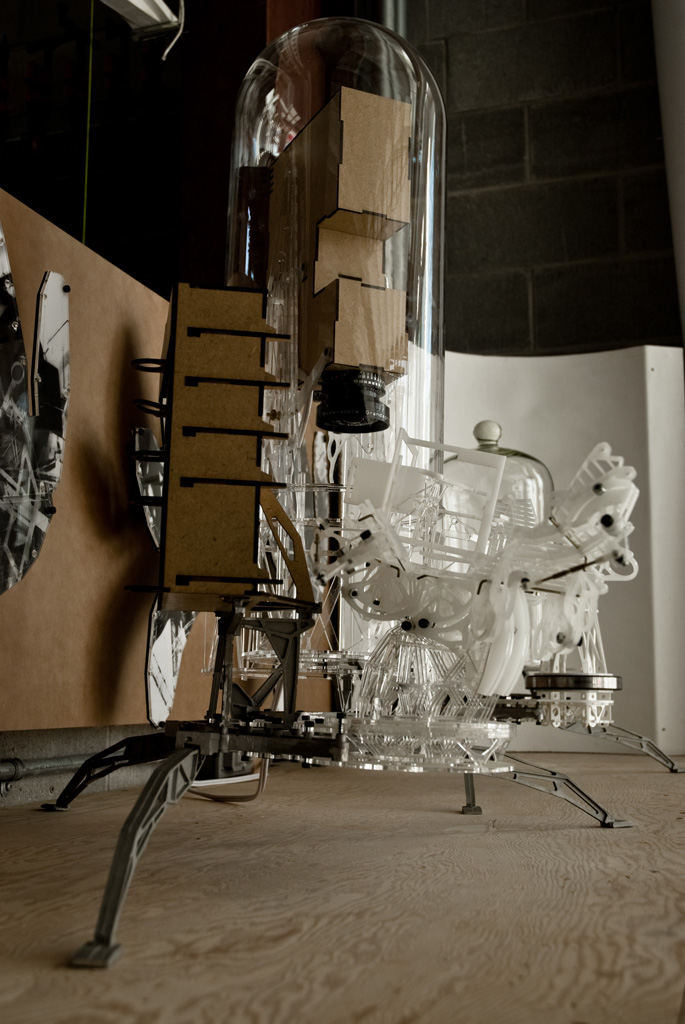
Instrument Three (photo: Frederik Petersen)

Instrument Three (photo: Frederik Petersen)
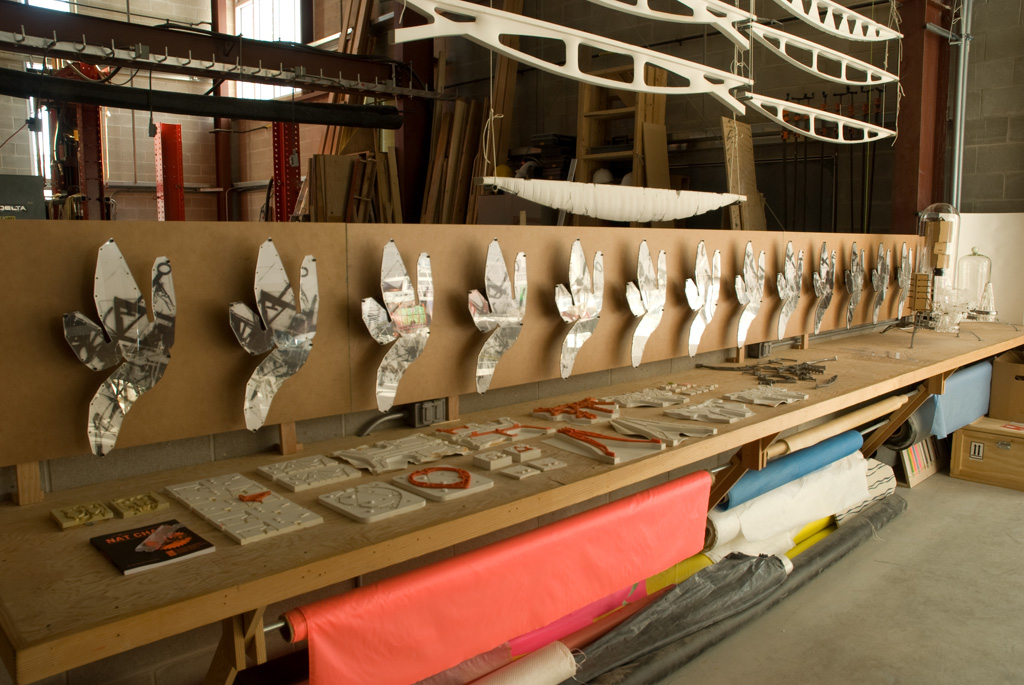
Instrument Three (photo: Frederik Petersen)
Above: In the foreground are some of the moulds to cast the wax from which the aluminium components were cast using a lost wax (or investment casting) process.

Instrument Three Drawing (photo: Frederik Petersen)

Instrument Three Drawing (photo: Frederik Petersen)

Original Dome (Nat Chard)
In the previous post I mentioned that the first instruments were designed to take a glass bell jar, and promised to post some pictures. Here are a few.

Original Dome (Nat Chard)
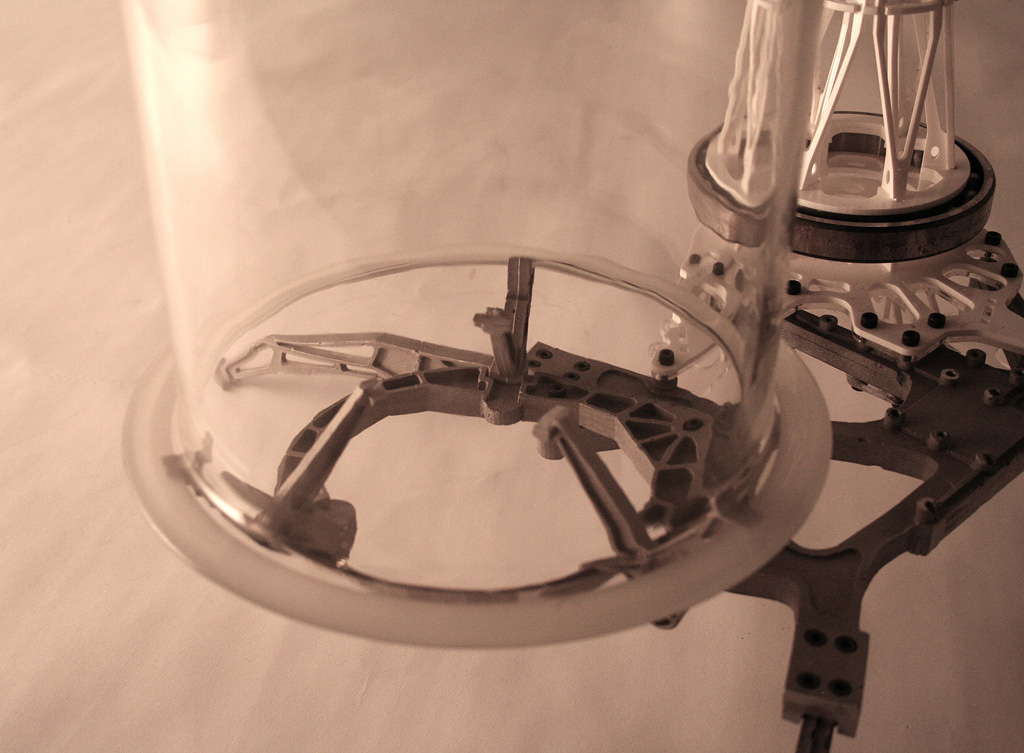
Original Dome (Nat Chard)

Cast Aluminium Frame Underside (Nat Chard)

Early Drawing Instrument Drawing (Nat Chard)
An early drawing of the drawing instruments when I was working on the chassis that eventually supported instruments One, Two and Three. The instrument was designed to hold a Czech made bell jar. I will post a picture of one of these chassis with the intended glass dome. I subsequently chose 18th c. French domes that were larger and lighter (as you see on Instruments Two and Three and will be incorporated in the current instruments) and later from second hand clocks.
The instruments at this stage work between a vertical drawing on the wall and a horizontal one on the table. The observer can work with the vertical drawing through a headset fixed to a bracket on the wall. At this stage the folding picture plane is separated from the drawing instrument chassis.
At the time I was milling out the patterns for the instrument and the drawing was made as an illustration to show a group of colleagues (in a discussion group) what the pieces might look like when assembled. The characters and their condition were related to a story known to some of those in the group.

Instrument Five Model
The various versions of Instrument Five have models under a glass dome so that the person drawing is reminded of the content being discussed by each instrument. Each model shows part of the content of a later version of the bird automata test track, and the models and figures were designed and built by Samantha (Sam) Lynch and Jason Campbell while I was working on the instruments. The image above (and below in detail) is the workbench / operating table to assemble and maintain the automaton birds. It was made by Sam.
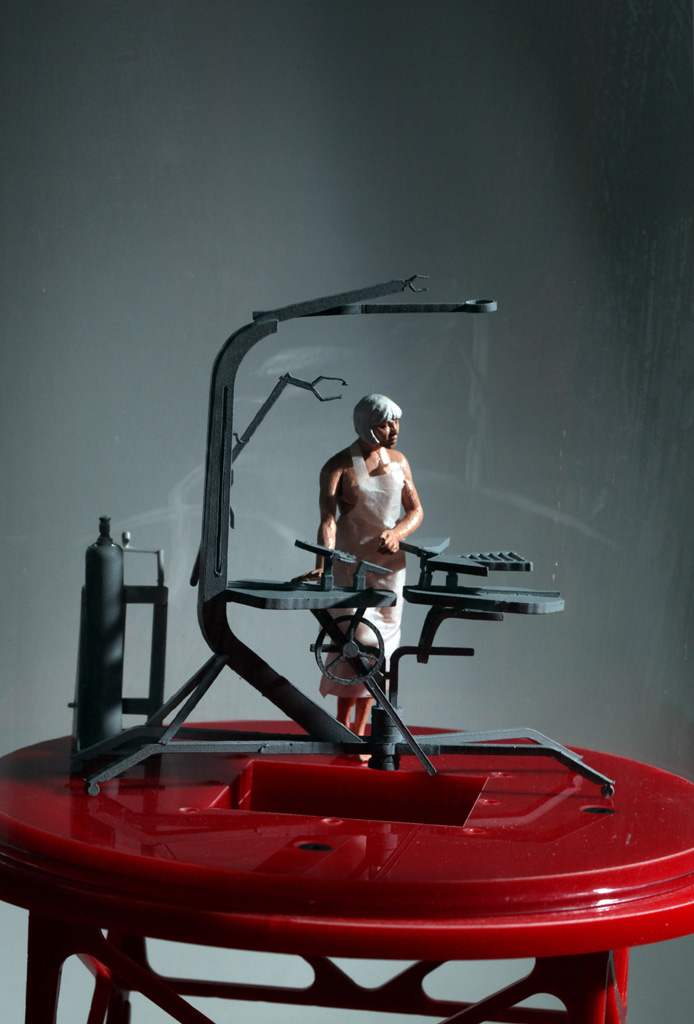
Instrument Five Model
The second model (below) by Jason shows the tracking station where all the bird’s movements during a test flight are recorded.

Instrument Five Model
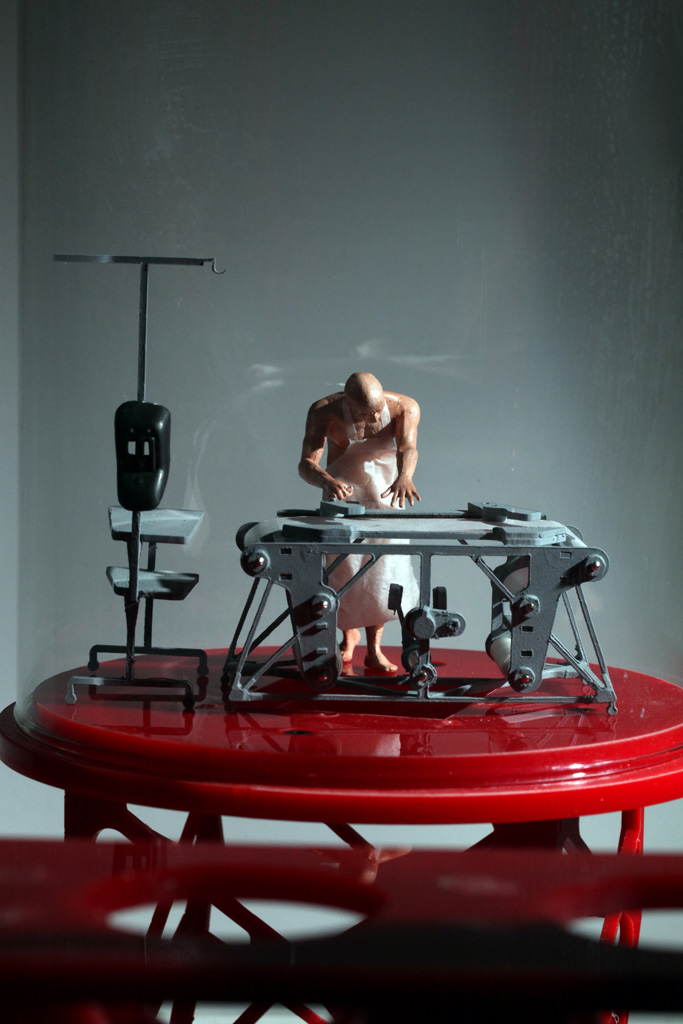
Instrument Five Model
The glass domes protect the models from the flying paint.

Instrument Five Model in position (Nat Chard)
The image above is a reminder of the model location in Instrument Five.
The models are built at 1:24. The figures are made up from a German kit of body parts that allow you to pick and choose from a variety of heads, torsos and limbs. They come naked, which seemed better than the available models with clothes – either military figures or estate agents. They looked a bit strange completely naked so Sam made some work aprons for them. If you think they look a bit pervy, compare them with the suggested assembly on the cover of the kit box.

Natural poses and clothes...

Some of the body parts
Here is one of the plastic mouldings from the female kit.
 Nat Chard