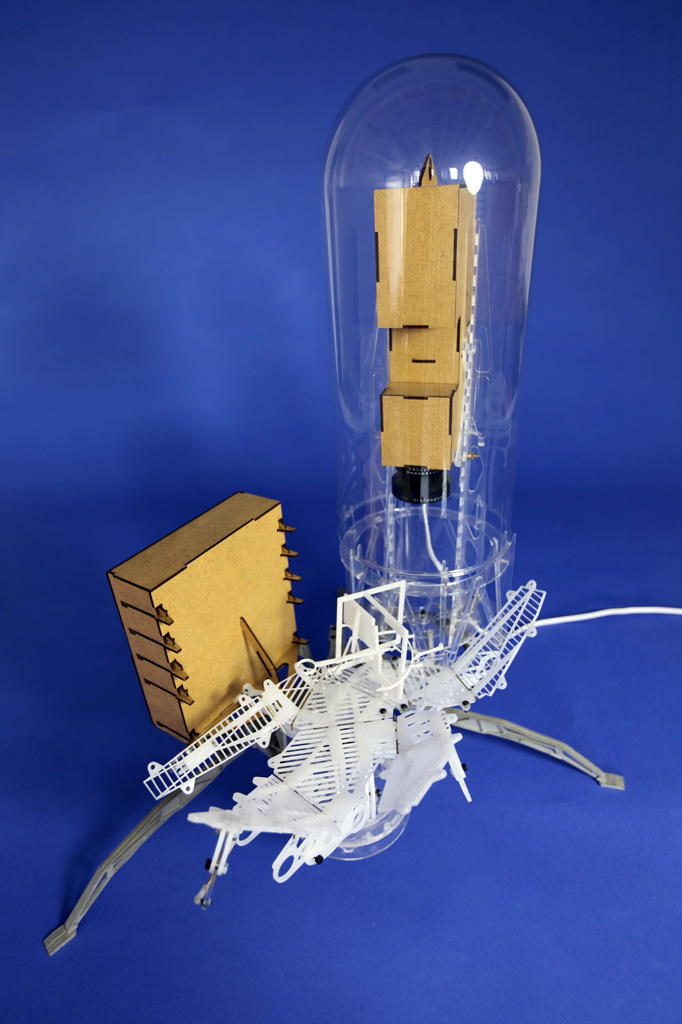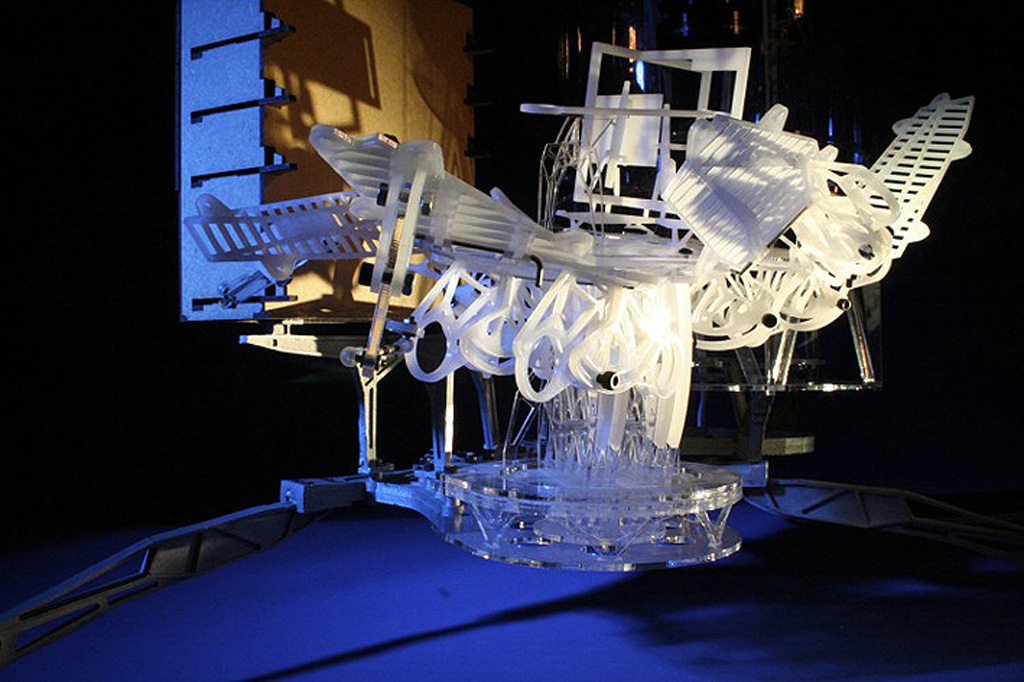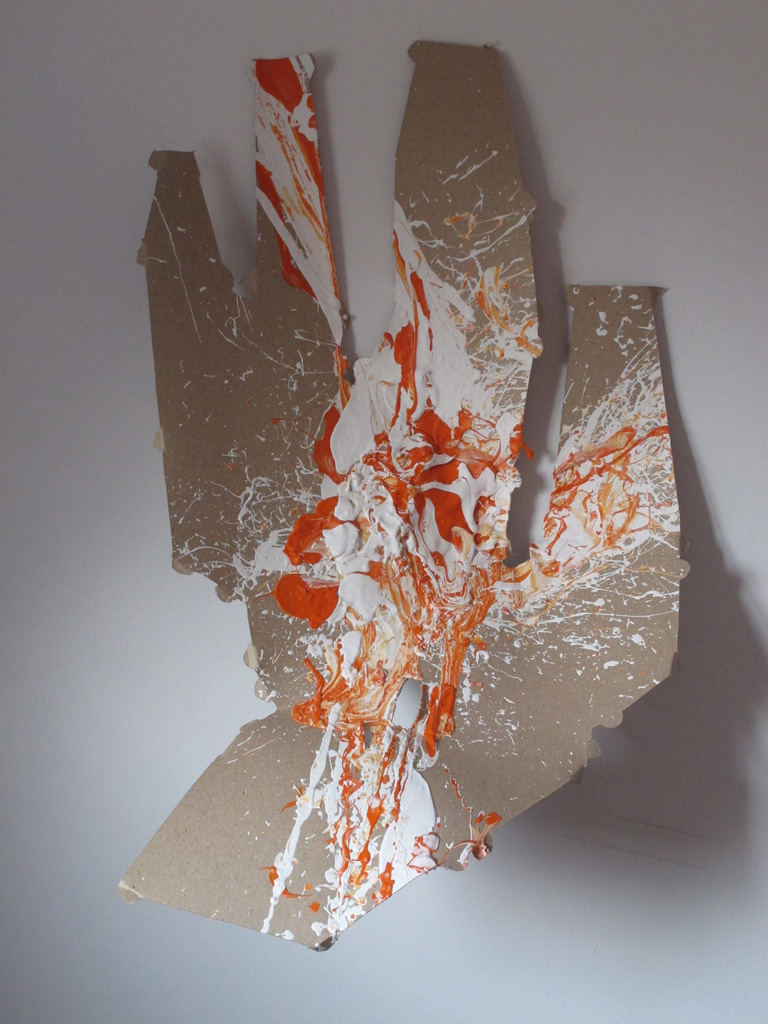
Instrument Five Drawing (Nat Chard)

This will make more sense if read as a continuation of the previous post on Instrument Five

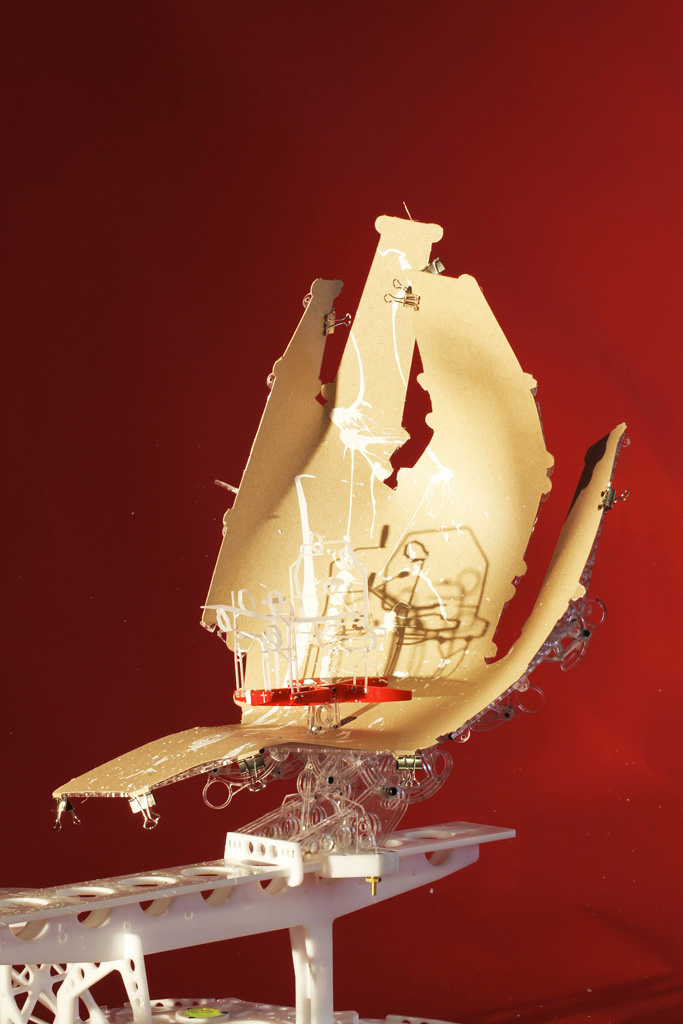
The first genration of Instrument Five Drawings have the continuing problem of the main thrust of paint obliterating the more subtle splatters that come from the collision of paint on the drawing pieces.

Instrument Seven solved this problem (future post)

The early experiments also played with paint viscosity and targeting the paint catapults, which were more accurate and had greater repeatability than i had imagined when designing and making them. They were designed for a disposable plastic tea spoon as a paint holder but I found that a hemispherical measuring spoon provided a more coherent throw.

As the throw happened very quickly, and having an fascination with the work of Arthur Worthington and Harold Edgerton, I decided to capture the paint in flight to see what it was up to – in effect the occupation of the architecture as the drawing pieces also constitute an architectural model (this will make more sense when I have posted a model from which the drawing pieces develop).
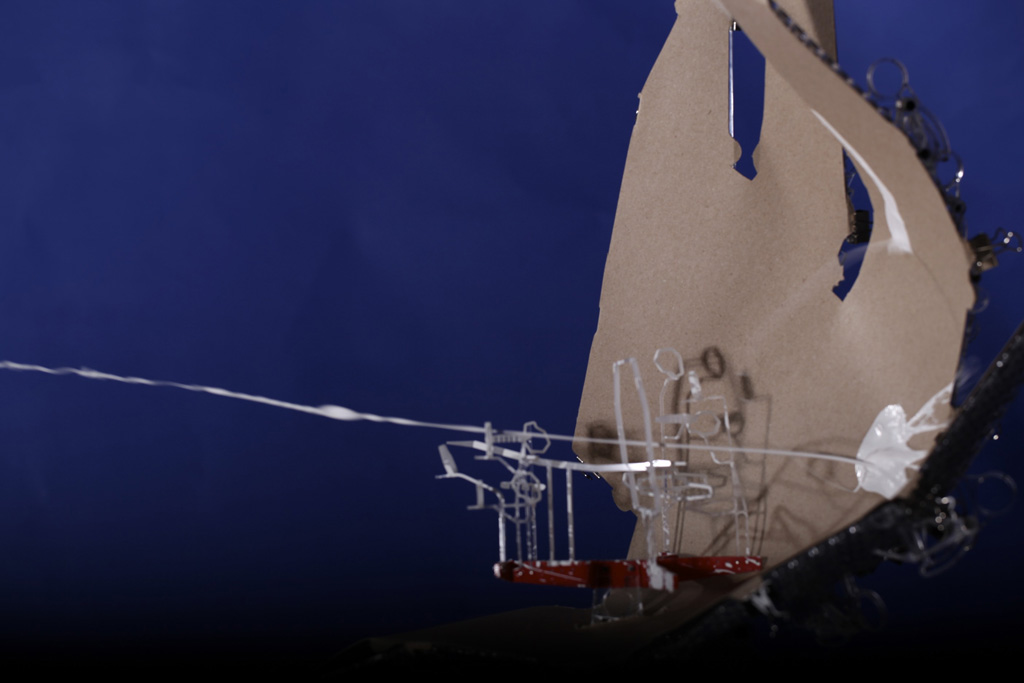
First genreration splat (Nat Chard)

The first attempts with 500 watt flash lamps used at their lowest power (for the fastest flash) were hopeful (above) but not fast enough to resolve the paint as a crisp frozen image. This would be solved by using a powerful battery powered flash in the subsequent generations. The significant discovery was that making these photographs made a hopeful change in my engagement with the work. When making a drawing I set the aim of the catapult in the hope of the paint travelling in a certain trajectory, and perhaps colliding  with one of the drawing pieces in particular. With the photograph, which is timed manually so that even with my most developed method I am only catching the paint in the photograph every two or three throws, I have more than one anticipation in making the throw of paint.

One is the aim – what I want the paint to do – and the other is the hope for the photograph. While the aim is predictable, the figure of the flying paint is not, so in both cases, even if the photograph does register, the real hope is for the unpredictable things that happens. Having the straightforward task (of getting the timing of the photograph right) made it much easier to have a sincere hope for the aiming of the paint while at the same time hoping that it would give much more.
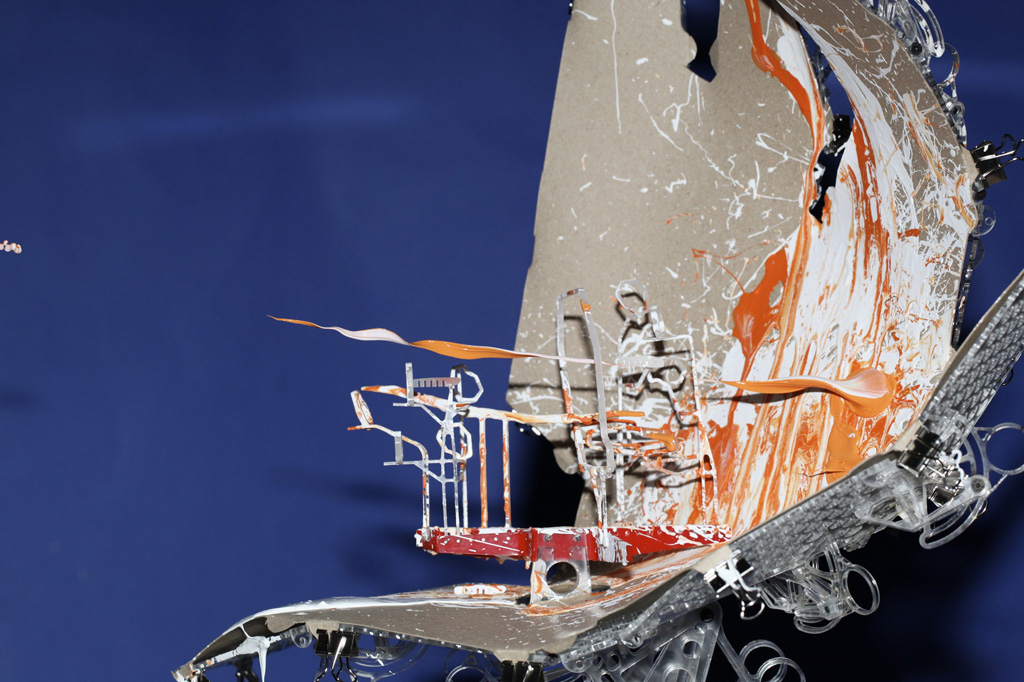
Second genreration splat (Nat Chard)

With a new flash that provided the speed that I needed, the photographs during the throw became more important to me than the  drawing. I alternated between orange and white paint to see the temporal build up of paint on the drawing surface and the residual paint from the previous colour, un mixed, helped describe the behaviour of the paint in flight. The story and architecture discussed by these drawings will be explained in a subsequent post.
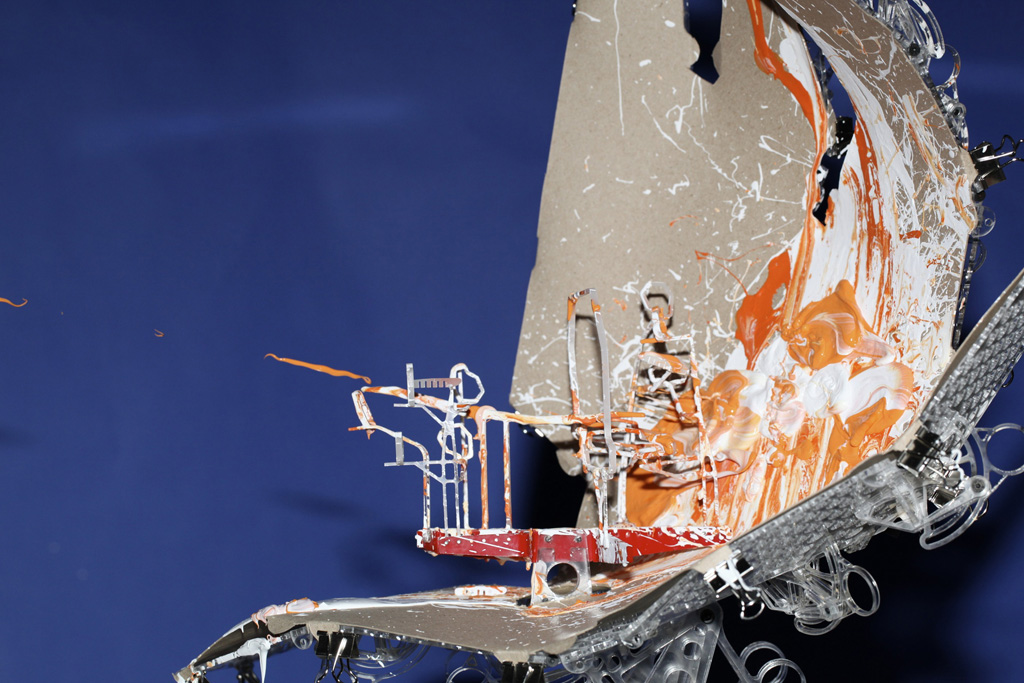
Second genreration splat (Nat Chard)
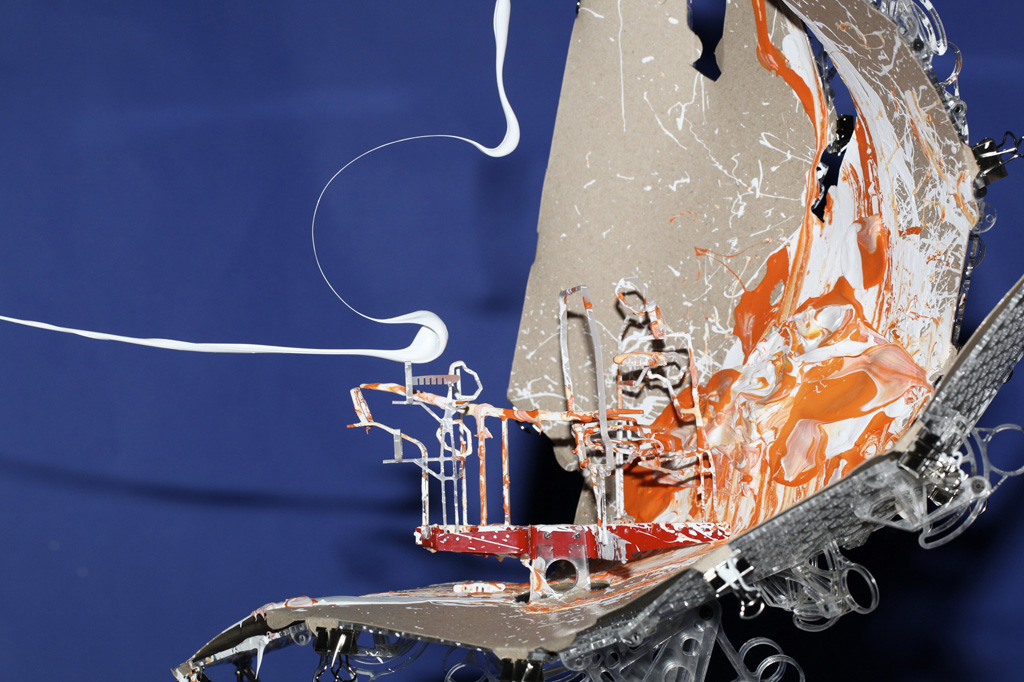
Second genreration splat (Nat Chard)
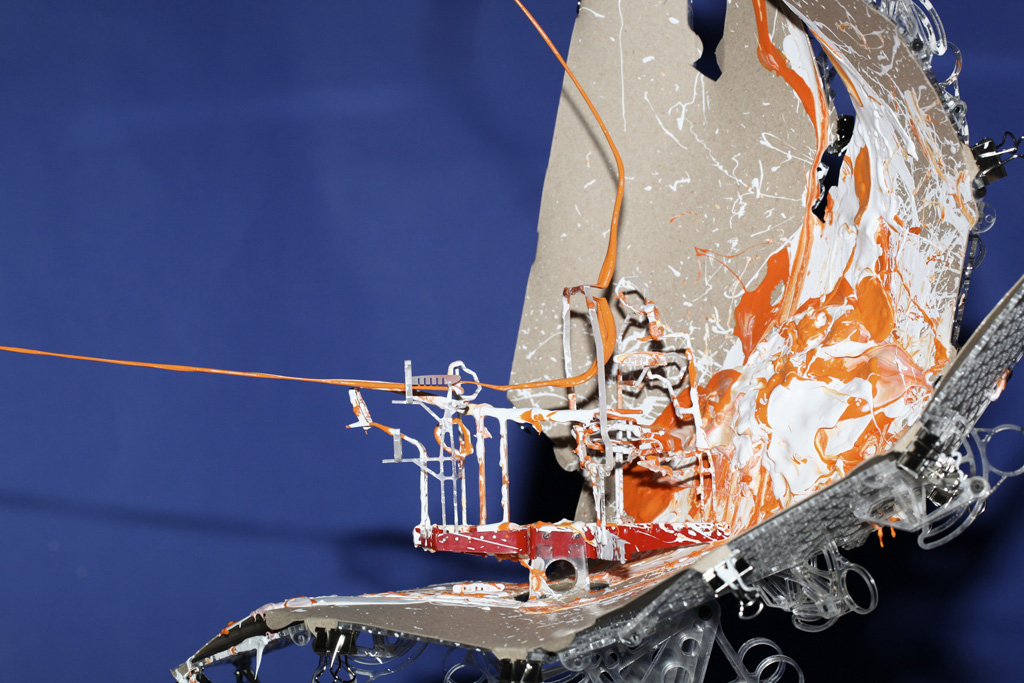
Second genreration splat (Nat Chard)

In the lowest image notice how the line of paint remains continuous as it stretches over the drawing pieces.
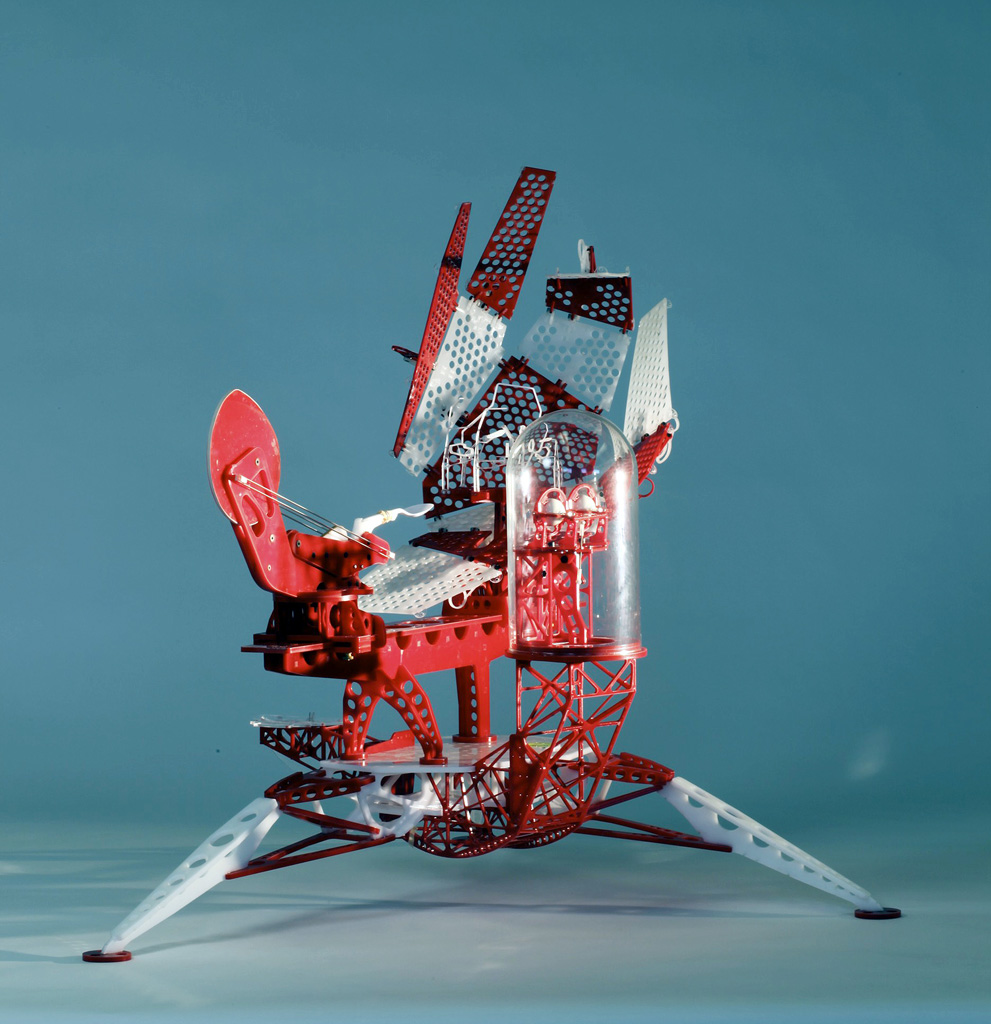
Drawing Instrument Five (Nat Chard)

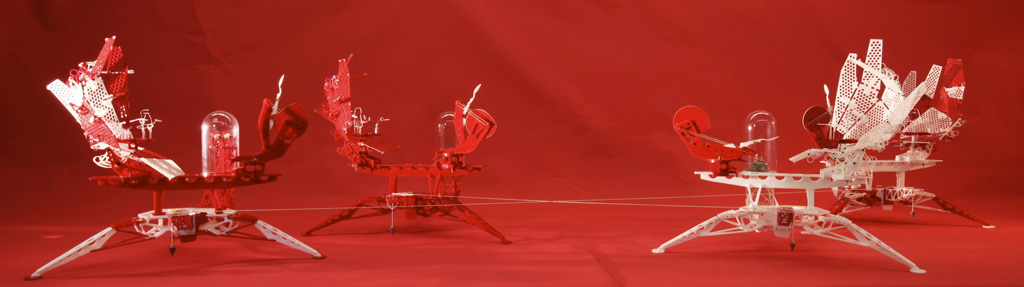
Drawing Instrument Five (Nat Chard)
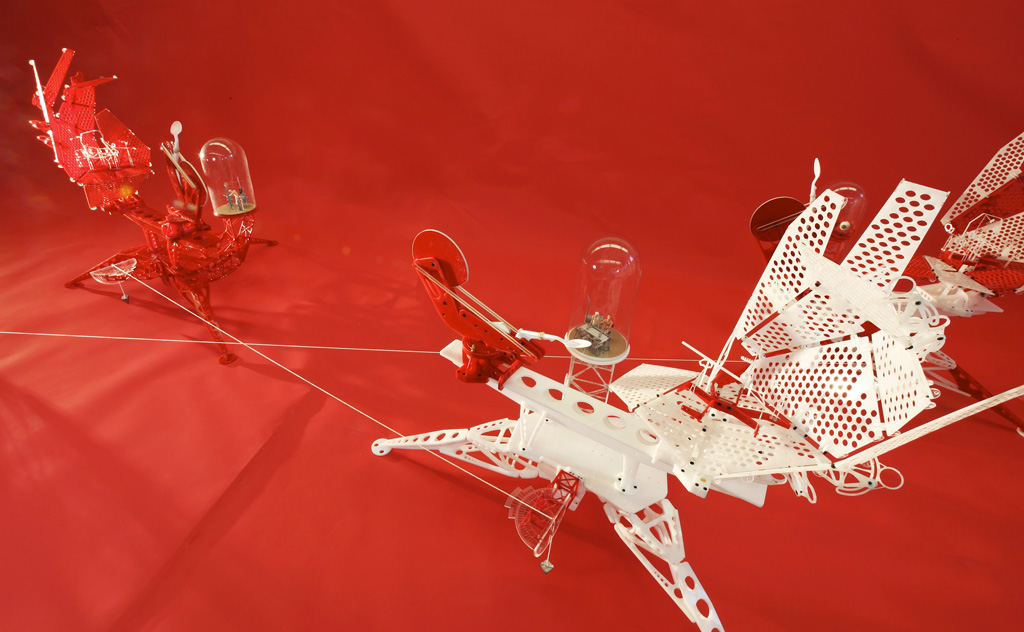
When light casts a shadow, the figure that lands on whatever makes the screen is a predictable combination of the angle of the light, the form of the objects and the nature of the screen. Instruments one, two and three played with the of manipulating such a projection as a critical reception of ideas. Every move was contained by the relentless obedience of light’s behaviour. Instrument fout tested out the idea that instead of projecting light, if paint were thrown at an object the shadow would not just be the figure of the object but also the dynamic conversation of one material hitting another. This visceral event would not be reliable and repeatable. Each time the paint were thrown the objects would be different, due to the accumulation of paint. Further more, as some of the objects had special figures to play with the paint in different ways,  they would would provide a range of ways in which the flying paint would behave during and after a collision of paint on drawing piece.

Set fo Four versions of Drawing Instrument Five (Nat Chard)

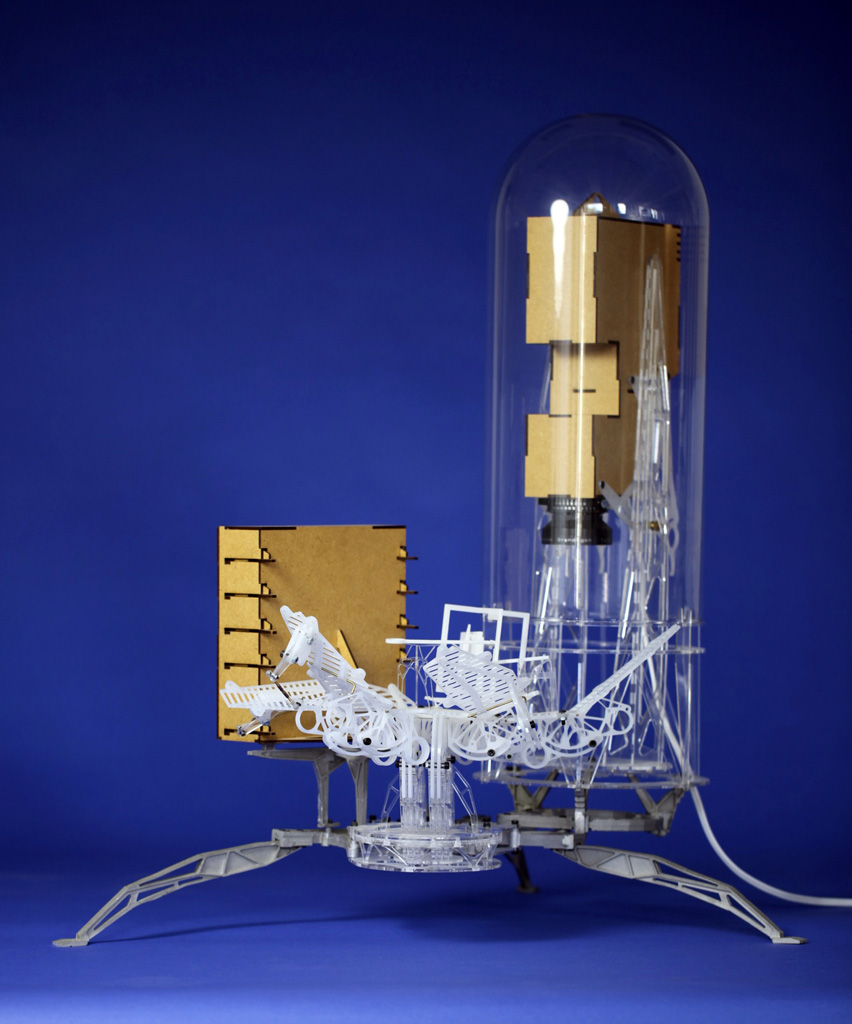
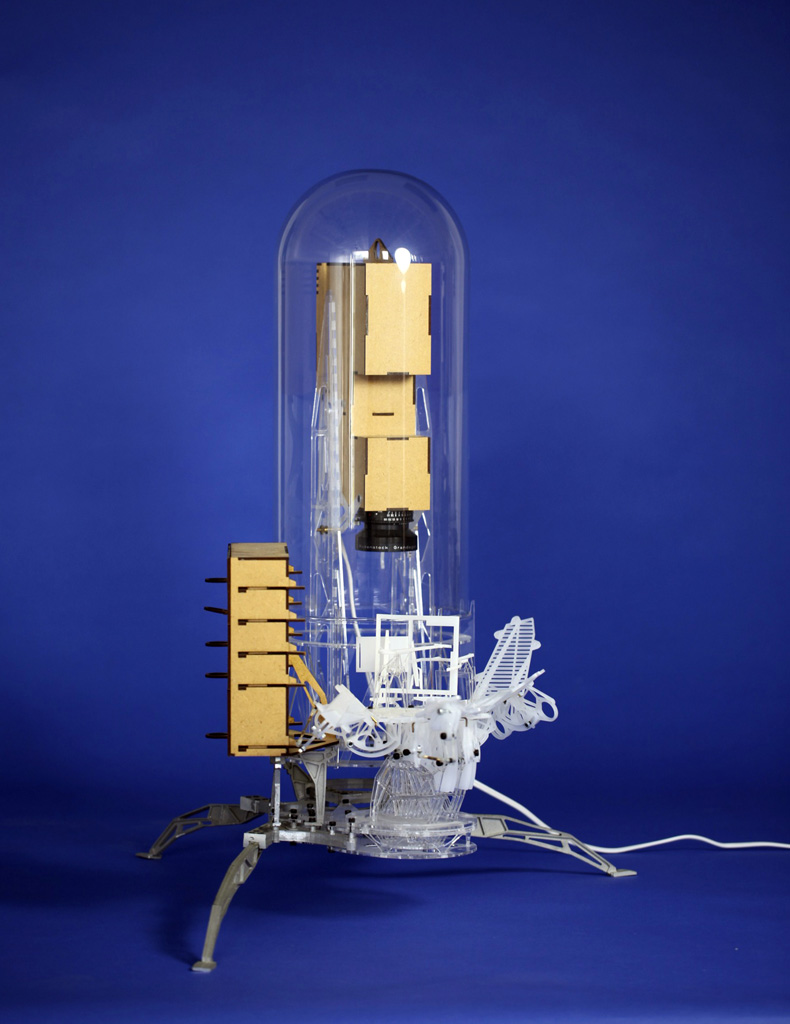
Each instrument has a number of parts. A three egged chassis holds a beam like an optical bench to hold a paint catapult, a picture plane and a set of drawing pieces. A side frame hold a model scene that is protected from flying paint by a glass dome. The scene reminds the person who is drawing of the content under discussion in the drawings they are making. As with the light projections, the form of the folding picture plane has a consequence on how the paint is accepted. Several other measuring instruments calibrate the relative positions of the instruments.

Some Versions of Drawing Instrument Five (Nat Chard)

There are four versions of Instrument Five. One is red, one white and the other two a combination of the two – where one has red legs, for instance, the other has white.

Two Versions of Drawing Instrument Five (Nat Chard)
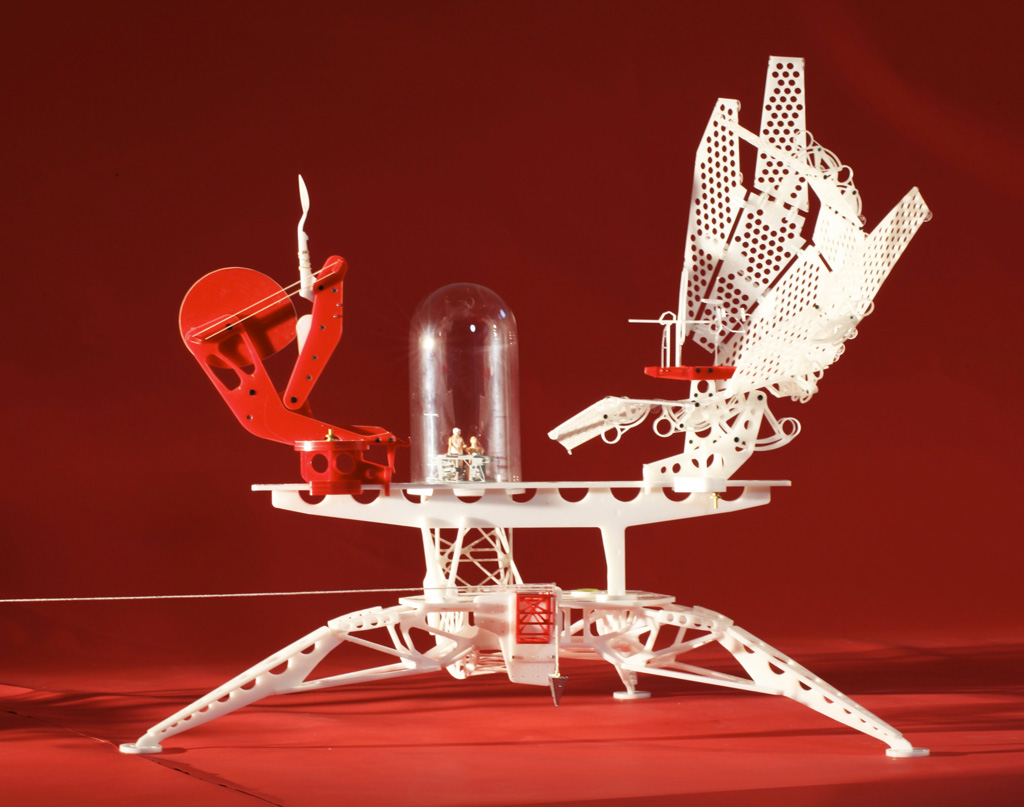
Each instrument has all the parts and can throw paint at any of the other instruments. The accumulation of paint on the drawing pieces may be from several other instruments.

Drawing Instrument Five (Nat Chard)Drawing Instrument Five (Nat Chard)

The pleasure in this instrument was the discovery that it can nurture the very condition that it tries to draw  in the person working with it. To get to that stage though, there is a further development that makes much more sense of the instrument. This is a series of high speed flash photographs of the paint flying though the air. I will show some of these in the next few posts.

Drawing Instrument Five (Nat Chard)

Drawing Instrument Five (Nat Chard)
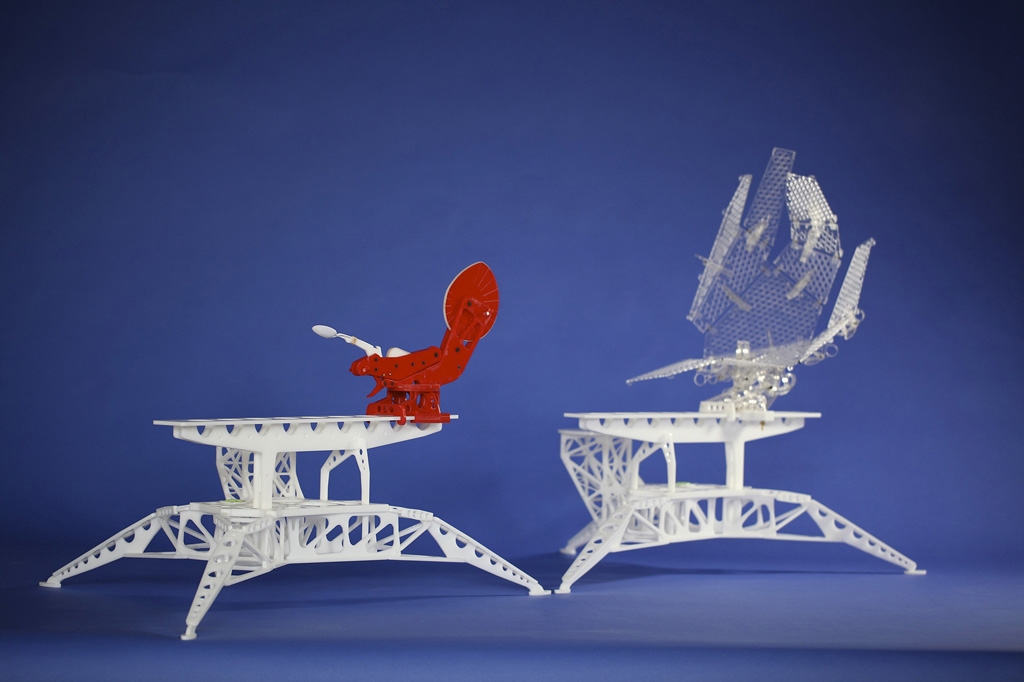
Instrument Four (Nat Chard)

Instrument Four is a departure and is a test bed for instruments Five and Seven. The previous drawing instruments projected light. In terms of working with uncertainty and indeterminacy the physics of light was too predictable and too much under my control. Instrument Four projects paint rather than light. There are two instruments that talk to each other, rather than the monologue of the previous instruments. I will explain the ideas more fully when discussing instrument Five, but the paint hits a series of objects and through that collision splatters onto the picture plane. Instead of a figurative shadow it is a shadow of the play between the action of the paint on the drawing pieces.

Instrument Four (Nat Chard)

Of all the instruments they are the least elegant as objects as I tried to find the measure of the new material i was working with.

Instrument Four (Nat Chard)

They did, however, provide enough encouragement that such a form of projection could provide a means of making indeterminate drawings and more importantly, an indeterminate relationship with the instrument.

Instrument Four (Nat Chard)

The drawing pieces are the white plastic pieces sitting above the picture plane. I will explain them further when showing Instrument Five.

Instrument Four drawing (Nat Chard)

The test drawing (above) shows one of the key problems with instrument four (and five). The folding picture plane is behind the drawing pieces so that the subtle splatters from the thrown paint hitting the drawing pieces are obliterated by the main thrust of the flying paint. At this stage the paint is standard interior house paint. In subsequent drawings it is thickened with acrylic thickening gel.

Instrument Four is very much a test –  the benefits reveal themselves in the subsequent instruments.

House (Nat Chard)
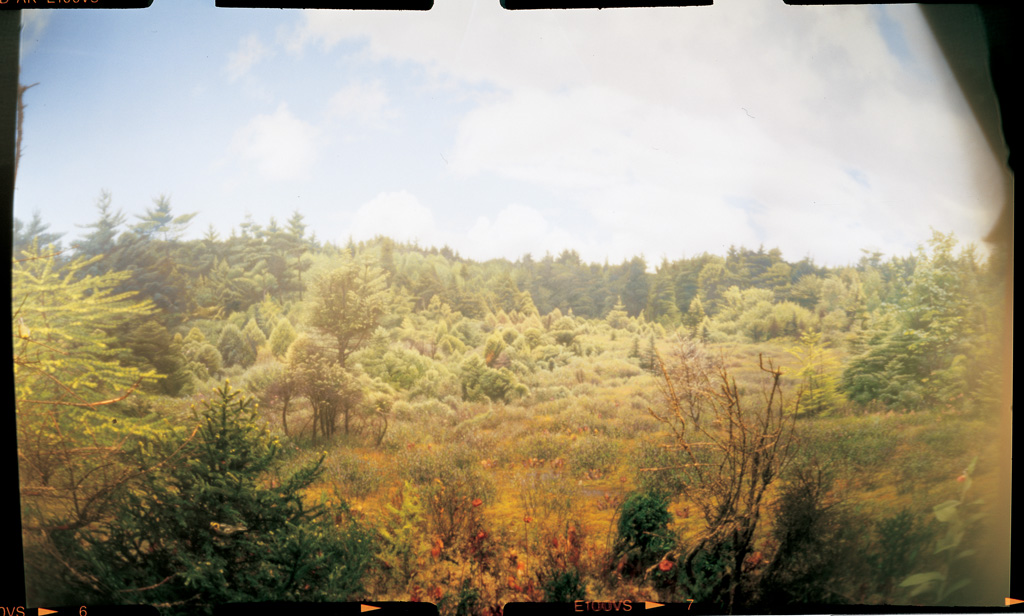
A project for our house in North London. We lived on the top two floors of a semi-detached Victorian house and needed more space. This proposal is for a steel exoskeleton to take a larger floor-plate and volume. Each programme in the hose is divided in two, with one part fixed on the outside walls and the other half on tracks around the internal full height space. There is also a  second level perimeter floor that sits between the outside walls and the moving elements. In this way parts of programmes could be recombined – kitchen with bathroom or library perhaps, or bedroom and workshop or kitchen. An ideal version would have the house recombine these pieces while we were out so that we would have to re-learn it when we came home. Instead of seducing us with easy comfort, it would tease and delight us with new possible combinations – maybe even with the programmes matching at some stage.

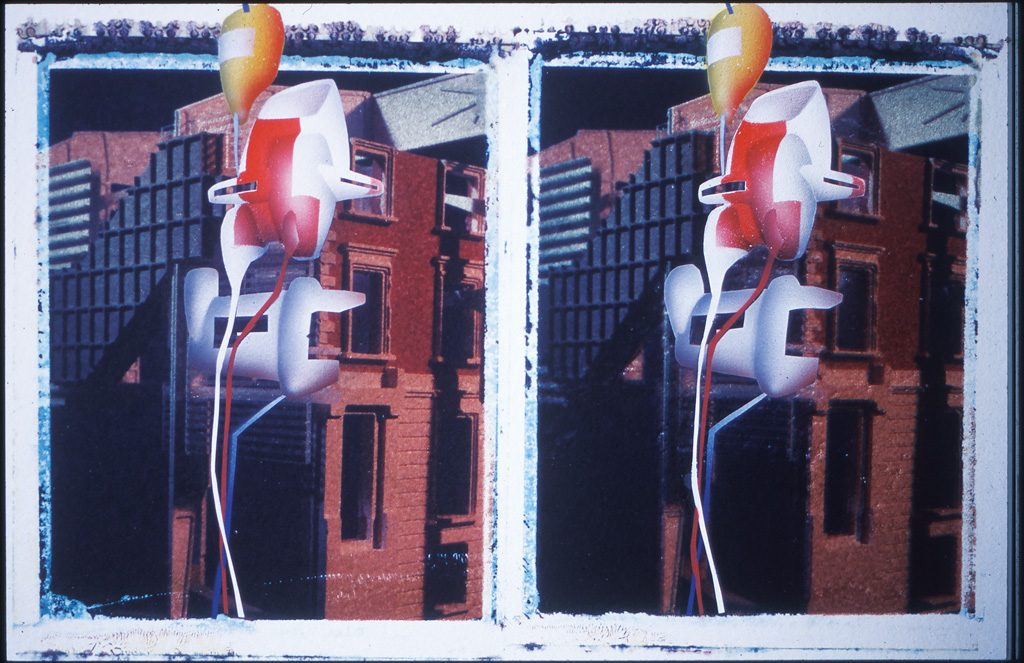
Wet services and  heavy components were fixed on the outside while the less grounded elements would be attached to internal screens that moved around the internal space. The project was developed through the model which establishes a spatial as well as mechanical structure for the project. The stereoscopic drawings are a range of speculations on the various components that make up the programmes  (if you are new to this bolg, to resolve the stereoscopic images go cross eyed until the two images resolve over each other, and try to relax to get a good three dimensional image).

House (Nat Chard)

House, view into interior (Nat Chard)

This view into the interior (above) gives a good sense of the space if you can resolve it stereoscopically.

House, external view (Nat Chard)

Fixed kitchen and bathroom parts (Nat Chard)
Again, the drawing above makes most sense when resolved as a 3D image.

View from garden (Nat Chard)

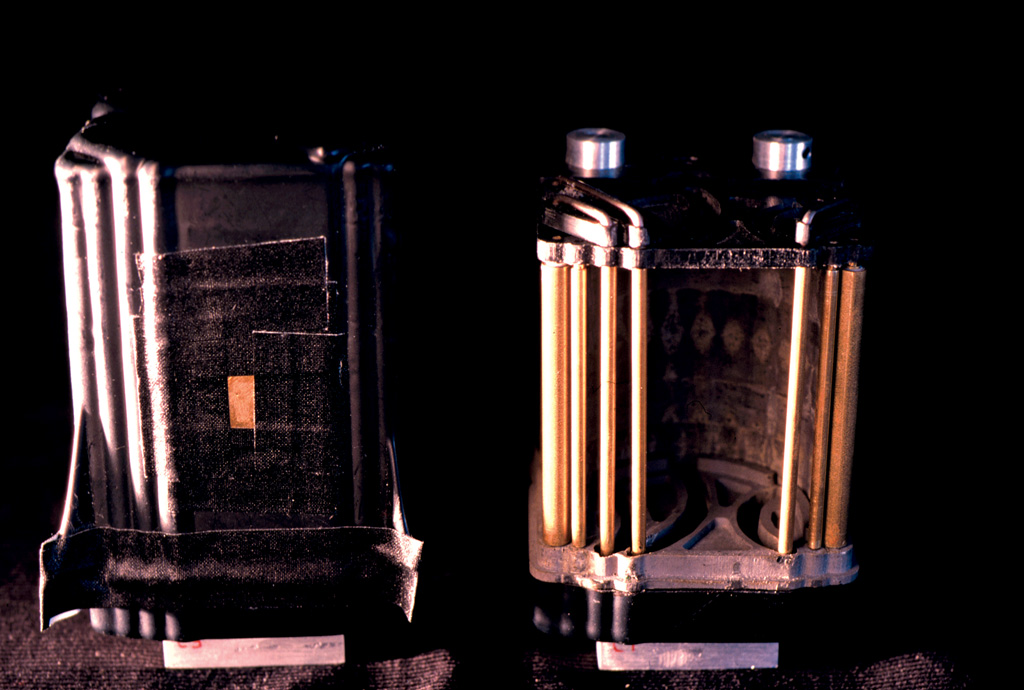
Pair of Bog Cameras (Nat Chard)
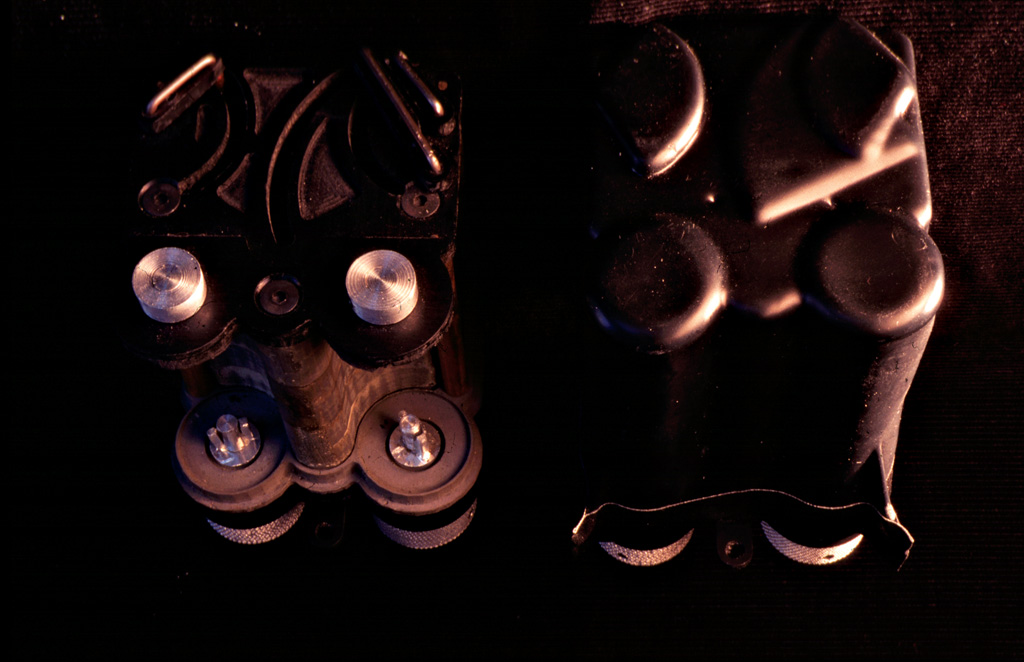
Tooling for Bog Camera (Nat Chard)
Bog Diorama Prints (Nat Chard)

(Continued from previous post below)

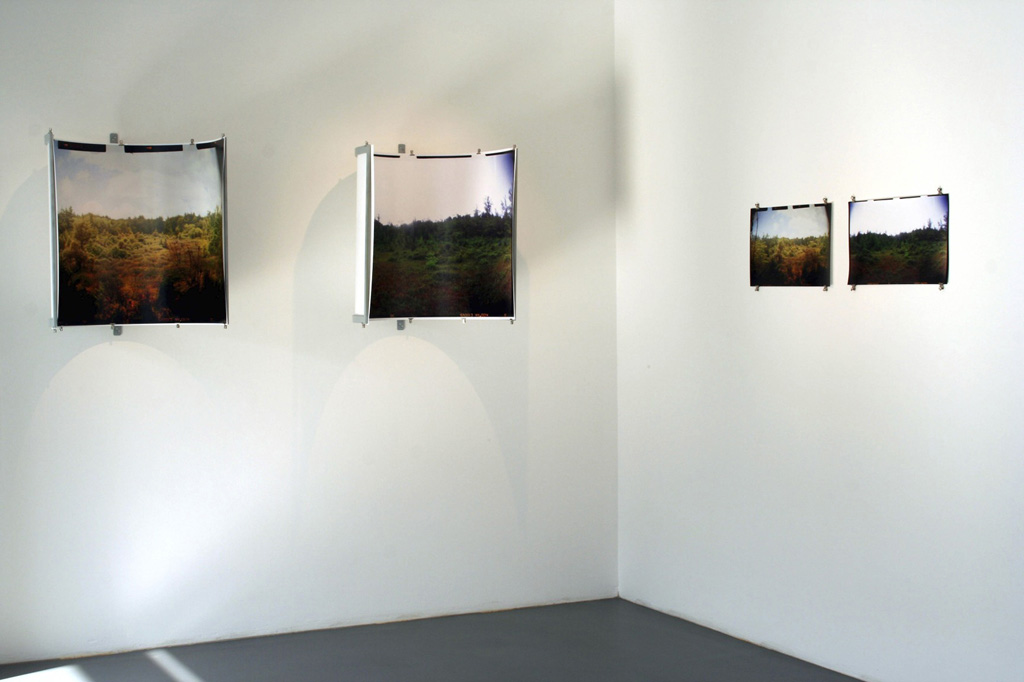
James Perry Wilson made his survey of the Cold Bog site on June the 17th 1949. Michael Anderson and Ruth Morrill, who had been Wilson’s assistant in painting the Cold Bog diorama, took me to see the original site on June the 17th 2001. Unfortunately the weather was not perfect, but it help up long enough to take the pictures. The next day Michael arranged to have the diorama opened and I took a set of photographs of the diorama. The photographs taken by the Cold Bog camera of the site produce an image that is the ideal projection for the diorama shell shape, as an unfolded sheet. The photographs of the diorama unfold the painting as if it were a flat sheet. The lowest of the photographs above shows prints of the Cold Bog camera photographs  of diorama (left in each case) and site both in the form of the diorama shell and as flat images (unfolded).

The test photograph in the previous post was taken just before leaving for New York and the knurled knobs I had made for winding the film on were aggressive on the skin, so on my arrival in New York I bought the leather work gloves, one of which is seen in the top picture, to help with this task.

J.P.Wilson's panorama of photographs (assembled by N.C.)

Above is J.P. Wilson’s survey photographs from 1949, assembled to (by me) to make a panorama. There is no attempt to blend them, so the range of exposures is apparent.

Wilson Grid (J.P.W.)

Kodachrome slide taken by J.P.Wilson on June 17th 1949 of Cold Bog with his grid scratched onto a piece of clear plastic placed over the slide.

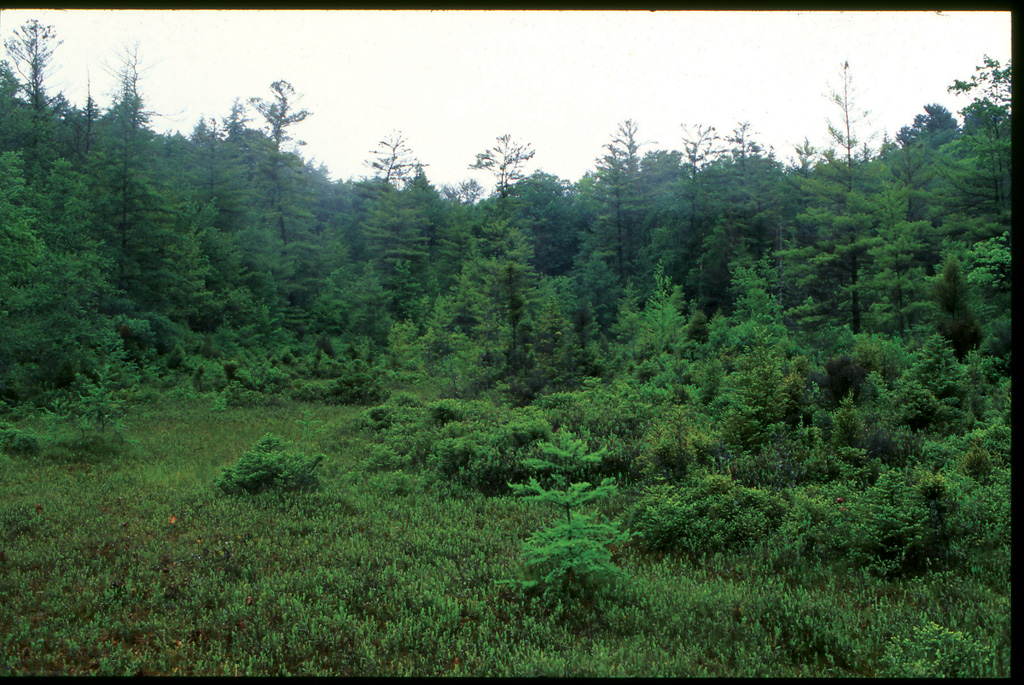
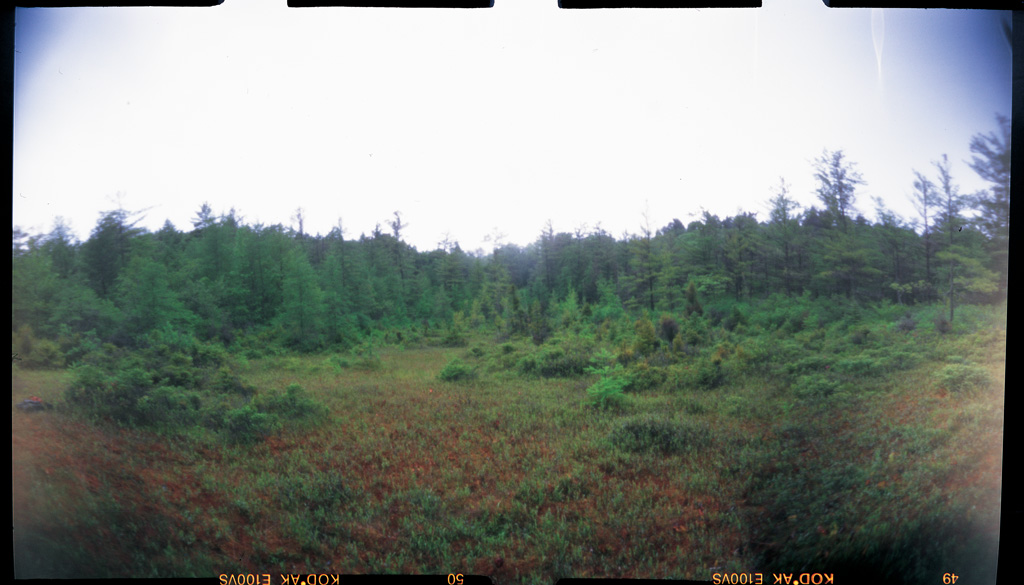
Normal view of site, 2001

Above is a photograph of the site taken with a normal 35mm camera on June 17th 2001.

Below is the same view taken with the Cold Bog camera

Cold Bog camera photograph of site (Nat Chard)

Normal camera photograph of Cold Bog Diorama

Above is a normal photograph of the diorama and below is a photograph of the diorama with the Cold Bog camera. As with the site, the shape of the diorama replicates the U shaped valley so the unfolded image appears to have a much flatter horizon than appears to the diorama viewer.

Cold Bog camera photograph of diorama (Nat Chard)

Stereo pair of Cold Bog camera photographs of diorama (Nat Chard)

I mentioned in the previous post that I built three cameras. I needed two to take stereoscopic photographs and a third in case one of the others broke down. Wilson worked with stereoscopic photography. I would suggest that a lot of the depth in his shadows in woodland scenes comes from his work with stereoscopic surveys. But the real benefit of making stereoscopic photographs of the diorama was to test my method. When looking at a pair of stereoscopic photographs of the diorama the form of the shell as a curved surface is very clear.

When taking the pictures with my Cold Bog Camera, viewing a stereoscopic pair should reveal a three dimensional foreground with a flat painting behind. If you go cross eyed so that the foreground bushed register in both images, you can see this take place in the stereoscopic pair above.

Some of the Cold Bog camera components (Nat Chard)

Bog Camera Top (Nat Chard)

Having realised the potential of the picture plane as an agent that could receive ideas critically, the question was how to find out more about this. Almost all the struggles with the picture plane are in the name of truthfulness to the original – quite different from my needs. There are several examples of more developed picture planes, for instance the spaces in the inventive Dutch Peep shows by Van Hoogstraten (that will feature one day soon), or the domes of planetaria with their associated (and wonderful) projectors. The world that I decided to search more deeply was that of the Habitat Diorama. Always a pleasure in the background, they came into focus through two events. One was that by coincidence two colleagues, Christine Hawley and C.J.Lim, were taking their students around the Yale

BogCamFront (Nat Chard)

Campus in New Haven on the same day that I was taking my group there. C.J. had been there before and I asked him if there was anything else I should see. Knowing me quite well he suggested I should see the embalmed dissected rats in the Yale Peabody Museum, and I immediately ventured there to examine them. In fact it seems these rats were fermented in C.J’s wonderful imagination, but in the museum I came across J.P. Wilson’s dioramas. A few years later when working on the picture plane I wrote to the Peabody with some elementary questions about the dioramas and received a speedy and short reply asking about the nature of my interest. So began an extensive correspondence with Wilson scholar Michael Anderson. Michael is the expert on Wilson and his research is generously offered on this website:

http://archive.peabody.yale.edu/james-perry-wilson/chapter1-early-years.html

(and follow the arrows at the top to find subsequent chapters).

BogCamSide (Nat Chard)

To get the proper story you should read Michael Anderson’s history, but in short Wilson studied architecture at Columbia and then worked for the architect Bertram Goodhue for twenty years before taking up diorama painting at the American Museum of Natural History. He brought with him his own rigour but also the precision of architectural perspective projection and transferred this to the problem of the curved background painting behind the taxidermy in dioramas. In all my diorama research I am hugely indebted to Michael for sharing his extensive and exacting research (and expertise) on Wilson. These cameras are the consequence of a hugely productive and enjoyable collaboration with Michael.

BogCamRear (Nat Chard)

To understand Wilson’s projection technique as fully as I could I designed and built three identical cameras that in one photograph would make all the calculations for an ideal diorama projection that Wilson would make when employing his process. I built three so that I had a backup, but also so that I could take stereoscopic pictures (more of which later), so the cameras were built 65mm wide, the typical separation between our eyes.

BogCam Chassis Pattern (Nat Chard)

Michael Anderson suggested using Wilson’s Cold Bog diorama at the Yale Peabody Museum as the basis for this work. He could arrange access to the original site that it is based on, and as he was working on some replacement birds for the diorama, he would be able to arrange to have the front glass removed so that I could photograph the diorama without reflections.

Copenhagen Harbour with flat picture plane camera (Nat Chard)

Bog Cam first test picture (Nat Chard)

Above you can see the difference between a photograph from a camera with a flat picture plane and one from my camera dedicated to the Bog Diorama (the lower photograph). The anamorphic distortion is accurate for the geometry of the Cold Bog diorama at the Yale Peabody – this view was outside my office in Copenhagen looking across the harbour. The views are not identical – the flat picture plane camera was next to the Bog Camera with a pinhole and the same focal length and used Polaroid film to test exposures before using the 120 slide film in the Bog Diorama camera. This was the first test shot.

So as to be able to take several pictures from each camera on the site, the film winds on to allow three shots from each roll (with a healthy margin to keep the film light tight). The mechanism in the front of the camera pulls back to keep the film in its curved track while winding on.

Tomorrow I will post some more pictures of the camera and of its photographs.

See also Michael Anderson’d Blog: http://jamesperrywilson.wordpress.com

Drawing Sink (Nat Chard)

This  fragment of a drawing is a question from about twelve years ago. How else to draw architecture and how it is occupied. This sink is at the entrance to a building and , like the one in the entrance to Villa Savoye, provides the opportunity to clean off the dirt of the outside world. Unlike the sink at Savoye, this one relished the dirt. The Ascot*-like gas heater and cold water pipe have hospital like taps so that your hands do not touch anything before being washed. Under the sink is a machine that feeds through filter papers one at a time for each washing. When the water has passed through then these are places int he cabinet to the right of the sink. The water drips away into a drain in the floor. The plug also has a hospital lever so that hands do not touch anything until they are clean. The drawings in the filter paper are probably more giving when seen as a group – the difference between each days grime, as opposed to the individual figures in the paper. It was the prelude to a number of experiments for a Drawing Room, some parts of which still reside in my basement.

*Ascot is or was a manufacturer of water heaters that used to sit over sinks in kitchens and seedy bedsits throughout the UK. The one in my drawing draws attention to its flue, rather than hiding it at the back of the device as happens with most commercially available water heaters.

Pattern1 (Nat Chard)

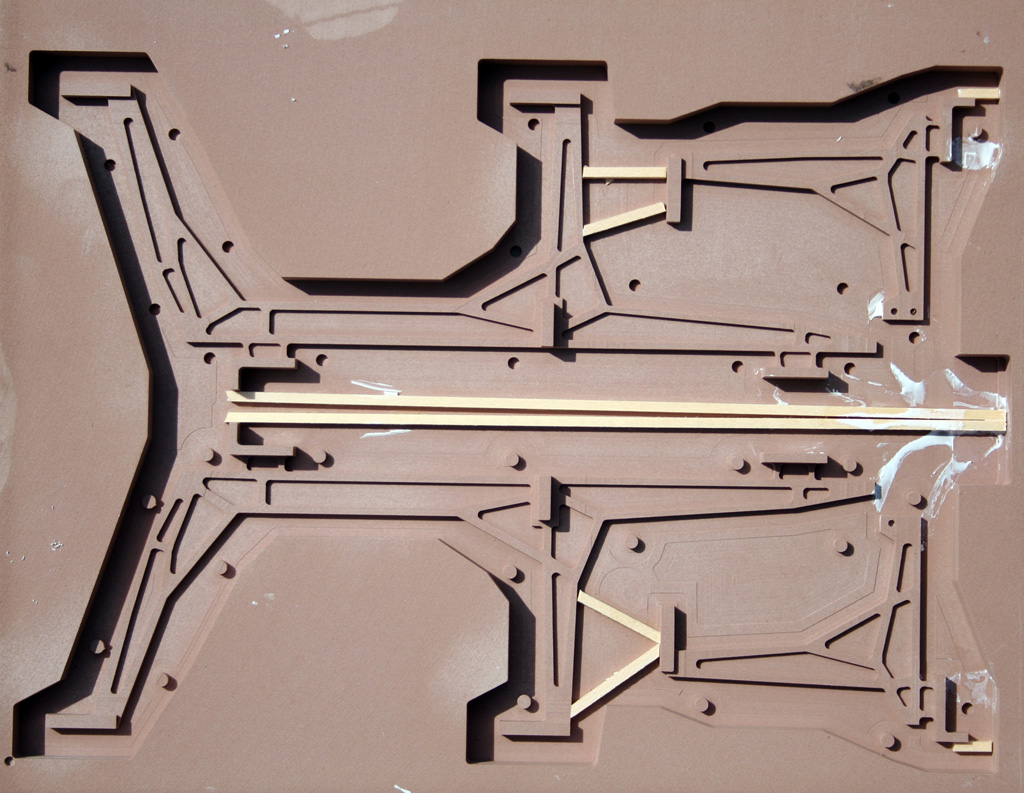
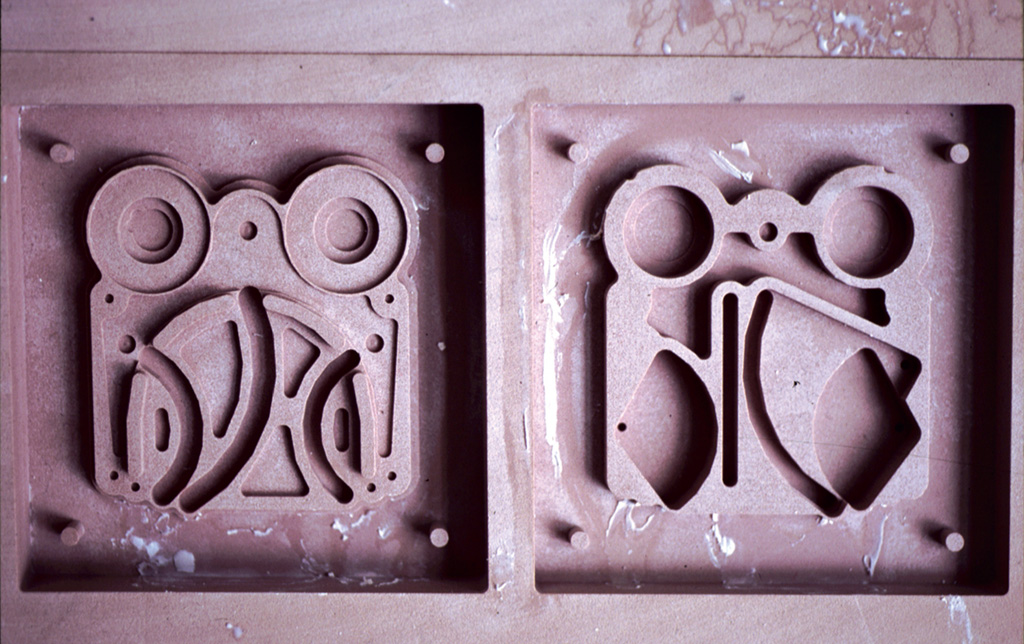
These are some of the patterns made to manufacture drawing instruments one to three. The following four types of instrument are made on laser cutters (and the subsequent ones have reverted to aluminium using a waterjet cutter). The patterns are made of cibatool, a homogenous and isotropic material designed to have no variation in character and to machine easily. I cut them on my small cnc mill.

Pattern 2 (Nat Chard)

The pieces of wood are added as air vents when making the silicon rubber mould so that whatever is poured into them can displace the air in the void. The parts for drawing instrument one were cast in plastic and for instruments two and three (and the incomplete instrument) in aluminium. For these I cast wax into the moulds that the foundry covered with a ceramic case and then melted the wax out to make the mould for the aluminium.

Pattern 3(Nat Chard)

Pattern three (above) was the first piece I machined. There are no drawings of the whole thing and no complete drawings any of the parts. They were designed incrementally, even within each part, so the only thing known about the next component was the dimension and geometry of the fixing to the previous piece.

Underside of chassis (Nat Chard)

Leg pattern (Nat Chard)

Dome brackets (Nat Chard)

Frame for drawers (Nat Chard)

Various components (Nat Chard)

Drawing Instrument 3 (Nat Chard)

Instrument Three is a linear development of Instrument Two, which was destroyed in transit while returning from an exhibition. The picture plane is a little different, but in most other respects it is a remake of Instrument Two.

Drawing Instrument 3 (Nat Chard)

Drawing Instrument 3 (Nat Chard)


Drawing Instrument 3 (Nat Chard)