Big Horn Sheep side view

This is the view I mentioned in the previous post. It is hard to see the form of the diorama shell. It curves towards the viewer quite gently on the left, where it is closer to the viewer, and sharply to the right where it is further away. The pictorial information suggests almost the opposite, so your consciousness is struggling with the assembly. There is a similar problem with the floating shadows from instrument six, which do things that shadows are not supposed to do. We believe shadows so implicitly that we try and put them back where they should be, even though we perceive them to be floating in space.

Usual process for resolving the stereoscopic image (See the post below if you are new to the blog).
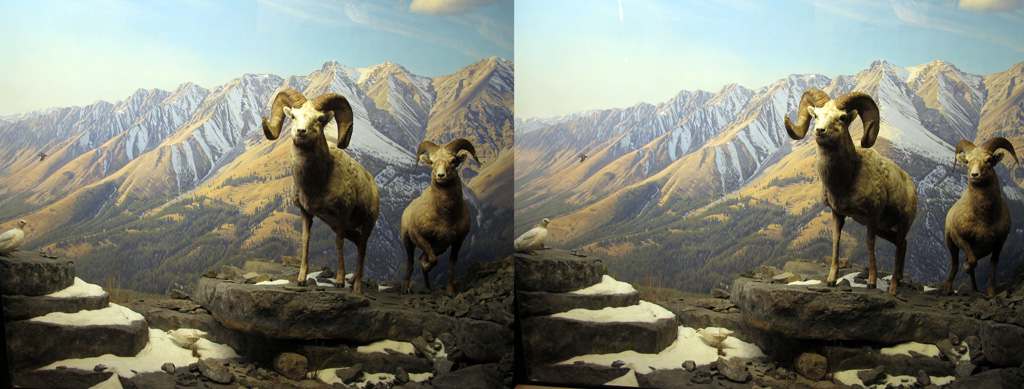
Big Horn Sheep (normal)

Big Horn Sheep (mirrored)

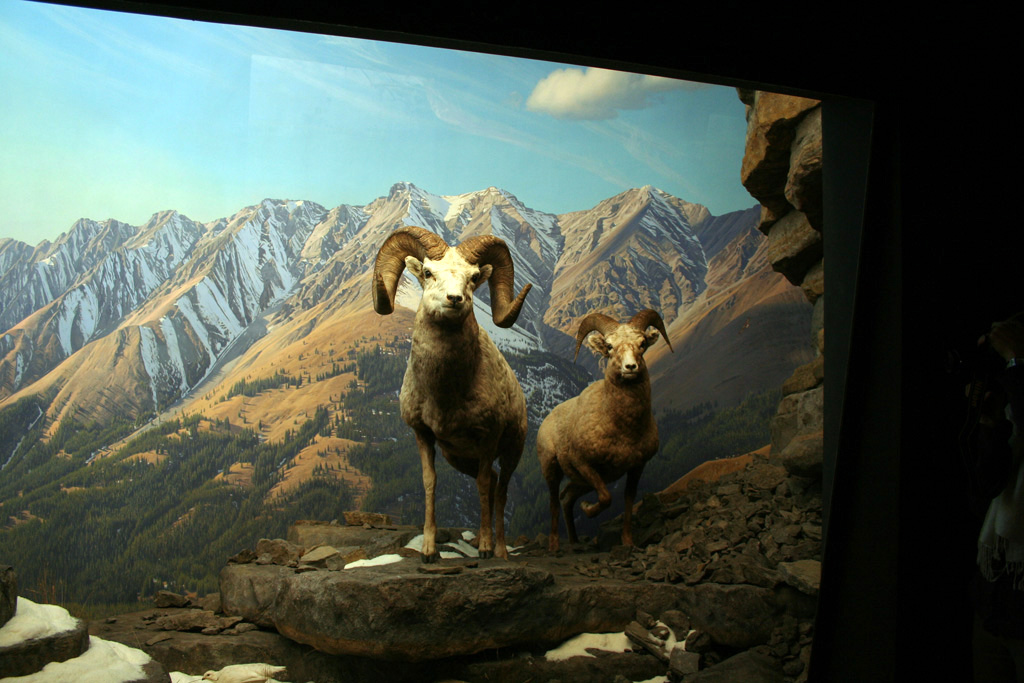
Here are two more views of the Big Horn Sheep group at the Yale Peabody Museum, with a background painting by James Perry Wilson. The top view is the right way round for the diorama and the lower one is mirrored – the correct way round for the original site near Banff in the Canadian Rockies. Again, if anyone recognises the exact location I would be grateful to hear from you.

It is hard to see the curve of the background shell in these views so I will assemble a slightly sideways stereoscopic view to see if that helps, and will post it if it does.

Employ the usual technique to resolve the stereoscopic images – make them small enough so that when you go cross eyed you can register the same sheep over each other when you go cross-eyed. You will see three images as you do this – concentrate on the middle one and try to relax. You can buy glasses (lorgnettes) to help resolve them and these definitely help when the images are larger, but I find I get a better three dimensionality when working without them.


Institute for Paradoxical Shadows

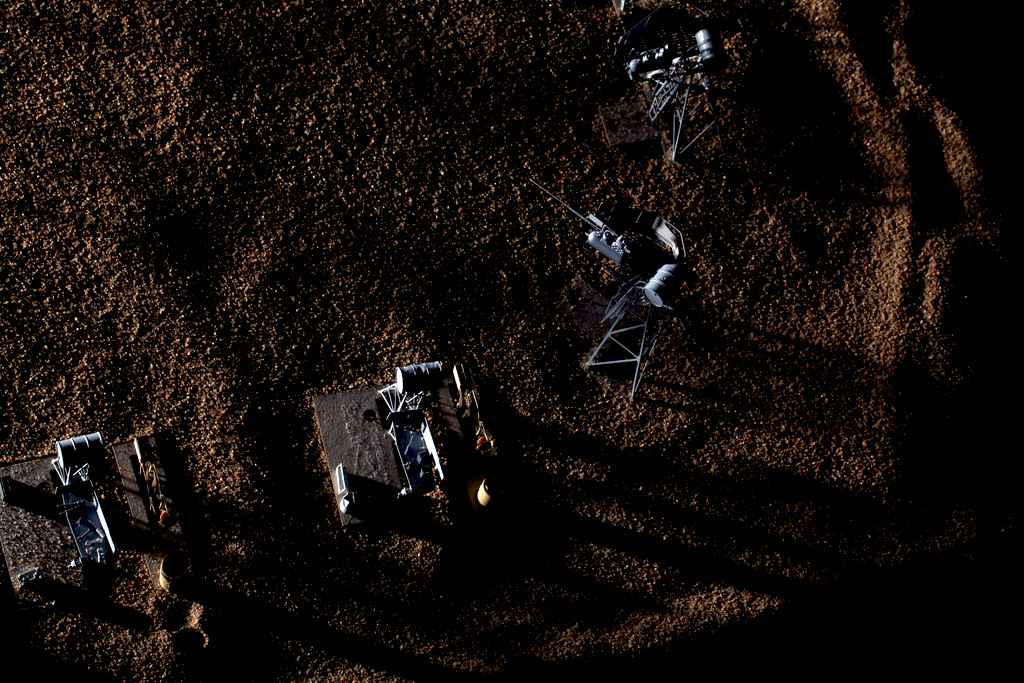
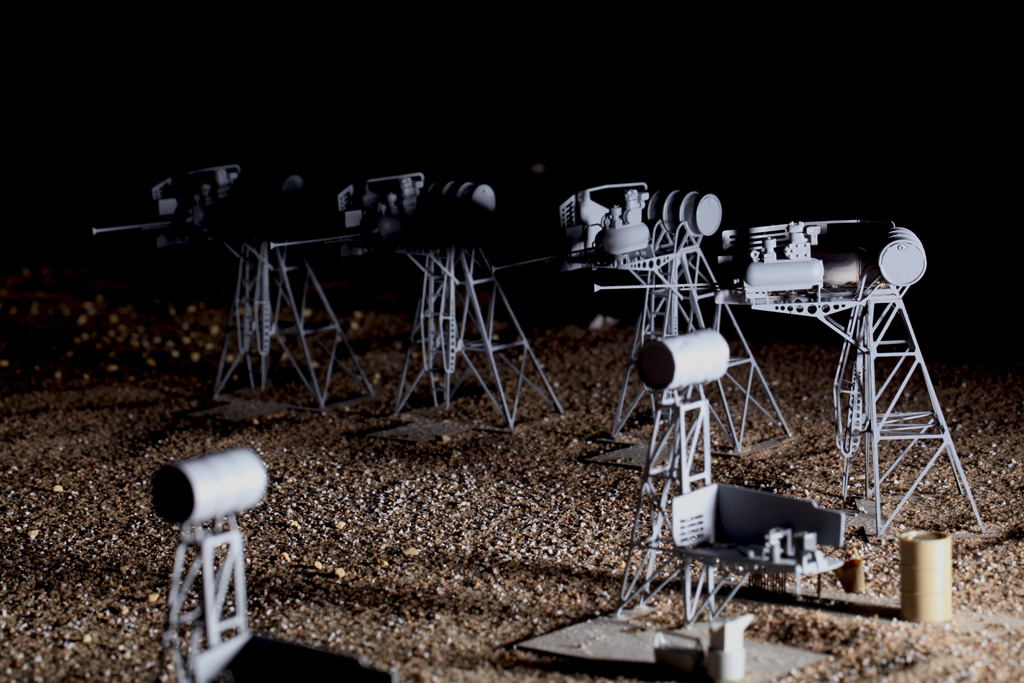
An earlier view of the Institute for Paradoxical Shadows. It is developing the full size implications of instrument Six, shown below.

Instrument Six in real-time floating shadow mode

Instrument Six in research (photographic) mode

Stereoscopic view of floating shadow from Instrument Six

To view the floating shadow make sure the image is small enough to register the shadow in the left image over the one in the right hand image when you go cross-eyed (you will see three images – concentrate on the middle one). Try to relax to get a good three-dimensional view. You will see that the shadow sits a short way off the surface in which you would expect it to land.

Big Horn Sheep

Big Horn Sheep

Big Horn Sheep

A few posts ago (here) I asked if anyone knew the location that this diorama at the Yale Peabody Museum represents. It is near Banff in the Canadian Rockies and one suggestion since then is that it is in the Bow Valley where Banff resides (thank you Mr. Bergem). Here are some snaps of the diorama (check against the survey photograph) that you can see has been mirrored. It is a wonderful diorama so if you are in New Haven do make sure you se it! There are others there, especially the Longshore diorama, that will also make the trip worthwhile.

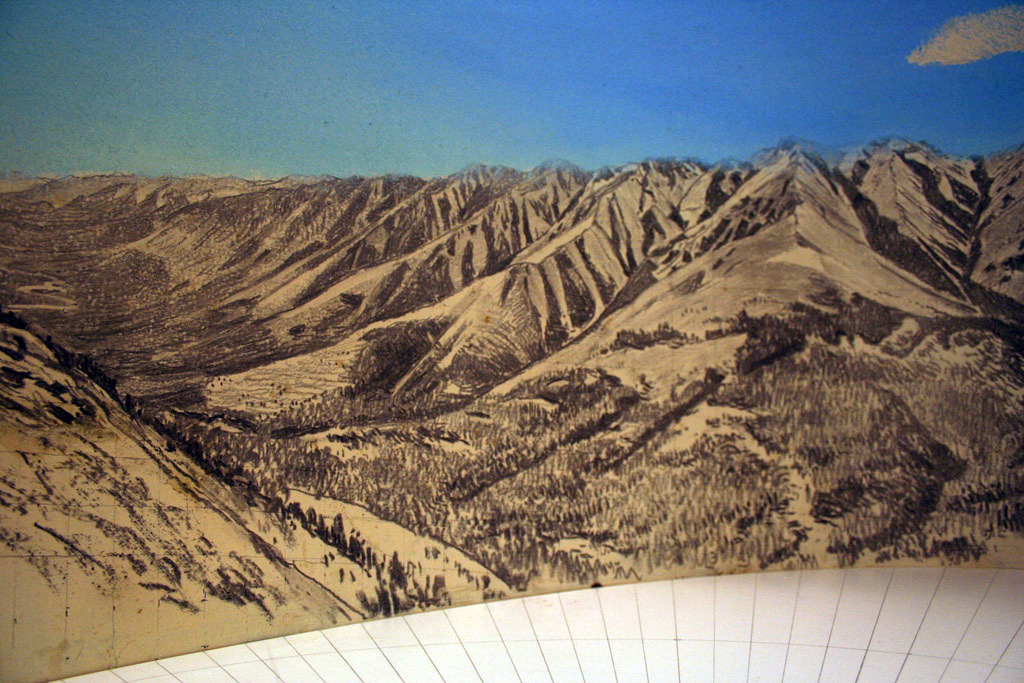
Again, if anyone recognizes the exact location of the site (reversed) I would be very grateful to hear from you. Below is J.P.Wilson’s test drawing on a model of the diorama. You can see the projection lines for his dual-grid system of diorama projection on the model floor.

Big Horn Sheep

Big Horn Sheep site

The panorama above is an assembly of the photographs that James Perry Wilson took as a survey near Banff for his Big Horn Sheep group at the Yale Peabody Museum. Do you recognize the valley? If you look at the diorama at the Peabody you will notice that Wilson mirrored the image. It is located in a slightly awkward corner and the shell is a-symetrical. The part of the shell that is closest to the viewer is on the left hand side and for some reason Wilson located the distant valley (on the right above) on this part of the background while the closest part, to the left of the image above,  he located at the deepest part of the diorama. I will post some pictures of the diorama in a couple of days. If you know this valley please click on this post and then leave a message, or click on ‘leave a comment’ on the left. The photographs are taken around sixty years ago so the trees will have changed somewhat.

I am working on a camera dedicated to the diorama and would like to use it on the original site as well, just as with the Cold Bog Camera (see Cold bog camera and cold bog camera two).

Any help would be greatly appreciated

Grizzly Bear

The Grizzly Bear group at the American Museum of Natural History (1941) has a foreground by Raymond de Lucia and a background by James Perry Wilson. If you look at the Coyote group a few posts back you will notice the seamless tie-in between the painting and the material foreground. Here the foreground horizon into the valley makes a clear scenic break (in which there is a tiny bird flying between the painting and the foreground, held on a wire) and the two are assembled by view but do not touch.

There is a photograph of Raymond de Lucia acting as if he was being mauled by one of the bears that did not amuse the directors at the time.

Use the usual procedure to resolve the stereoscopic images.

While these are great dioramas, I am obviously partly also using them to keep the blog alive while working on some new stuff. I hope to post some fresh work in the next week or so, so please keep checking for new posts.