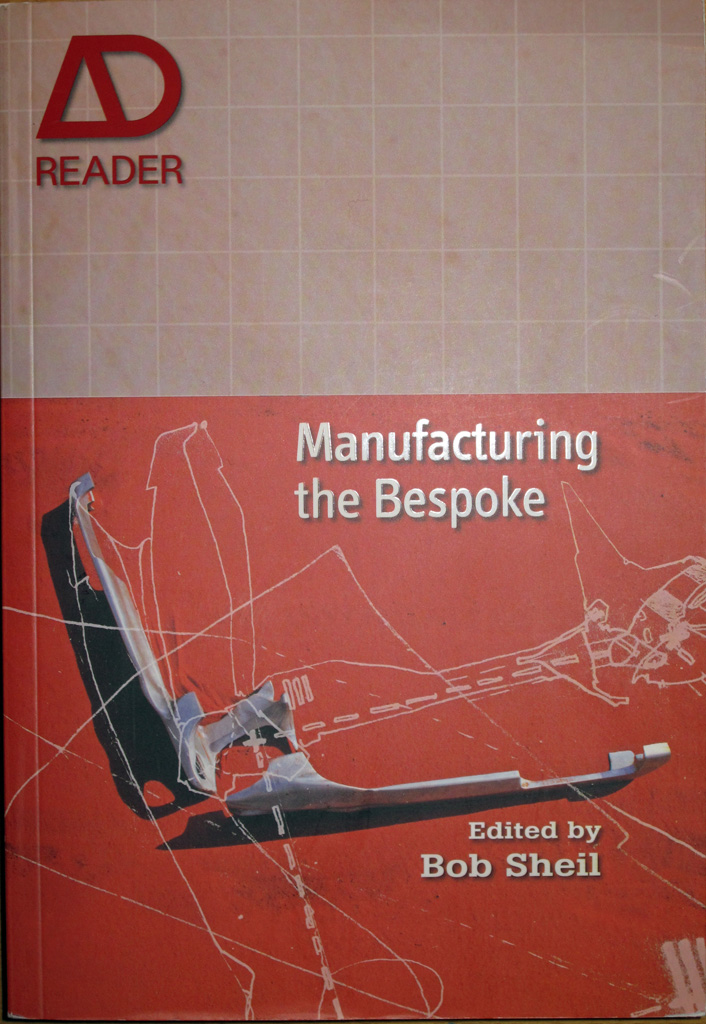
Very happy to have a chapter in Bob Sheil’s new book Manufacturing the Bespoke. My copy arrived today from Amazon and there is lots of wonderful work documented in the book. As well as Bob and Sixteen Maker’s wonderful 55/02 project there is a new project by Peter Salter, for instance. Other contributors include Stephen Gage; Mark Burry; Tobius Bonwetsch, Fabio Gramazio and Matthias Kohler; Mary Vaughn Johnson; Philip Beesley; Mark West; Liquid Factory; Natalija Subotincic and Frank Fantauzzi; Guan Lee; Anderson Inge; Charles Walker and Martin Self, Michael Stacey; a great piece by Phil Ayres; Rachel Armstrong; Xavier de Kestelier and Richard Buswell; Neri Oxman and Constance Adams. My chapter discusses some of the drawing instruments.
More Instrument 8
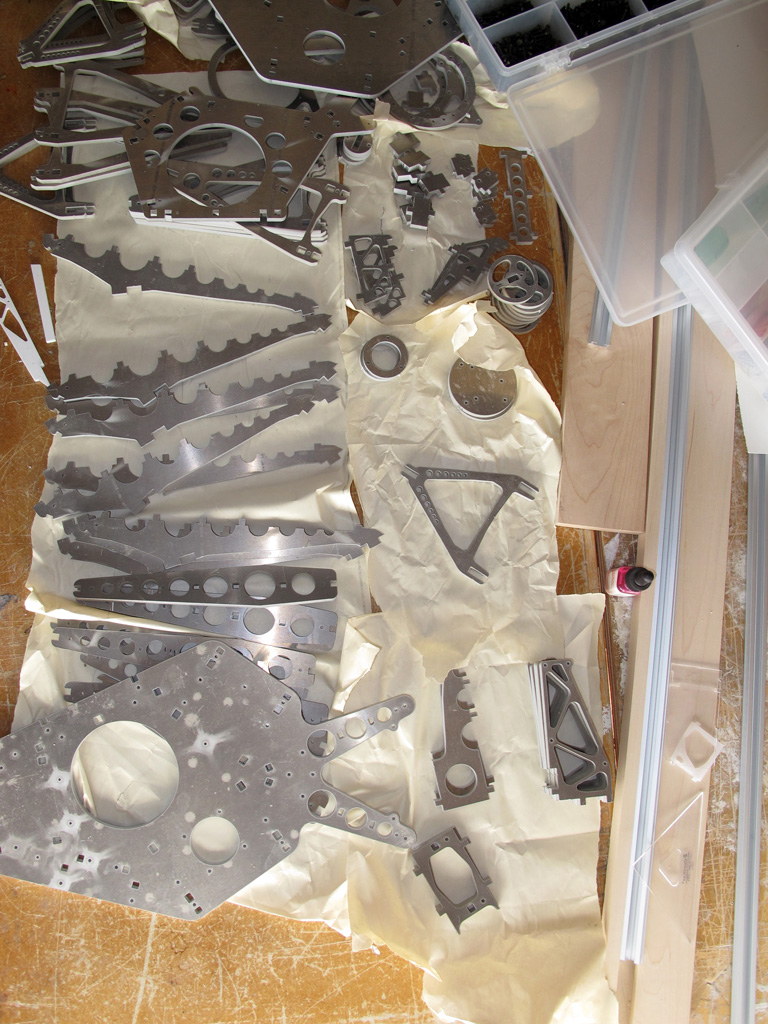
A couple of pictures of components and sub-assemblies for the various versions of Instrument 8.
I managed to get the chassis for the first version together – see:
and am hoping to find time to get the others assembled soon. There is lots yet to resolve on the active parts – I will post some more on that when I get there.
More Van Hoogstraten
A while ago I posted some pictures taken through a model of Samuel Van Hoogstraten’s peepshow:
https://natchard.com/2011/09/30/403/
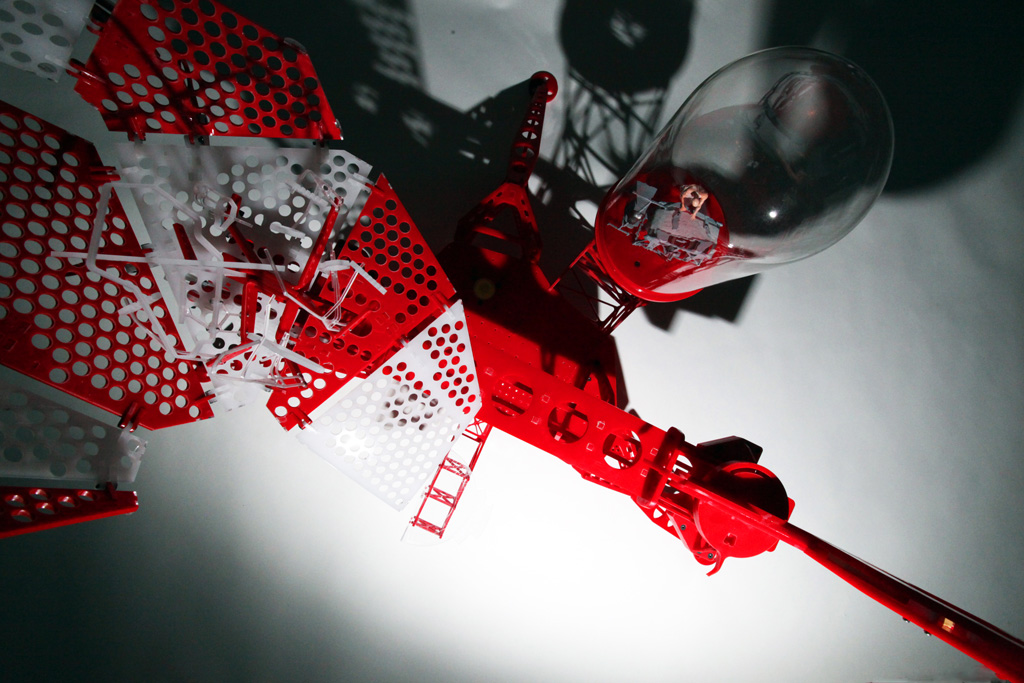
I dug out some of the test shots, where some of the less successful ones reveal the seam between the material and pictorial space.
They are shot using a home made camera. It uses a pinhole to get the depth of field to make sense of both the space inside the box and my studio behind (the model is much smaller than the real peepshow). The camera has a lot of shift so that the image captures the whole available view with close to the ideal resolution of the anamorphic projection.
In the image above, where the lighting is not even enough, you can see the form of the box more clearly than in the previous shots. This image does not have the light shining up through the cut out doors.
Test (above) with too short an exposure so that the light shining though the cut out door is exposed but hardly anything else. It does, however, isolate that light to compare with the other shots. The light is only shining though one of the doors at this stage. When shining though both the shadows present an even greater paradox.
Compare the photographs above with the more balanced exposure above. All are shot using Polaroid 669 stock. The demise of Polaroid is a great loss. I have not tried the Impossible project’s material yet – all my Polaroid backs are for peel-apart film as I mostly used 669 and type 59.
A test for the reverse view (above). The reflections of the (painted) light from the window undermines the form of the ceiling’s timber beams.
A less balanced exposure again reveals the form of the box rather than the pictorial space of the room.
Drawing Instrument Five
Dioramas 6
The background for the White Rhinoceros group at the American Museum of Natural History was painted by James Perry Wilson in 1937. Apparently the back of the rhino closest to the background is painted white to reflect as much light as possible in the tight space and to avoid a shadow on the vertical surface. The painted detail in the mud around the pool and the reflections in the water is very accomplished but not up to the standard of the water in Wilson’s Coyote group (see Dioramas 2) where he also made the survey drawings and photographs. If you are looking at these as a stereo pair you can just see the very low ceiling masked as dark clouds.
Use the usual procedure to reconcile the stereo pair of pictures.
In the attic
Dioramas 5
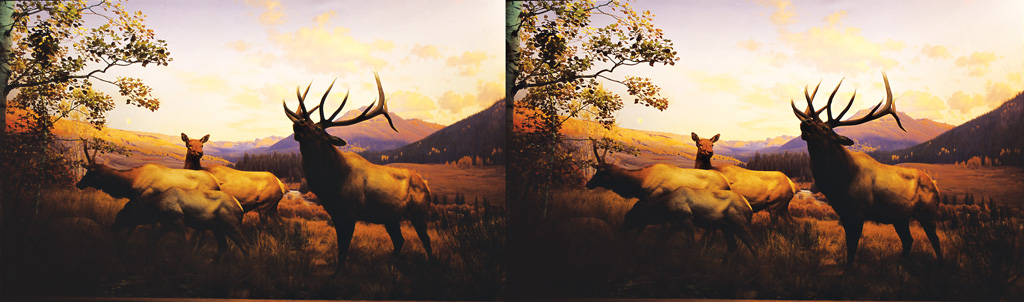
The Wapiti or Elk group is from the Hall of North American Mammals at the American Museum of Natural History (1941). The background painting is by James Perry Wilson. Michael Anderson, the Wilson scholar who is based at the Yale Peabody Museum, wrote to me quoting a letter from Wilson where he is describing how he projected a slide he had taken of the moon so that it was three-foot by two foot on the wall. The moon came out three and an eighth inches in diameter. He notes that this is the same size as in the moon he painted in the Wapiti diorama (above). Michael asked me to calculate the focal length of the lens Wilson was using and therefore, working with Wilson’s projection method, calculate if the moon was the correct size in the diorama. The lens turned out to be 300mm, something Michael was later able to corroborate from notes on some of Wilson’s moon slides. From this and working out the depth of the diorama where the moon is painted from a scale drawing, I calculated that Wilson had painted the moon 50% too large. The picture above is rather small, but you can see the moon just above the horizon next to the tree in the left foreground. Wilson was fastidious about such things, so the discrepancy needed chasing. There is an optical anomaly called the moon illusion. When the moon is close to the horizon it appears 50% larger than when it is high in the sky. There are many theories for why this is, but there is consensus on the 50%. There are no notes from Wilson about this, but my speculation is that this is the reason why Wilson painted the moon this size.
Anyway, it is a stunning diorama and is looking wonderful after a spring clean (if a little over lit).
Look in the earlier Diorama posts for suggestions on how to view 3D pairs of photographs.
Dirty Dedicated Daring Delicate Drawings
I have just received a copy of the book Dirty Dedicated Daring Delicate Drawings published by the Danish Architecture Centre to accompany the Drawing by Drawing exhibition (see a few posts back for pictures of the exhibition and other details). As you might be able to see it is two formats of book intertwined. Lots of colour reproductions of the drawings in the exhibition and a series of short essays by the director of the DAC, the contributors and curator as well as a few longer essays by Carsten Thau, Alberto Perez-Gomez, Juhani Pallasmaa, Henrik Oxvig and Sue Fergusson Gussow.
Contact details for the DAC bookshop:
http://www.dac-bookshop.dk/Shop.aspx?ID=126&GroupID=NYHEDER@@SHOP1&PageNum=1
Dioramas 4
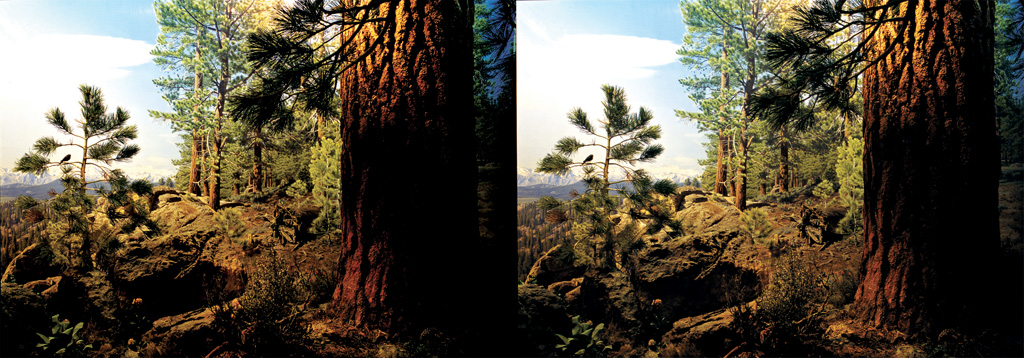
This is another James Perry Wilson diorama, this time from the Hall of North American Forests at the American Museum of Natural History. Wilson had brought the rigour of architectural perspective projection to diorama painting and had developed his dual grid method of perspectival projection to deal with the cycloramic diorama shell. In his later work (this gallery opened in 1957) he was also using stereoscopic photography in his survey work and would paint working from stereoscopic viewers. If you compare his forest paintings of this time with the work of others there is a spatial clarity in the shaded areas that is unique, a facility that I suspect is partly due to what is revealed in his stereoscopic surveys.
See the posts below for suggestions on how to view stereoscopic images.
Dioramas 3
Usually the diorama painters tried to keep everything but the sky on the pat of the diorama shell below where it forms a half dome. Although this section is curved in plan it is vertical in section. As soon as a part of the painting transgresses onto the part of the wall that curves in section there is a problem when the observer moves – the parallax between the two viewing positions will distort the object. This is fine for a desert or even a mountain scene, where it is possible to paint everything below the dome. In a woodland scene where you are among the trees it is impossible to avoid, so James Perry Wilson, who painted this background, kinks the trunks of the trees just as the diorama shell transitions into the domed ceiling, or masks the straight trunks with palm leaves. You can see this transition if you look at the pair stereoscopically. (See advice on this a couple of posts down).
The light in this painting is very beautiful, catching a hazy moisture-laden air. It was painted in 1947 and is another diorama from the American Museum of Natural History in the North American Mammals hall