Archive

Tag Archives: nat chard

Pattern1 (Nat Chard)

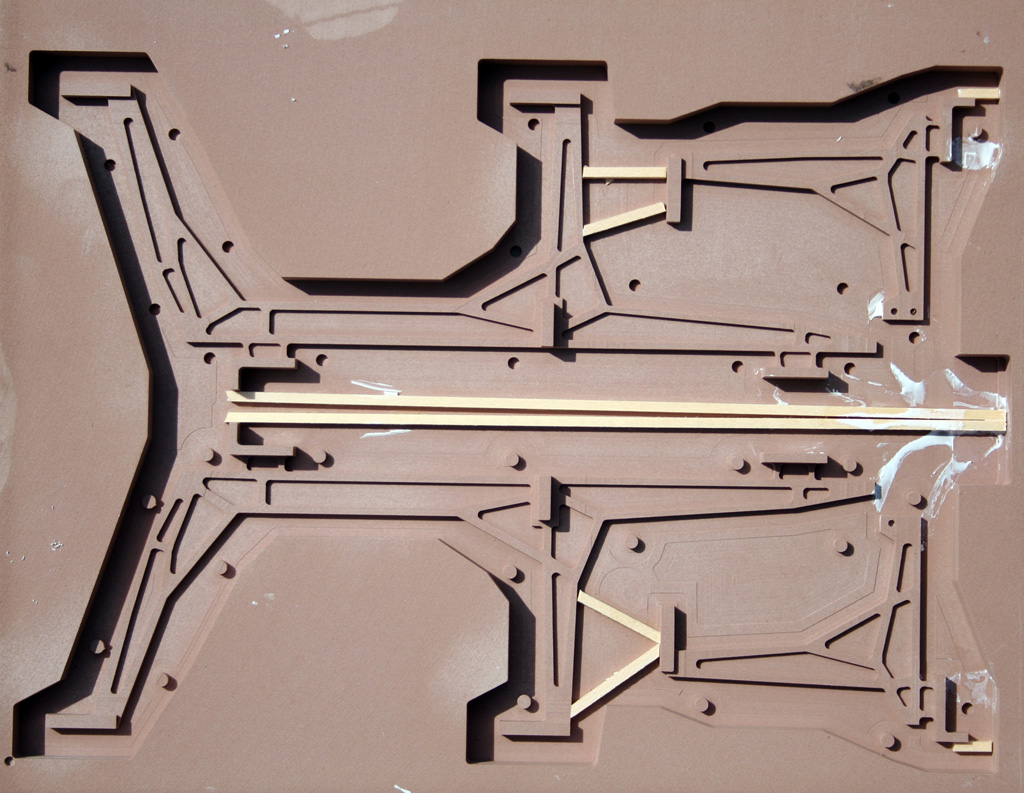
These are some of the patterns made to manufacture drawing instruments one to three. The following four types of instrument are made on laser cutters (and the subsequent ones have reverted to aluminium using a waterjet cutter). The patterns are made of cibatool, a homogenous and isotropic material designed to have no variation in character and to machine easily. I cut them on my small cnc mill.

Pattern 2 (Nat Chard)

The pieces of wood are added as air vents when making the silicon rubber mould so that whatever is poured into them can displace the air in the void. The parts for drawing instrument one were cast in plastic and for instruments two and three (and the incomplete instrument) in aluminium. For these I cast wax into the moulds that the foundry covered with a ceramic case and then melted the wax out to make the mould for the aluminium.

Pattern 3(Nat Chard)

Pattern three (above) was the first piece I machined. There are no drawings of the whole thing and no complete drawings any of the parts. They were designed incrementally, even within each part, so the only thing known about the next component was the dimension and geometry of the fixing to the previous piece.

Underside of chassis (Nat Chard)

Leg pattern (Nat Chard)

Dome brackets (Nat Chard)
Frame for drawers (Nat Chard)

Various components (Nat Chard)
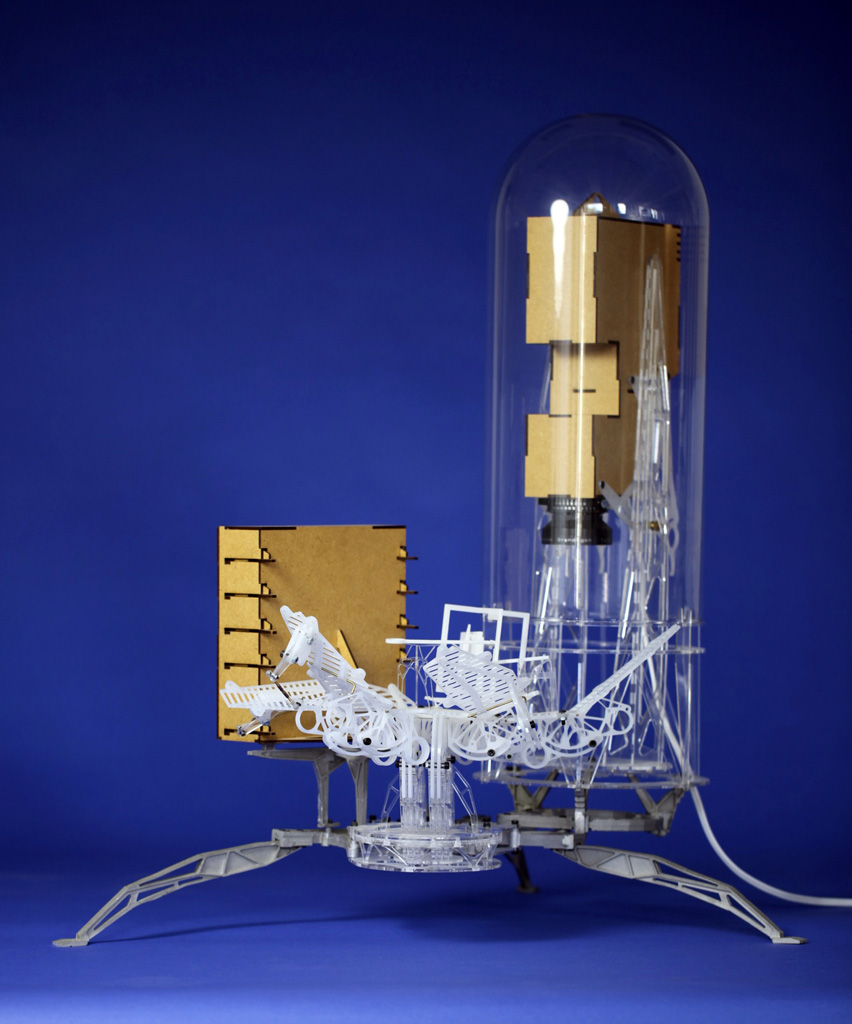
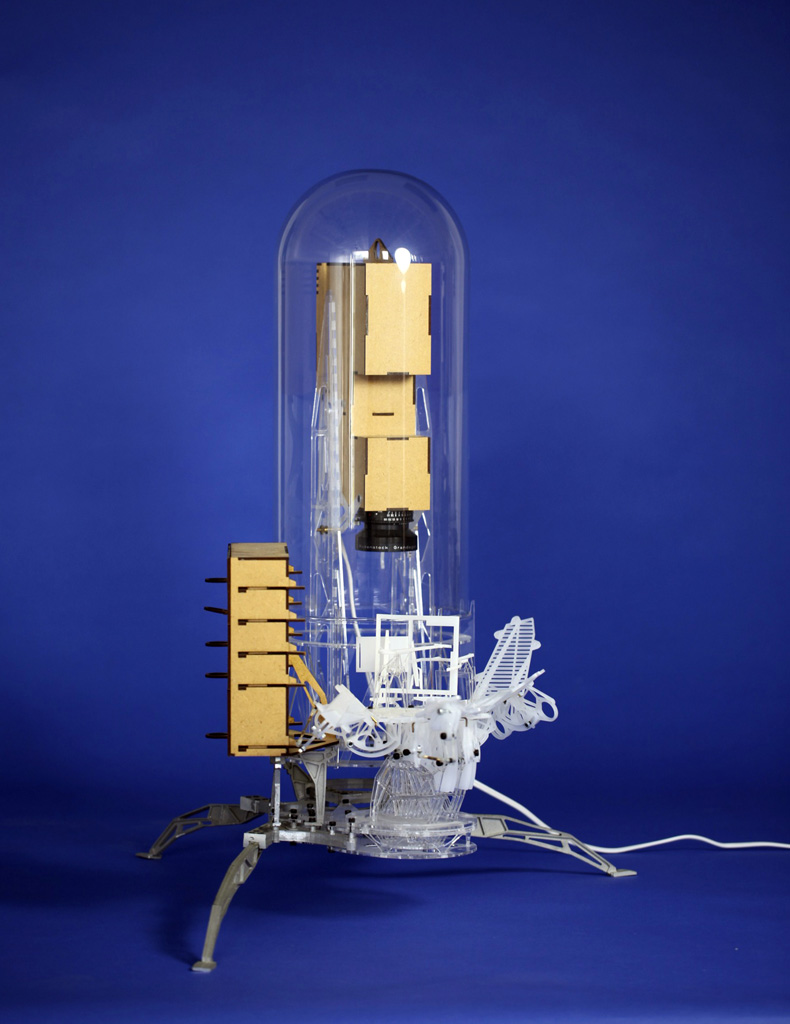
Drawing Instrument 3 (Nat Chard)

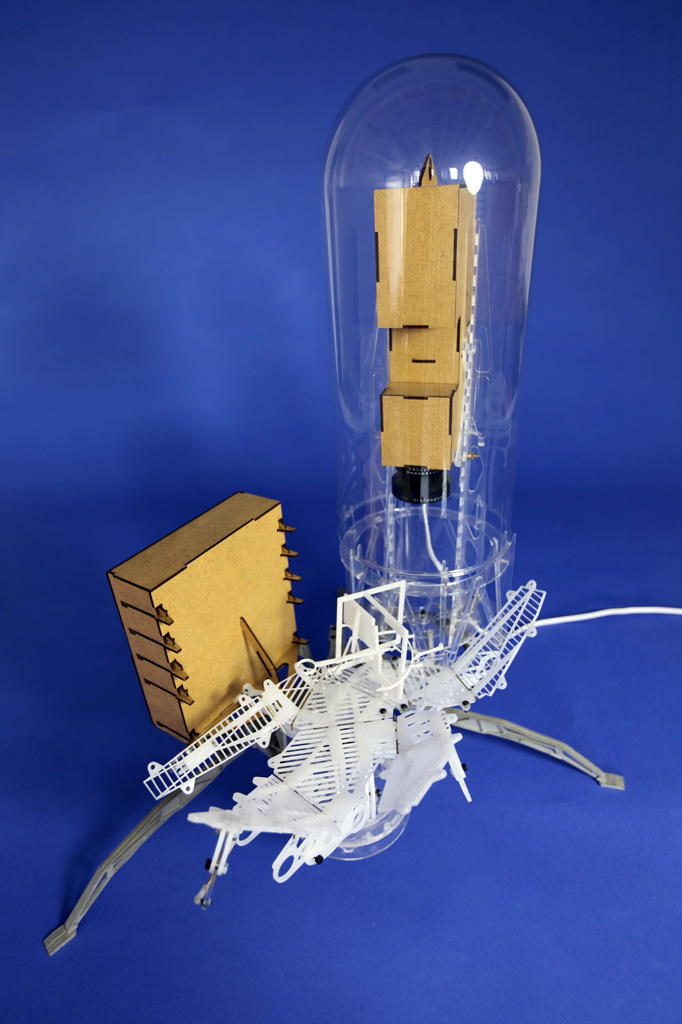
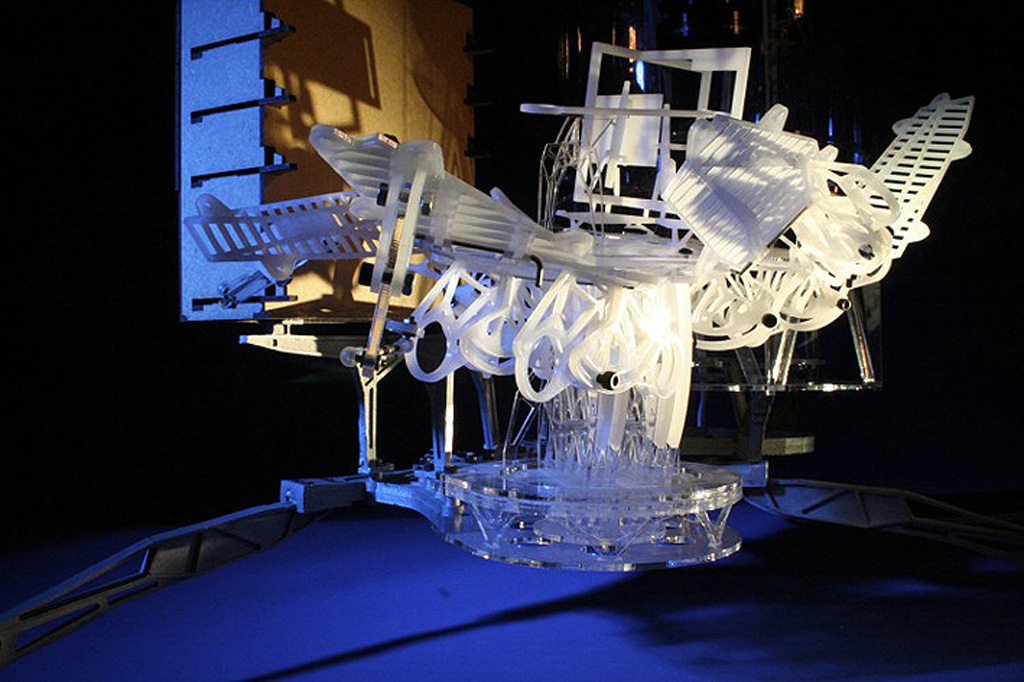
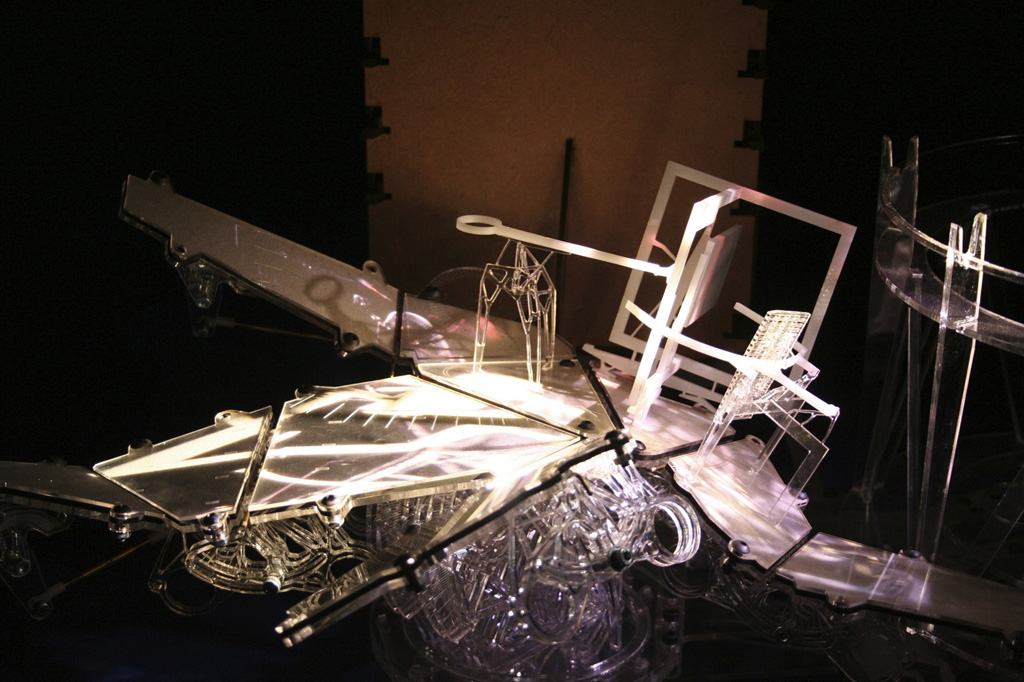
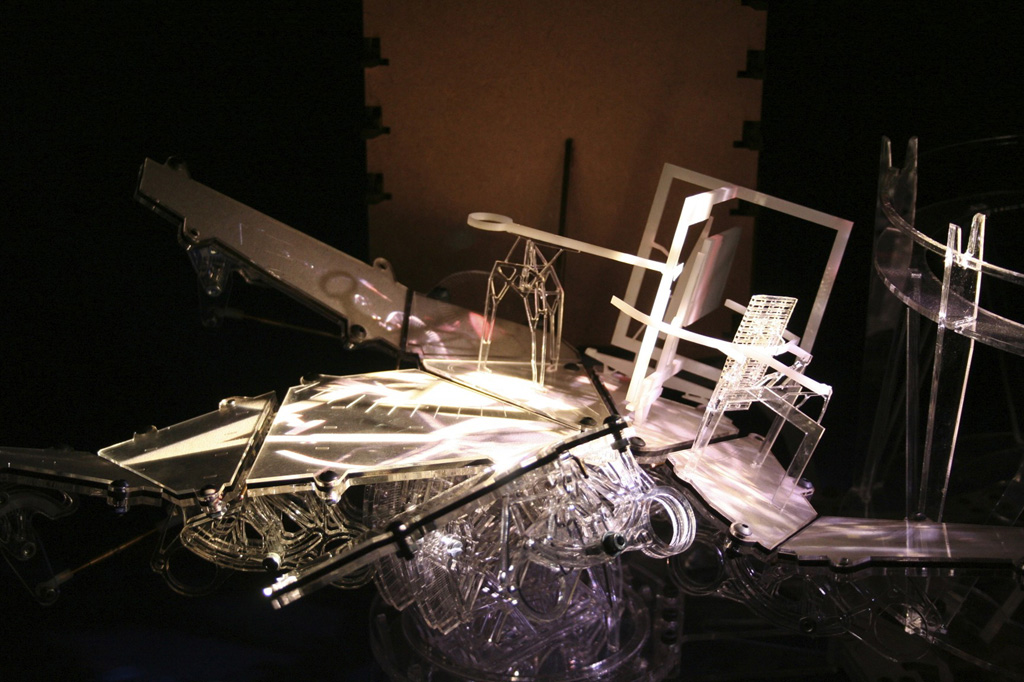
Instrument Three is a linear development of Instrument Two, which was destroyed in transit while returning from an exhibition. The picture plane is a little different, but in most other respects it is a remake of Instrument Two.

Drawing Instrument 3 (Nat Chard)

Drawing Instrument 3 (Nat Chard)


Drawing Instrument 3 (Nat Chard)

Space between feet study (Nat Chard)

After the work int he previous post there are a number of studies that look closer at some of the conditions within the yellow drawing. Above is a study for a much larger drawing (below) of the space between the lower legs of the two people walking. In each case a single (and sectioned) figurative foot locates the scale and nature of the abstract registration of knee, lower leg and foot.

Full size space between lower legs (Nat Chard)

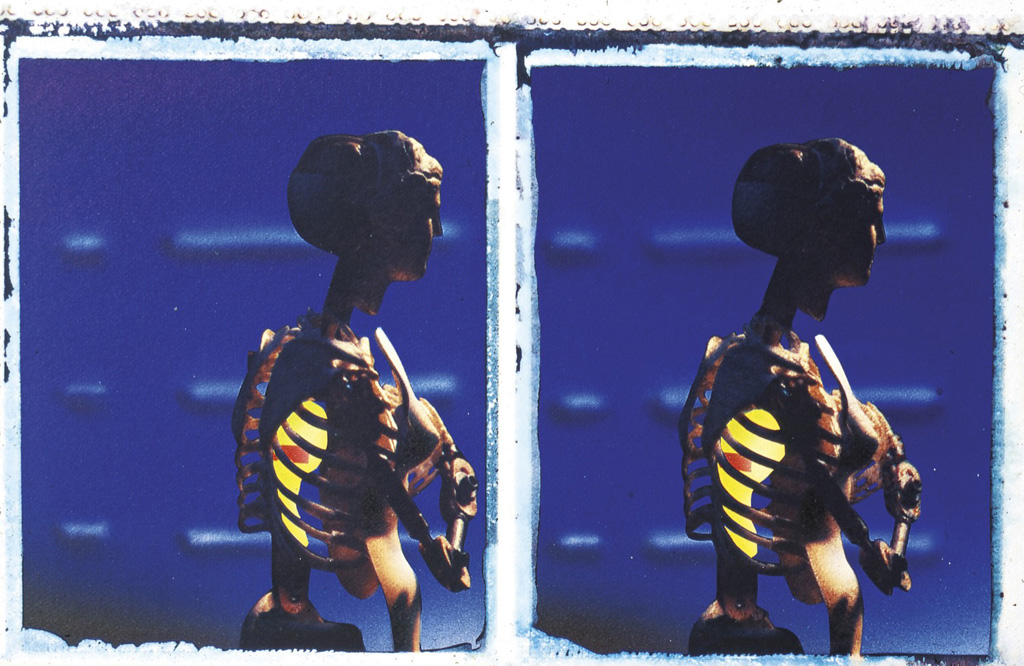
Some other drawings (this time drawn over Polaroid transfers) build up a perceptual composite of the foot during this walk (below). Both are drawn oer images of X-Rays.

Foot study 1 (Nat Chard)

Foot study 2 (Nat Chard)

Electronic context (Nat Chard)

As I mentioned in the last post, the vertical yellow lines in the yellow drawing sit in place of a coherent idea of context for the space. THis drawing is a suggestion that the skin of the space, which is sensitive to electronic signals in the skin of the people who walk through it, is also sensitive to electronic signals in the ether. The impressions in the architectural skin in this image (above) are from navigation signals and are quite stable. As with previous pairs of drawings, these are stereoscopic so if you go cross eyed so that one image registers over the other, you will see the thing in 3D. The animation figure was built for a stereoscopic film of this project. I think it is stored on obsolete media, but if i can find it I might post it.

Personal space study (Nat Chard)

The image above (also stereoscopic) is a personal space study. It is quite a hard one to resolve as there is  incomplete overlap in the images, but if you can resolve it the personal space drawn around her body works quite well.

Time/space section (Nat Chard)

The last image in this post is a later attempt at similar content to the yellow drawing (in the previous post) but with a mixture of instantaneous and durational images (working from a photofinish-like photograph of two people walking). All these drawings are from 1994.

Space of two people walking (Nat Chard)

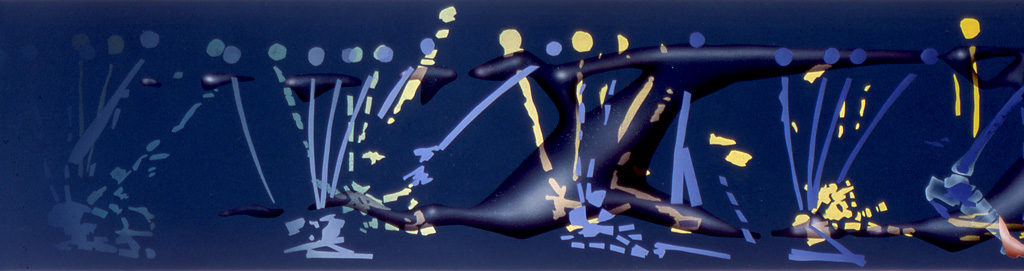
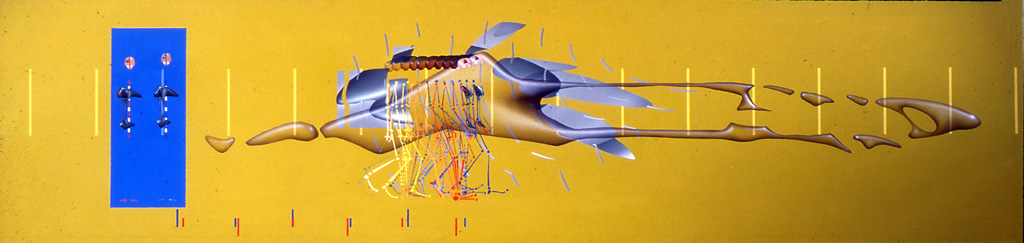
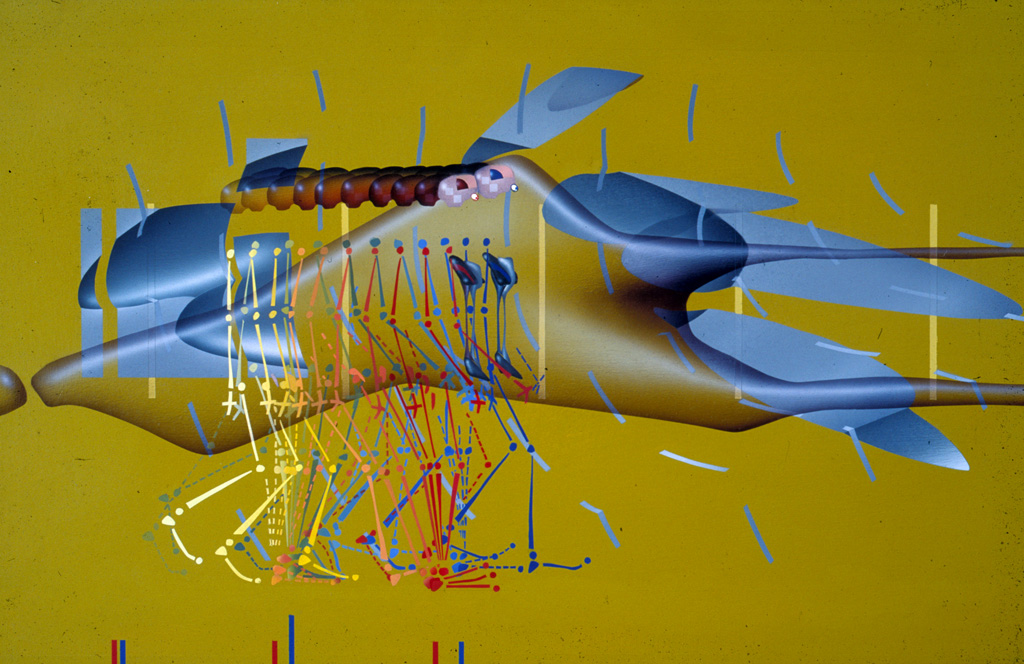
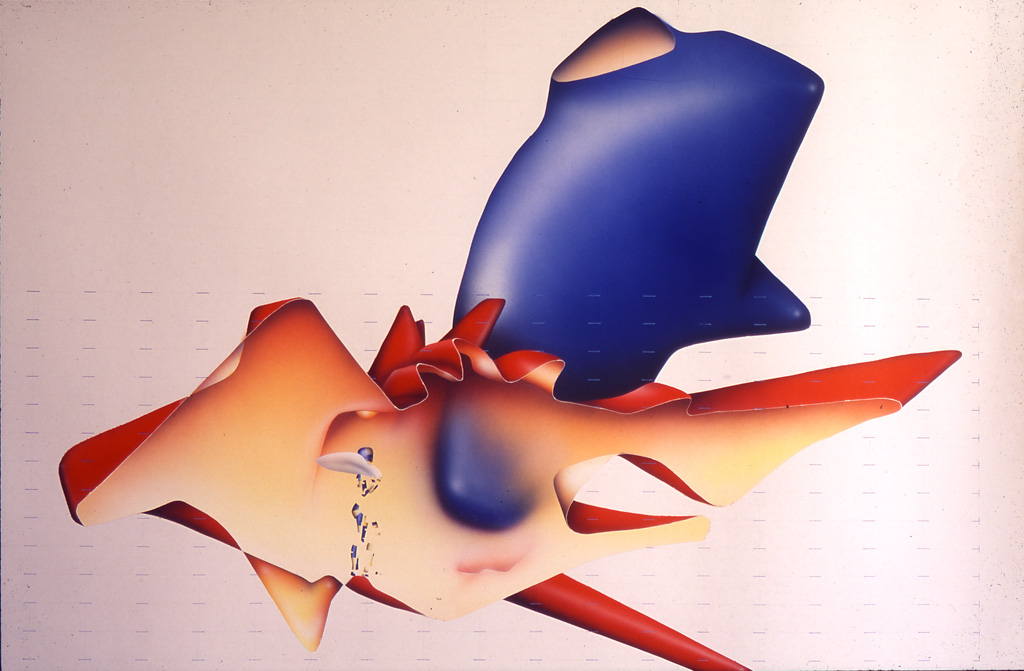
After drawing the spaces in the previous post (Hall and Staircase) the thing that fascinated me most was how one would perceive such a space, where you are implicated in the nature of that place. How would you construct a spatial consciousness in a space that was constantly adapting to you and others? The drawing above, and below in detail, shows two people walking, as a Marey-like abstraction of the body. Around them are a series of grey pieces that are a mixture of perceptions (with the rounded edges, rather as the resolution of an optical cone, and recollections with the squarer edges (that are behind them). It is an incomplete composite of a duration, where some parts of the space are emerging and others decaying while the sense of the whole is neither what is was, nor what it will be and certainly not what it is. The snotty stuff int he middle is what they imagine to be their personal space while the vertical yellow lines discuss an as yet unresolved sense of context. These are from 1993.

Space of two people walking, detail (Nat Chard)
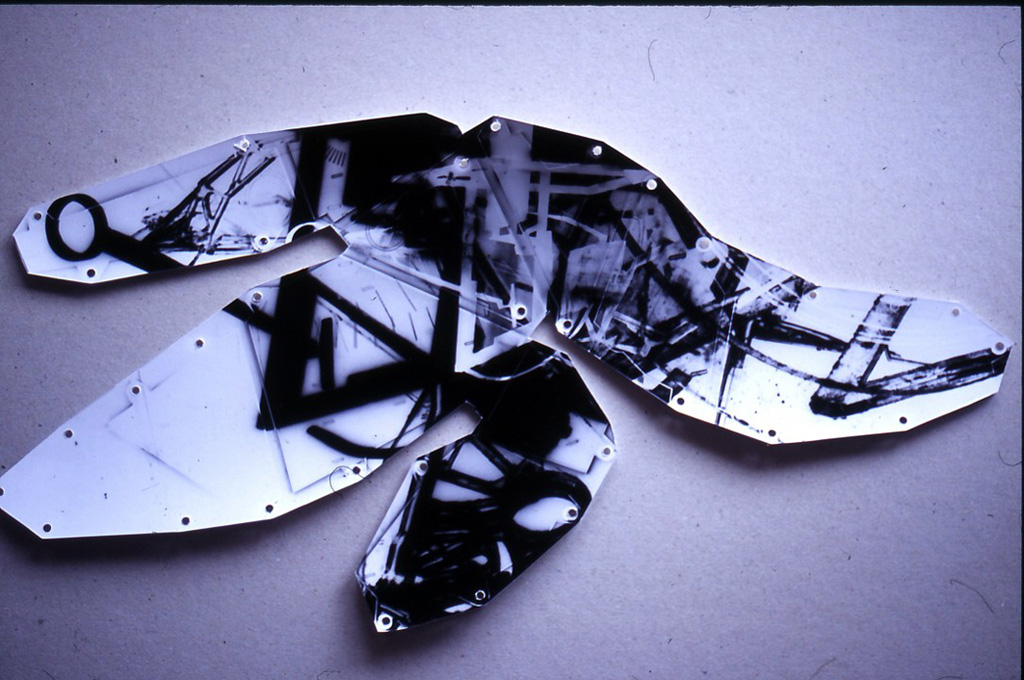
The figures in the blue frame are an elevation of the two people showing them as an imagined presence, trying to imagine how they would imagine their part in the evolving condition. The drawings relate to a couple of studies that I will post some other time, but there is a specific drawing that speculates on this issue relative to the drawing above. It is shown below.

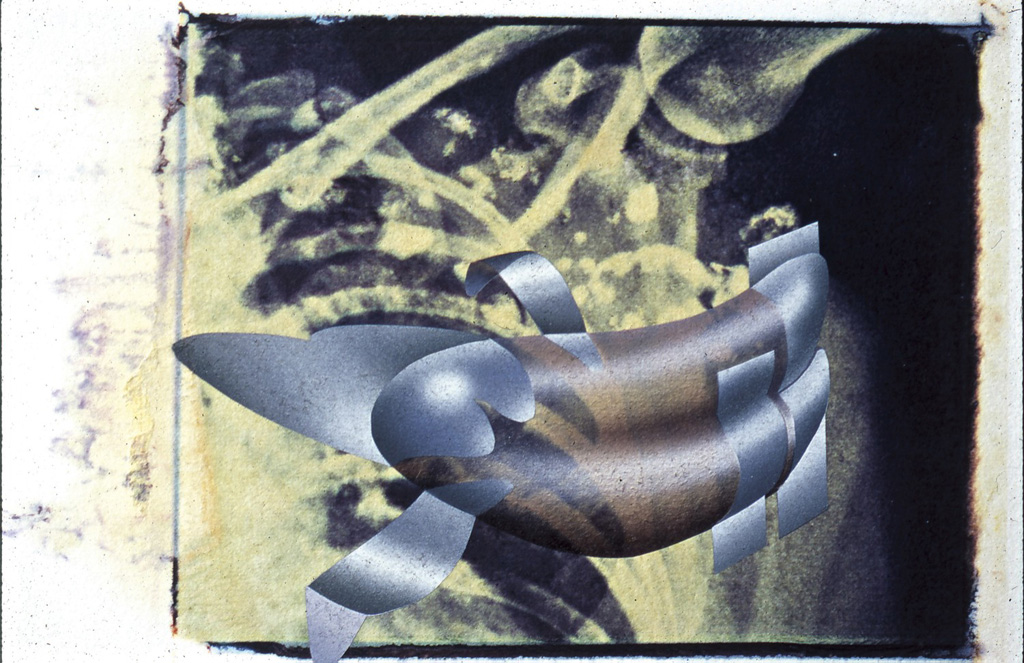
Feedback perceptions in desire sensitive space (Nat Chard)

The top drawing is airbrushed ink and paint as well as acrylic painted directly on housepaint. The lower drawing (above) is airbrushed ink and paint over a Polaroid transfer, this time using 669 type film. The chemical marks on the left of the image come from the developing chemicals and film dye being spread out when rolling down the peel-apart negative.

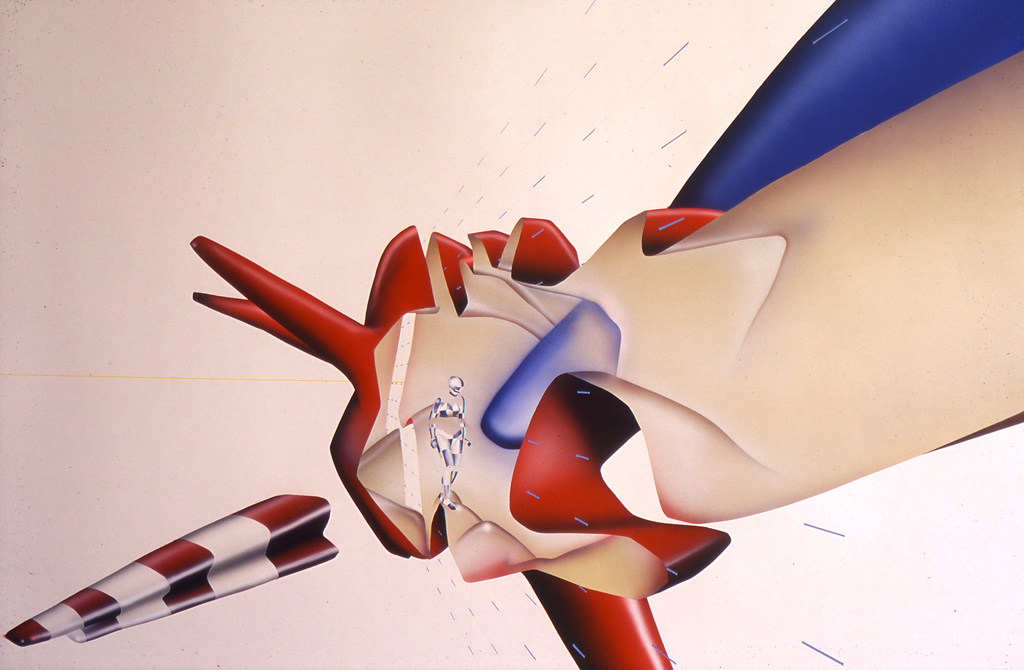
Hall and Staircase - perspective section (Nat Chard)

These drawings were made in 1992 when i was looking at the implications that a range of emerging new technologies might have on architecture. One in particular, intelligent gel, offered the possibility of an active flexible surface. In the four sections below someone walks in a hallway that is sensitive to her desires and anxieties. These are translated spatially (and detected for the natural electronic signals in her skin). There are also practical movements – the ground moves up to accept each step to maintain a certain horizon, for instance. In the second section a staircase appears (the same situation as in the perspective above), in the third the person emerging from the staircase enters the first person’s space. In the fourth drawing the two people go their own ways while the space tries to reconcile their composited desires and anxieties. THe project was far more of a question than a proposal but it was the questions that came out of these drawings that nourished the work much more.

Hall and Staircase 1 (Nat Chard)

Hall and Staircase 2 (Nat Chard)

Hall and Staircase 3 (Nat Chard)

Hall and Staircase 4 (Nat Chard)

All these drawings are airbrushed ink and paint on paper

Instrument Two in Action 1 (Nat Chard)

Instrument Two in Action 2 (Nat Chard)

Instrument Two in Action 3 (Nat Chard)

Instrument Two in Action 4 (Nat Chard)

Instrument Two in Action 5 (Nat Chard)

Instrument Two in Action 6 (Nat Chard)

A sequence of adjustments to the picture plane as well as to the model in the projector. You can see the shadows of the model on the picture plane. If this is your first view of the blog, the rest of the instrument can be seen in a post further down the page, as can the drawings that result from working with the instrument. The nature and geometry of the folds in the picture plane were developed to provide a range of subtle to developed adjustments within the area covered by the projection lens.

In a later post I will put up some films of the picture plane moving to show its range of folds.

Unfinished instrument (Nat Chard)

This was an attempt to repeat the performance of Instrument Two in real time, so the projection would be a durational one, drawing with moving points of light onto a photosensitive paper on a moving folding picture plane. It still sits in this state, as it became clear that the predictability of light projection was too predictable for my needs. It uses identical cast aluminium components as Instrument Two (and Three, yet to come on here) but the active parts are completely different. The large roller bearing is to carry the picture plane, also located by the small bearing on top of the tower.

Instrument two drawing (Nat Chard)

Here is one of the drawings from Instrument Two. It is a photograph on photographic paper that was held on the picture plane with acrylic plates, so the holes around the edges are from blots that hold the plates (and the photographic paper) to the picture plane. The dark parts are the projection of the white model in the box (projector) and the white parts are the negative of the shadow. below is the positive from this negative (in conventional photographic terms).

Instrument two drawing positive (Nat Chard)

The only reason for showing thei image is that it makes it easier to see where the various parts came from, so the projection is now white and the paradoxical shadow is black. The shadow seems to register with the base of the projected model, but is mysteriously smaller, geometrically perhaps appearing to be the object for which the projection is the shadow. You can also see photograms of the plate edges (that hold the paper flat on the picture plane) and some of the registrations cut into the surface of the plates.

Below is a sequence of drawings. The whole sequence can be seen in a picture in the previous post.

Instrument two drawing (Nat Chard) 2Instrument two drawing (Nat Chard) 4

Instrument two drawing (Nat Chard) 9

Instrument two drawing (Nat Chard) 10

The difference between the images is established mostly by folds in the picture plane. As the picture plane adjusts to question the projection, the model int he projector also moves to try and sustain its opinion on the picture plane.