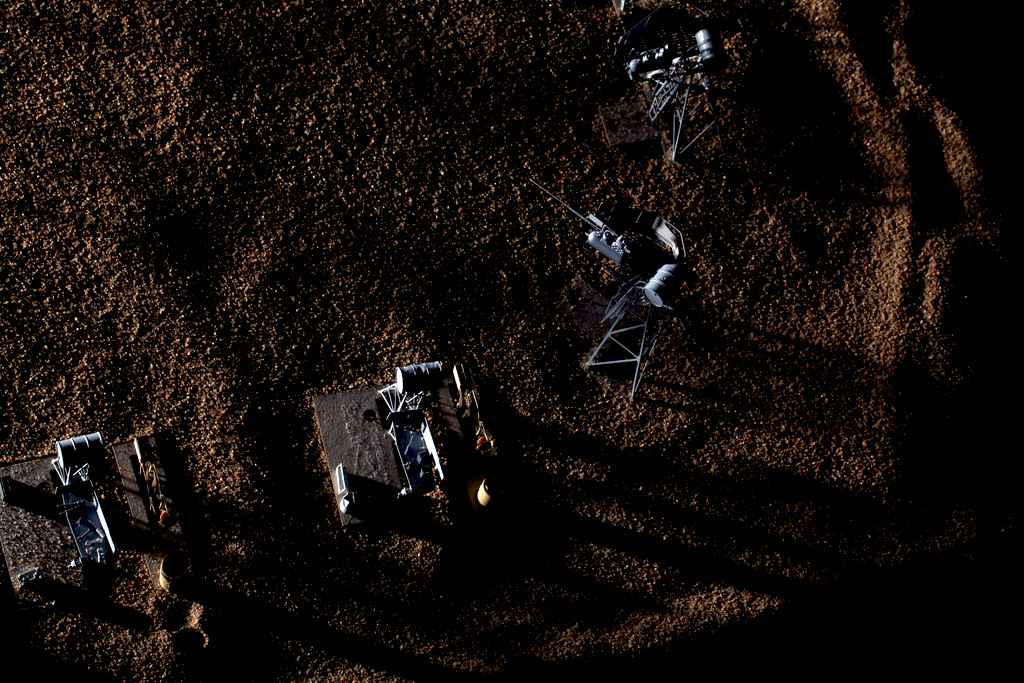
Institute for Paradoxical Shadows detail
An extra detail.
Institute for Paradoxical Shadows detail
An extra detail.

Institute for Paradoxical Shadows
An earlier view of the Institute for Paradoxical Shadows. It is developing the full size implications of instrument Six, shown below.

Instrument Six in real-time floating shadow mode

Instrument Six in research (photographic) mode

Stereoscopic view of floating shadow from Instrument Six
To view the floating shadow make sure the image is small enough to register the shadow in the left image over the one in the right hand image when you go cross-eyed (you will see three images – concentrate on the middle one). Try to relax to get a good three-dimensional view. You will see that the shadow sits a short way off the surface in which you would expect it to land.

Institute for Paradoxical Shadows

Institute for Paradoxical Shadows

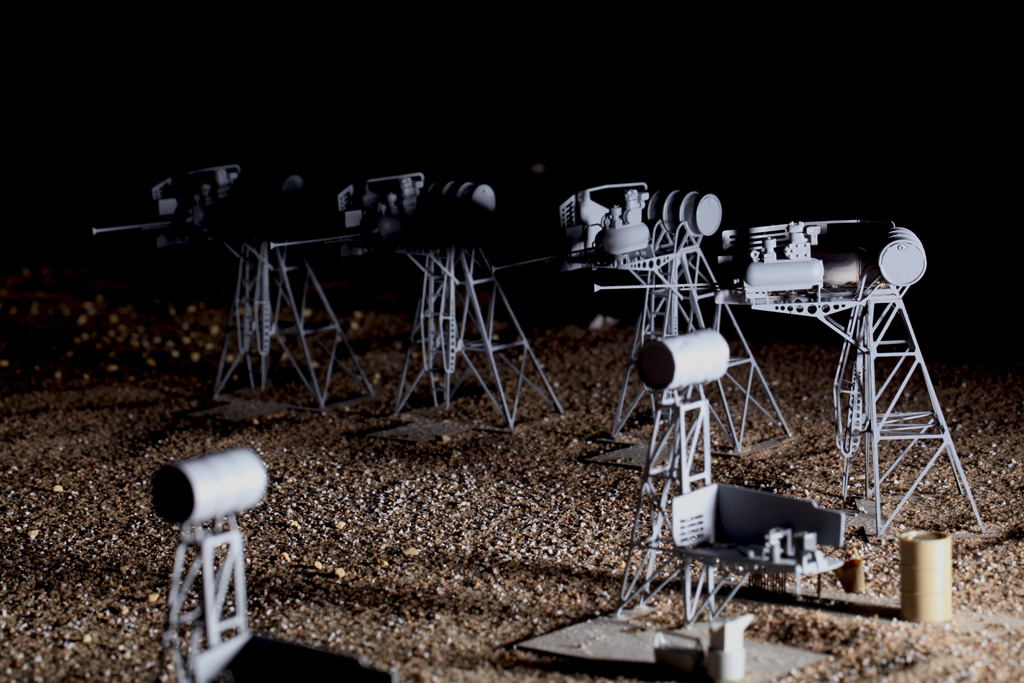
IPS infrastructure

IPS infrastructure
Misting towers and workbenches at the IPS research field.
(see aerial view of the field here)
Here is a film of instrument three in action – it makes some sense of how the instrument works. During the first half the picture plane folds to provide a critical review of the projection. In the second half the model that is projected is moving, both to persuade but also, when the picture plane is folding, to try to insist on its opinion.

Peepshow Ladders (Nat Chard)
A study for some ladders to hold peep shows for an exhibition. Each peepshow would have openings that would allow a view through to the gallery space or to another peep show or a drawing on the wall. In this way the composite view of the gallery from the ladders would be different from at ground level. The view above has one peep show looking through to the anamorphic projection of another peep show. To discuss the idea, models of Van Hoogstraten’s peepshow were used, although new ones would be made for the exhibition.

Peepshow Ladders (Nat Chard)

Peepshow Ladders (Nat Chard)
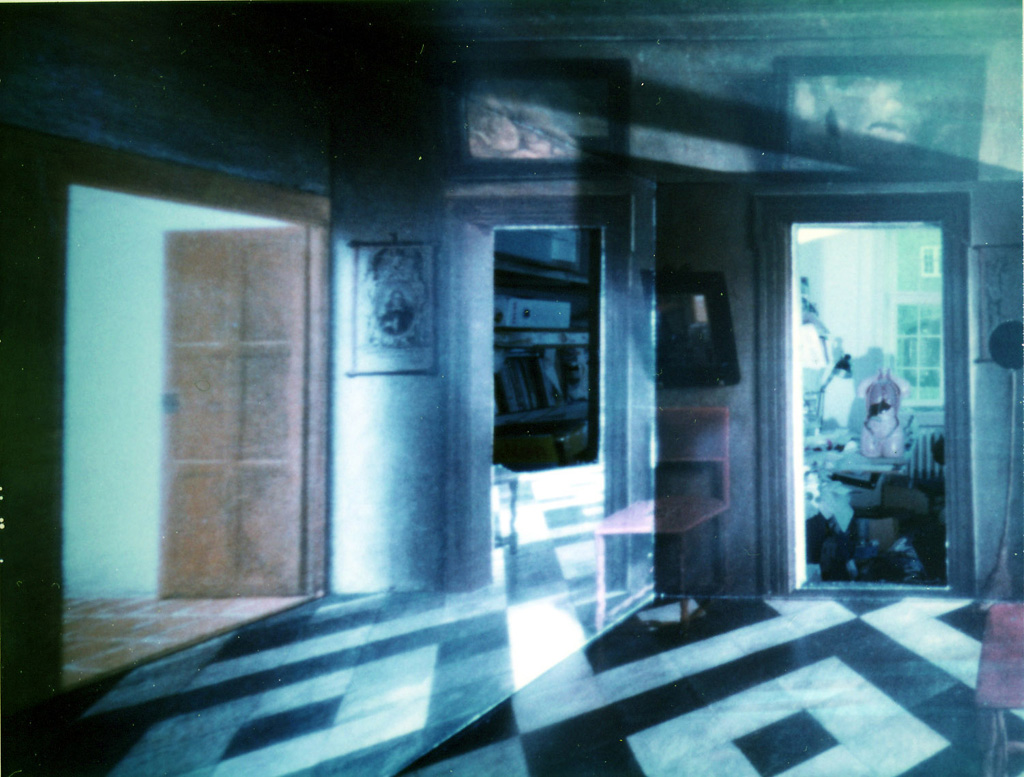
Van Hoogstraten in Nat's Office
This is a short post as I am away at the moment, but this is a model of Samuel Van Hoogstraten’s peep show (from the National Gallery, London) with the doors removed so that you look through it into my office. The photograph is taken with a camera I built to take the ideal picture to resolve the anamorphic view. The camera is built with a lot of shift to achieve this and to fill the frame. In the peep show there is a disturbance between pictorial and material space and this is played on with a (real) light coming through the doors that lands on the ceiling of the box. The furthest part of the ceiling of the box pictorially represents the wall of the room, so the light appears to land on the inside surface of the exterior wall it comes through. More paradoxical shadows. As we implicitly believe light, this disturbance takes a moment or two to register.
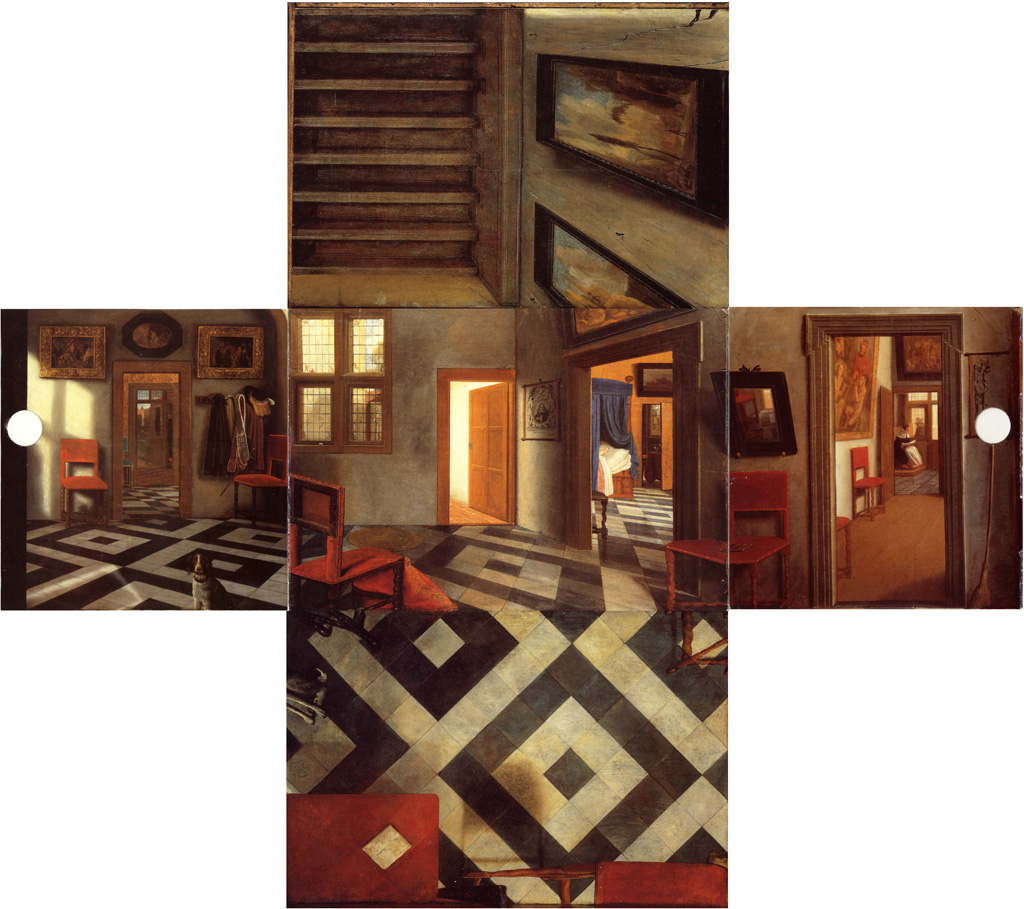
Van Hoostraten's peepshow unfolded
The unfolded view of the peepshow shows the anamorphic distortions of the room to get it to make sense when folded into a box. The two peep holes can be seen at either end.
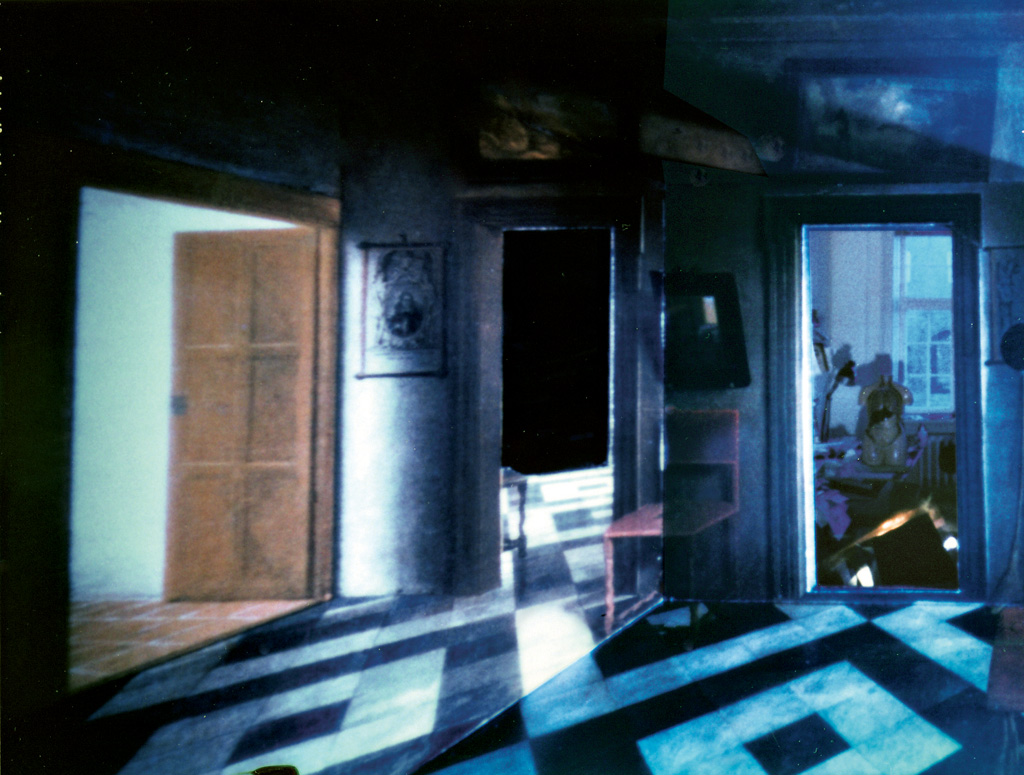
Van Hoogstraten's peepshow in Nat's office
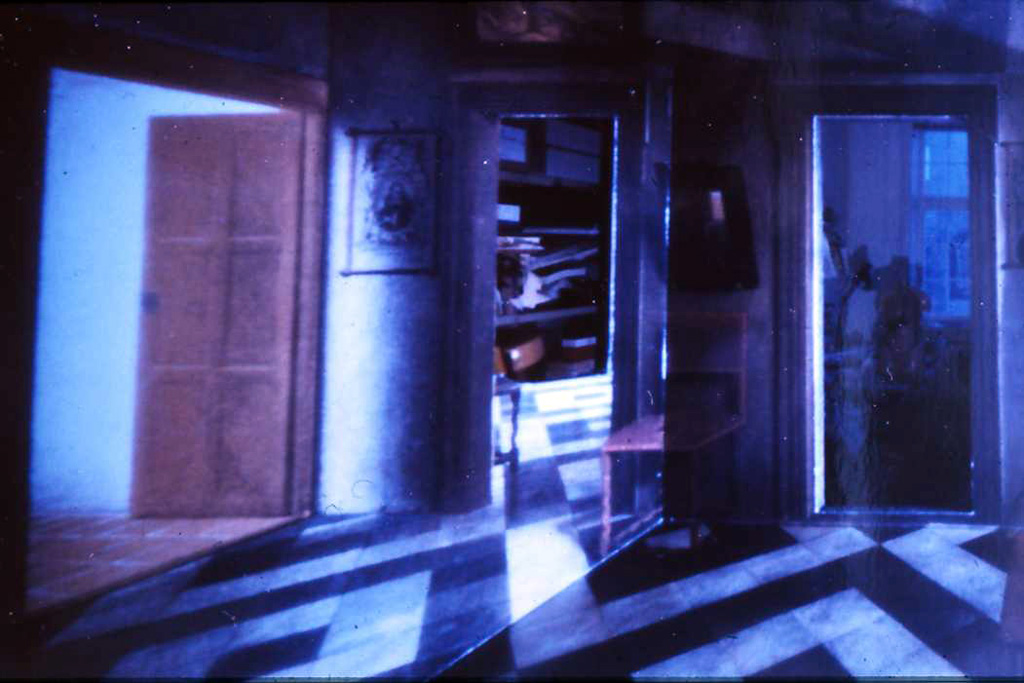
Van Hoogstraten's peepshow in Nat's office
There are some views looking back the other way that I will dig out.
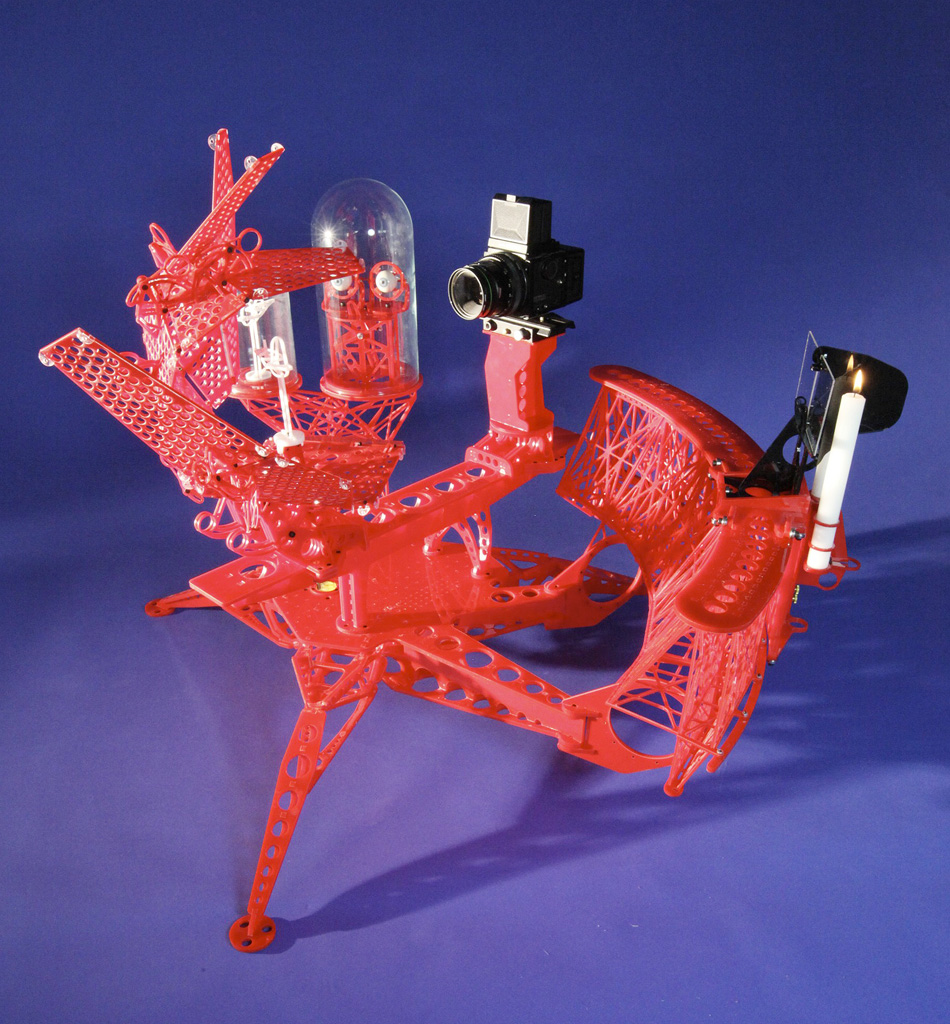
Instrument Six (Nat Chard)
Instrument Six is not on the same trajectory as the other instruments, but arrived as a consequence of a conversation about instrument five. I was explaining the drawing pieces to a friend as elements of space that were active.

Drawing Pieces on Instrument Five (Nat Chard)
As an analogy I said that they were a little like the interior of a submarine that was made up entirely of programme and not of passive elements. My friend e-mailed back to say that he had not been in a submarine so I assembled and sent off a pair of stereoscopic photographs I had taken a couple of years earlier showing such a space. After I had sent them I took a closer look at the stereo pair and noticed what was at first an annoying blur hovering in space. Quickly I realised that the annoying blur was on fact the very thing I had been chasing, a paradoxical shadow. It was so obvious how it had occurred that I was annoyed at not thinking of it before. At the time I was working on Instrument Five and stopped work on those instruments to build Instrument Six to play with the possibility of a shadow detached from the surface on which it should by rights be cast. The picture I sent is below but the lower image from another view works at least as well. Tomorrow I will post some more pictures of the instrument and its floating shadows in 3D.

Submarine interior with floating shadow (Nat Chard)
The floating shadow is just to the right of the periscope. If you are new to this blog, yo can view the image in 3D by going cross-eyed. When doing so, place one image over the other until they register. You will see three images, with the 3D image in the middle. If you are having difficulty pinning it down, try adjusting your horizon slightly to make sure the images are level with each other. The three dimensionality improves if you hold it for a short while.

Submarine interior with floating shadow (Nat Chard)
It is worth persevering with resolving the 3D image – apart from the floating shadows, submarine interiors really come alive in 3D.

 Nat Chard