Archive

Drawing instruments

Drawing Instrument Five Drawing (Nat Chard)

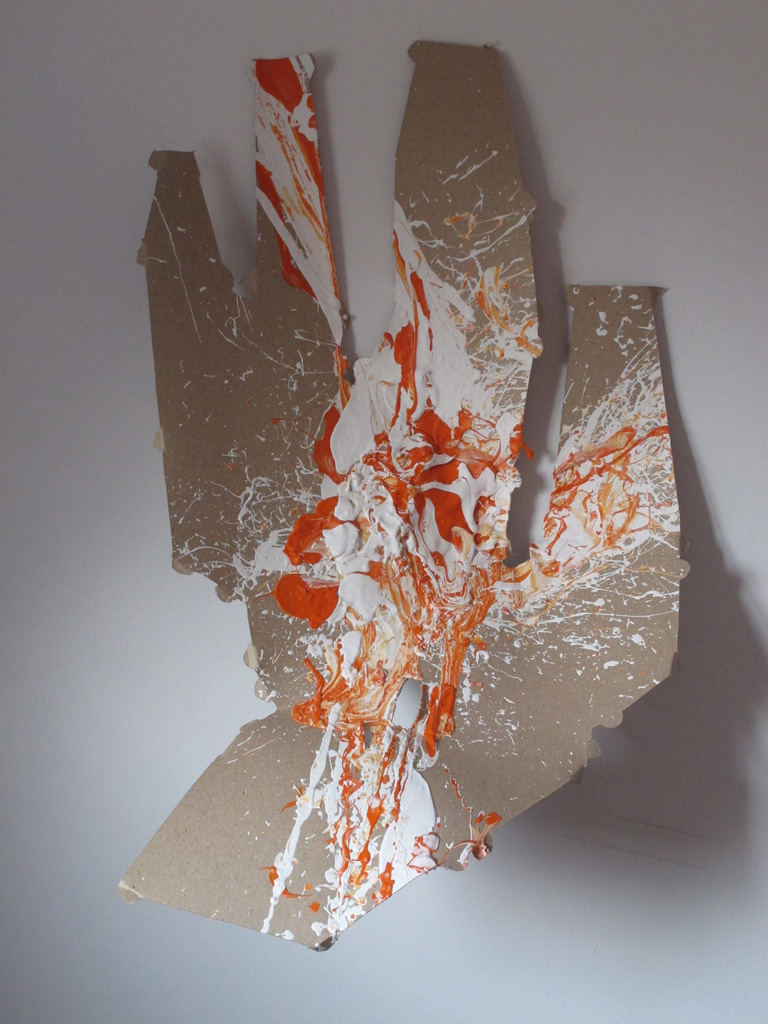
The earlier Instrument Five drawings were mostly media tests to learn and practice the instrument. The drawings in this post are discussions of a more developed version of the Bird Automata Test Track.

Drawing Instrument Five Drawing (Nat Chard)

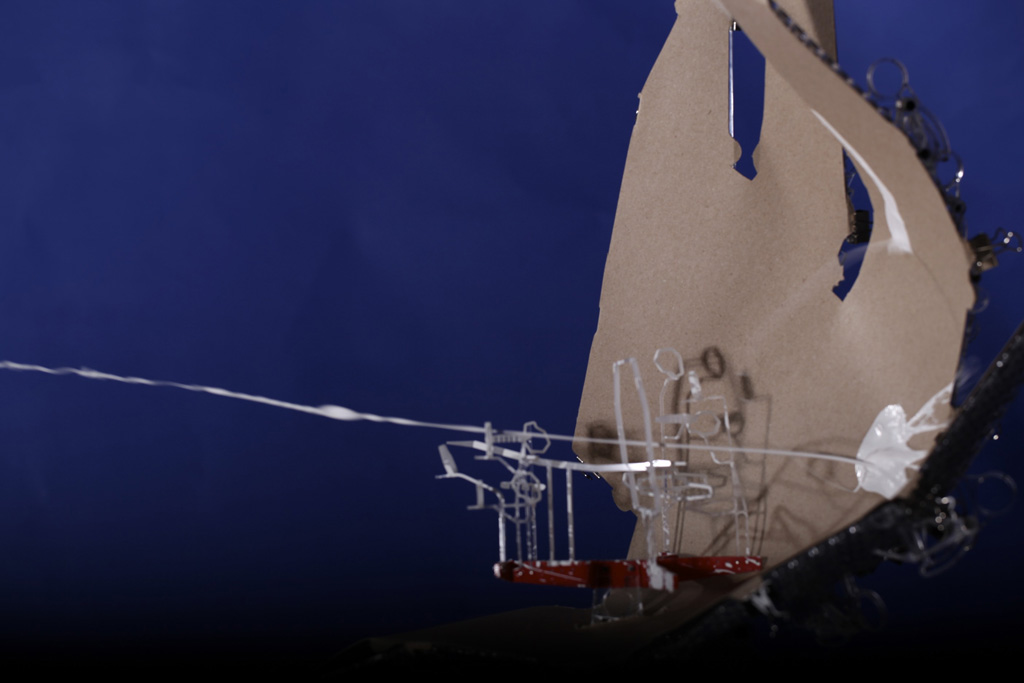
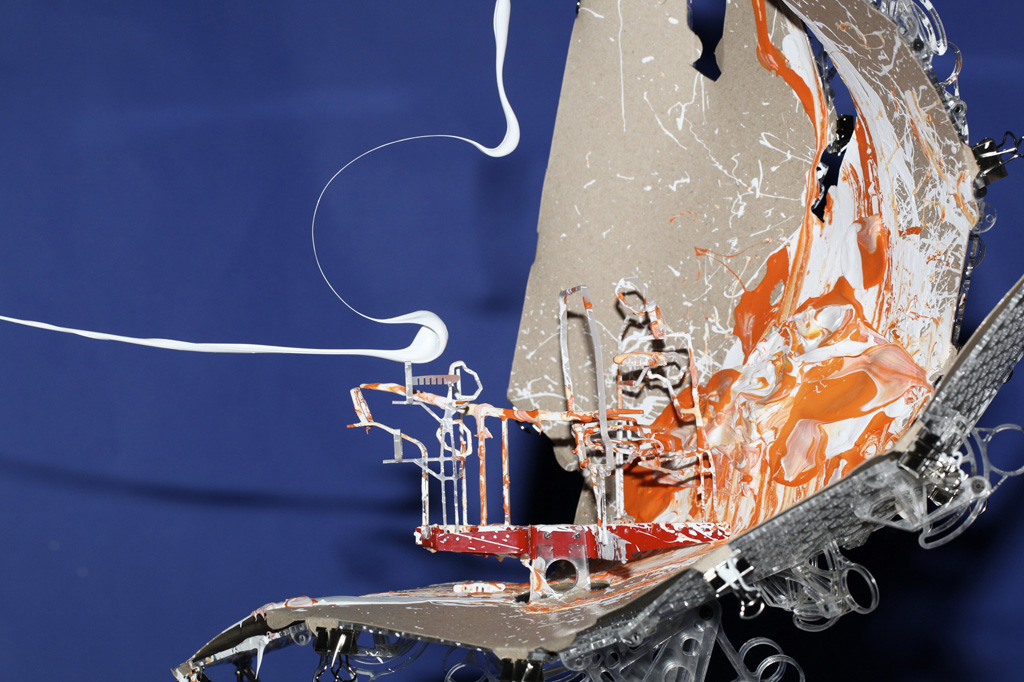
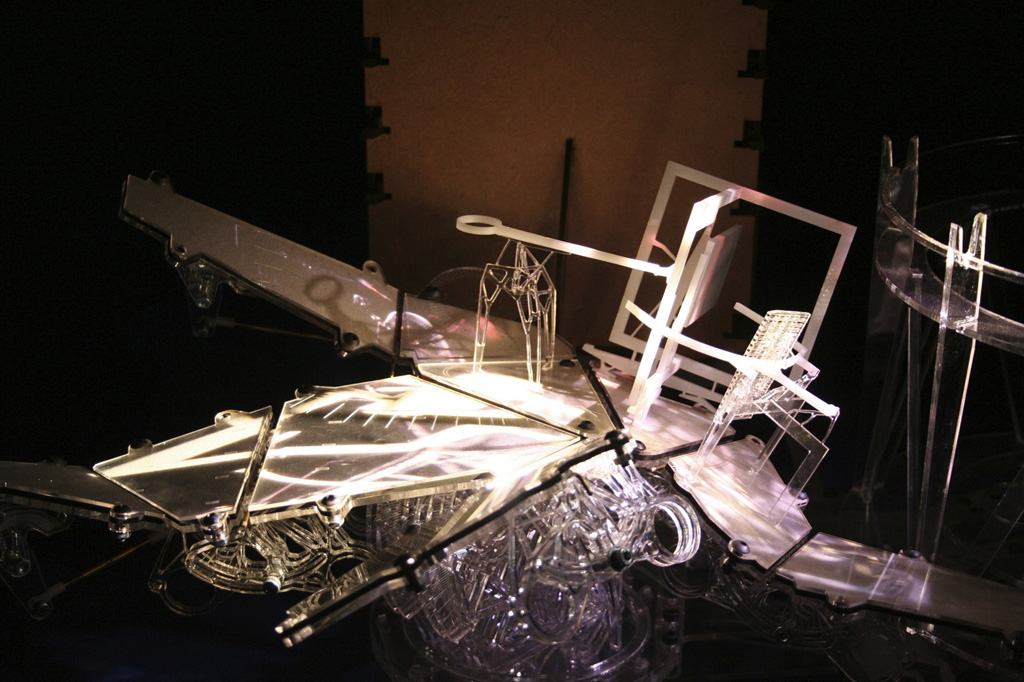
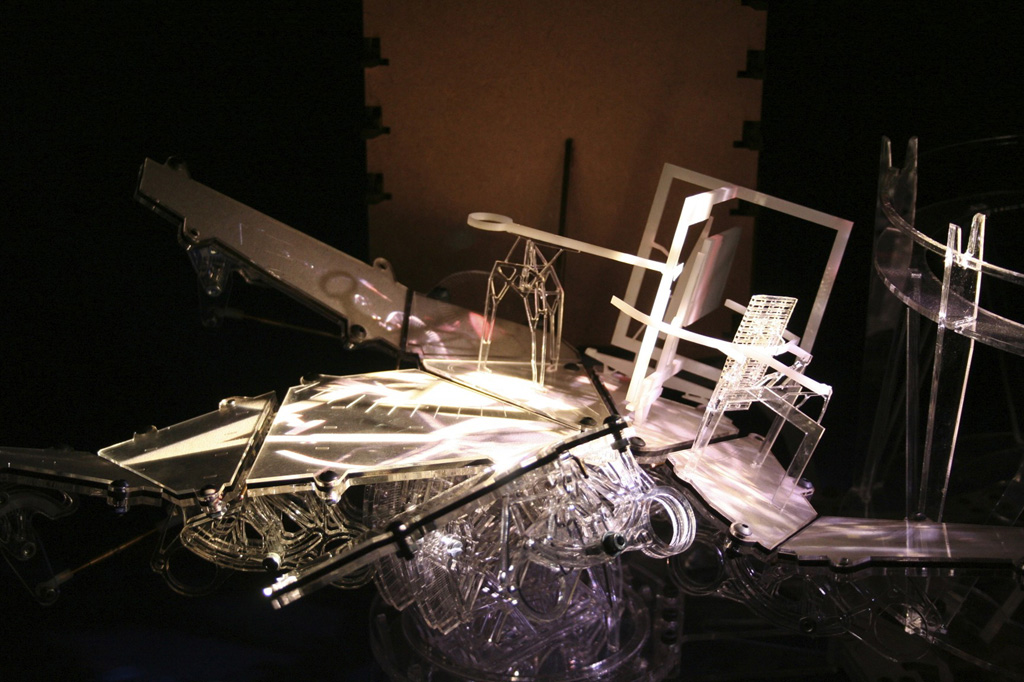
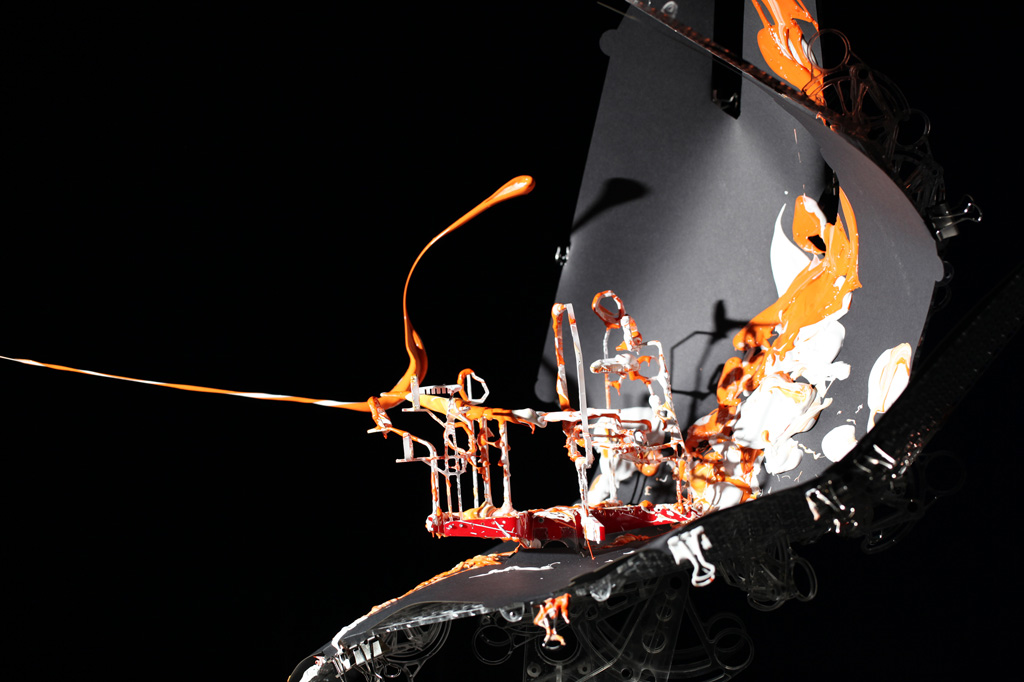
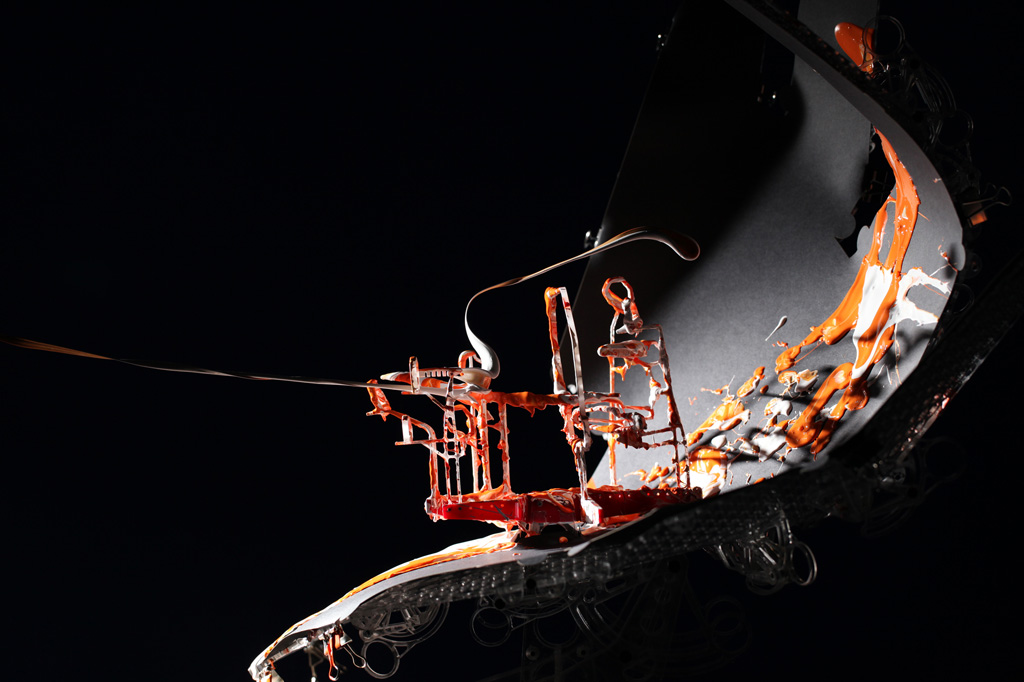
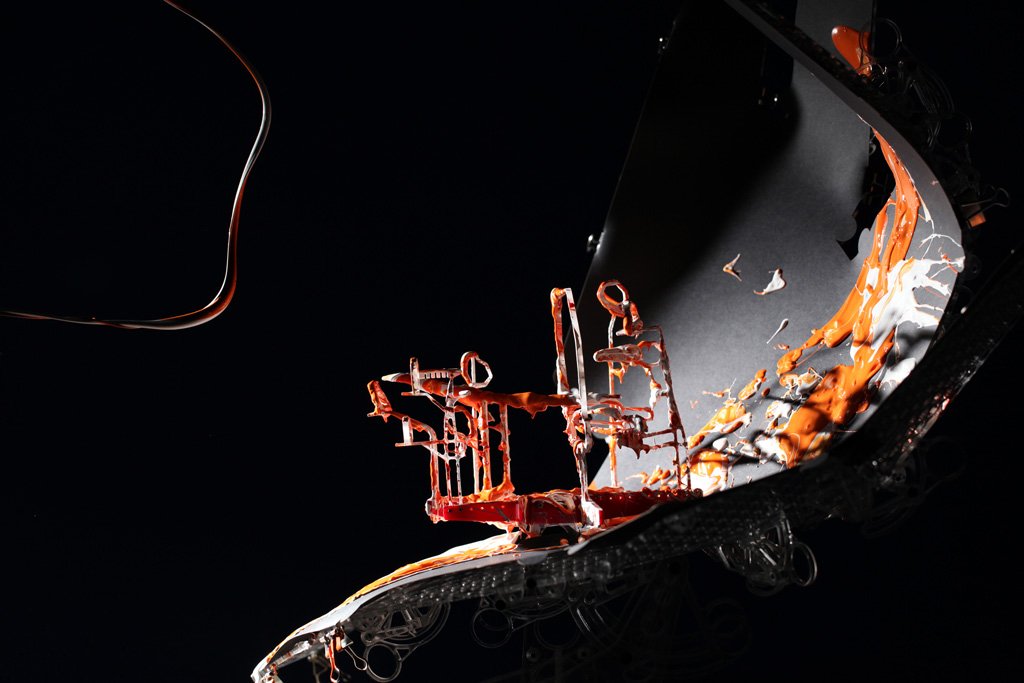
(Above) The flying paint discusses a particular flight. The new more developed beam can be seen running horizontally in the middle of the frame, with the paint flying just above it. You can see one of the hoop-like drawing pieces has caught a meniscus of paint that will burst and make its own splatter after the event.

Drawing Instrument Five Drawing (Nat Chard)

Drawing Instrument Five Drawing (Nat Chard)

Drawing Instrument Five in the process of drawing (Nat Chard)

Drawing Instrument Five in the process of drawing (Nat Chard)

Drawing Instrument Five in the process of drawing (Nat Chard)

Drawing Instrument Five in the process of drawing (Nat Chard)

Drawing Instrument Five in the process of drawing (Nat Chard)

Drawing Instrument Five in the process of drawing (Nat Chard)

Instrument Five Drawing (Nat Chard)

This will make more sense if read as a continuation of the previous post on Instrument Five

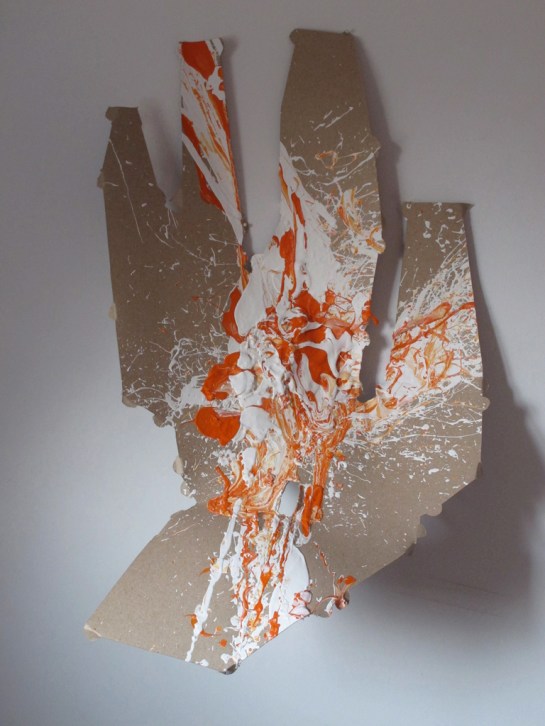
The first genration of Instrument Five Drawings have the continuing problem of the main thrust of paint obliterating the more subtle splatters that come from the collision of paint on the drawing pieces.

Instrument Seven solved this problem (future post)

The early experiments also played with paint viscosity and targeting the paint catapults, which were more accurate and had greater repeatability than i had imagined when designing and making them. They were designed for a disposable plastic tea spoon as a paint holder but I found that a hemispherical measuring spoon provided a more coherent throw.

As the throw happened very quickly, and having an fascination with the work of Arthur Worthington and Harold Edgerton, I decided to capture the paint in flight to see what it was up to – in effect the occupation of the architecture as the drawing pieces also constitute an architectural model (this will make more sense when I have posted a model from which the drawing pieces develop).
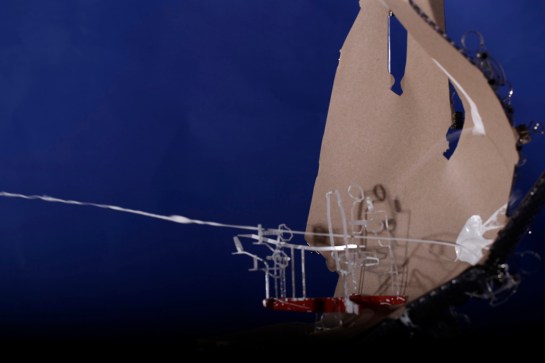
First genreration splat (Nat Chard)

The first attempts with 500 watt flash lamps used at their lowest power (for the fastest flash) were hopeful (above) but not fast enough to resolve the paint as a crisp frozen image. This would be solved by using a powerful battery powered flash in the subsequent generations. The significant discovery was that making these photographs made a hopeful change in my engagement with the work. When making a drawing I set the aim of the catapult in the hope of the paint travelling in a certain trajectory, and perhaps colliding  with one of the drawing pieces in particular. With the photograph, which is timed manually so that even with my most developed method I am only catching the paint in the photograph every two or three throws, I have more than one anticipation in making the throw of paint.

One is the aim – what I want the paint to do – and the other is the hope for the photograph. While the aim is predictable, the figure of the flying paint is not, so in both cases, even if the photograph does register, the real hope is for the unpredictable things that happens. Having the straightforward task (of getting the timing of the photograph right) made it much easier to have a sincere hope for the aiming of the paint while at the same time hoping that it would give much more.
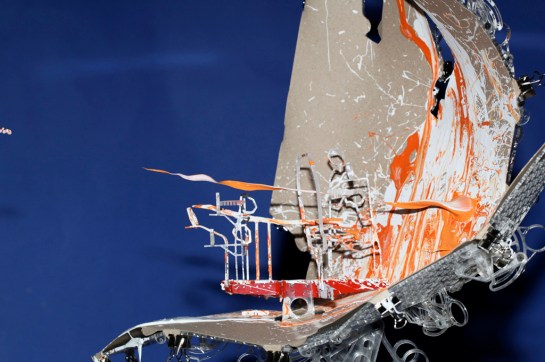
Second genreration splat (Nat Chard)

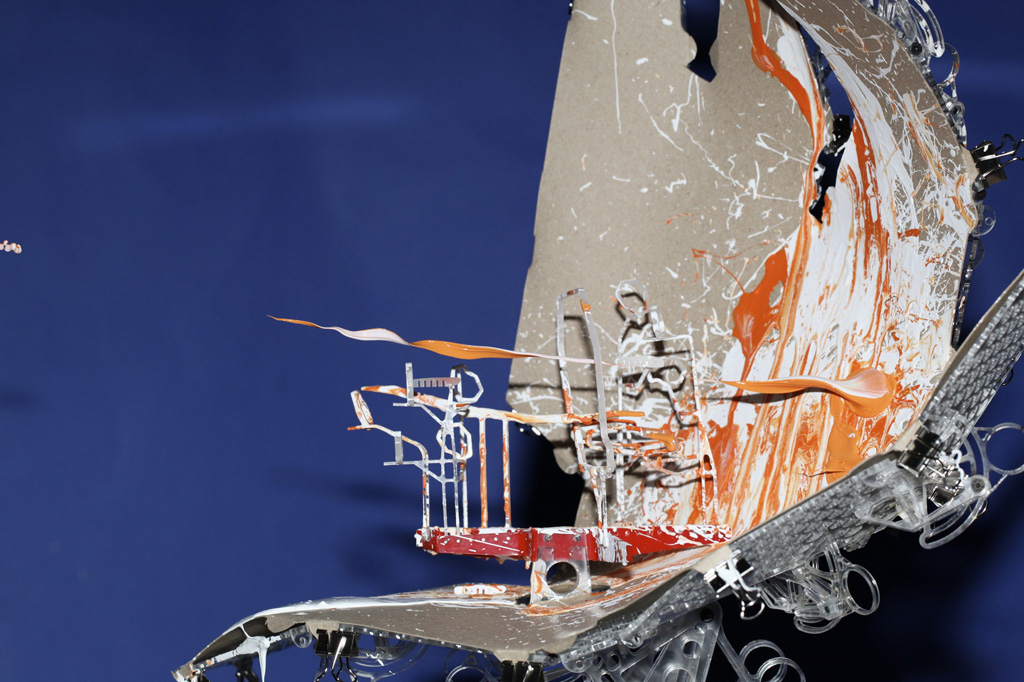
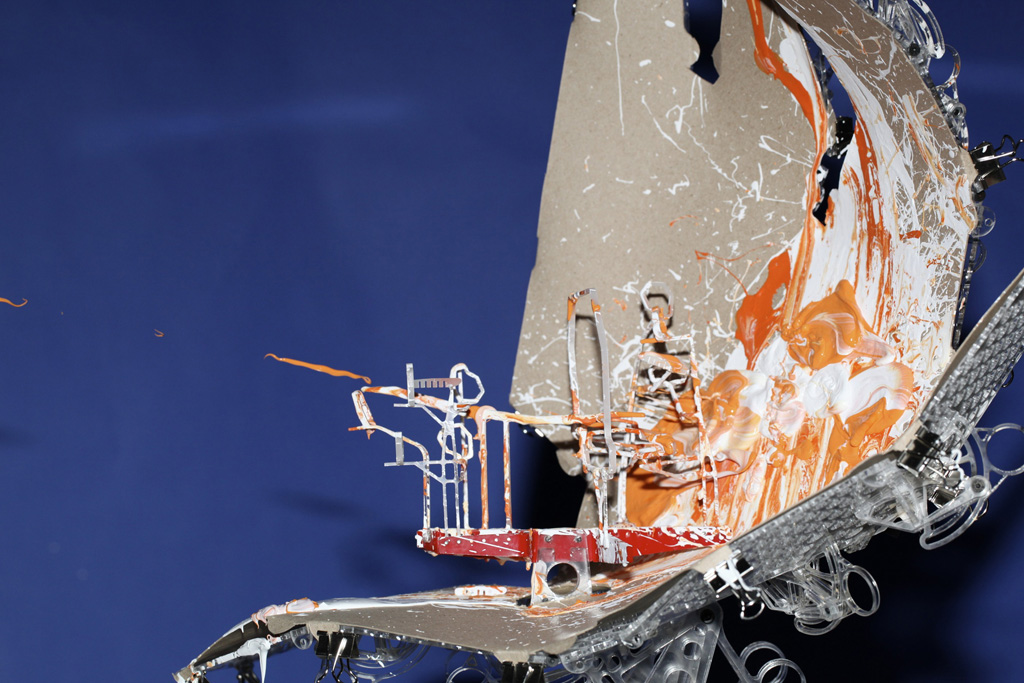
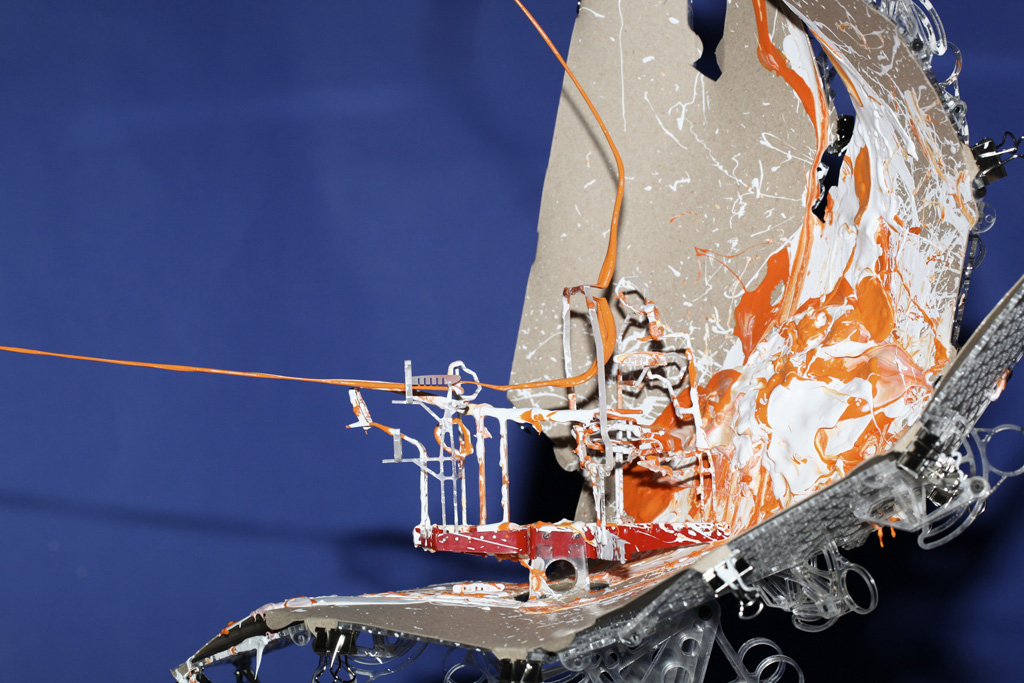
With a new flash that provided the speed that I needed, the photographs during the throw became more important to me than the  drawing. I alternated between orange and white paint to see the temporal build up of paint on the drawing surface and the residual paint from the previous colour, un mixed, helped describe the behaviour of the paint in flight. The story and architecture discussed by these drawings will be explained in a subsequent post.
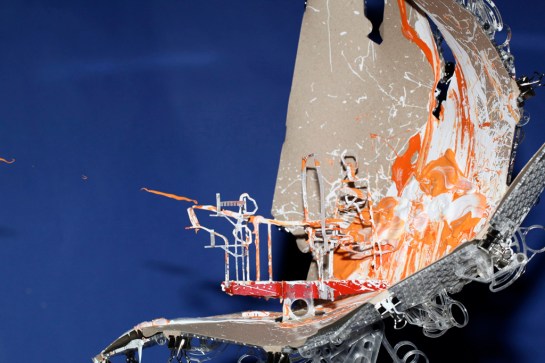
Second genreration splat (Nat Chard)
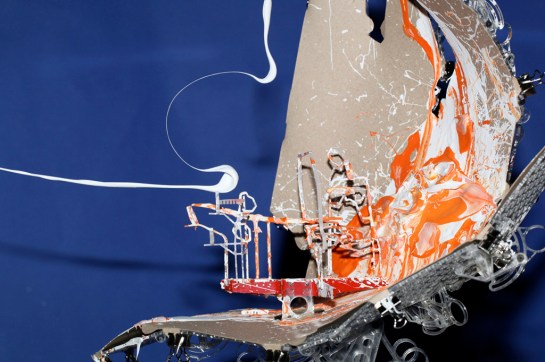
Second genreration splat (Nat Chard)
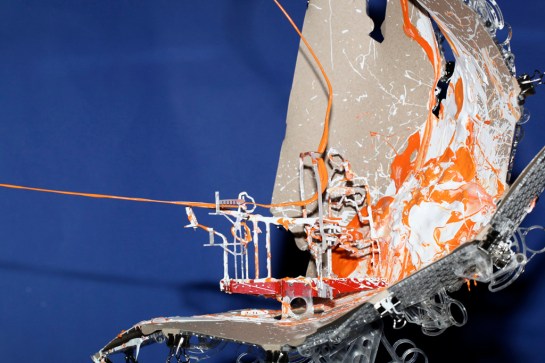
Second genreration splat (Nat Chard)

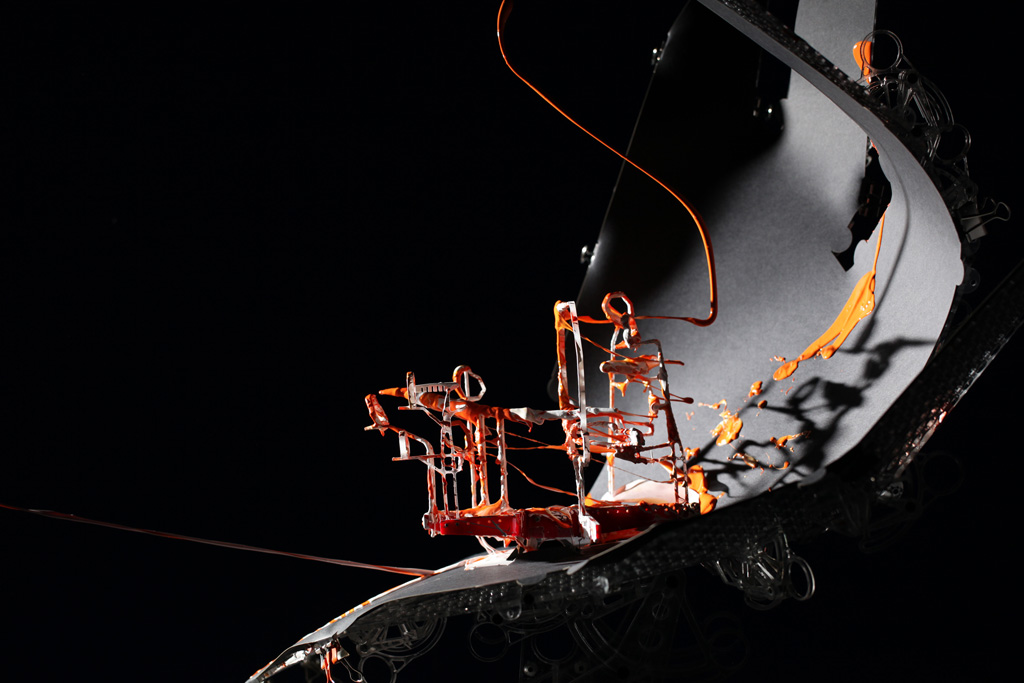
In the lowest image notice how the line of paint remains continuous as it stretches over the drawing pieces.

Drawing Instrument Five (Nat Chard)
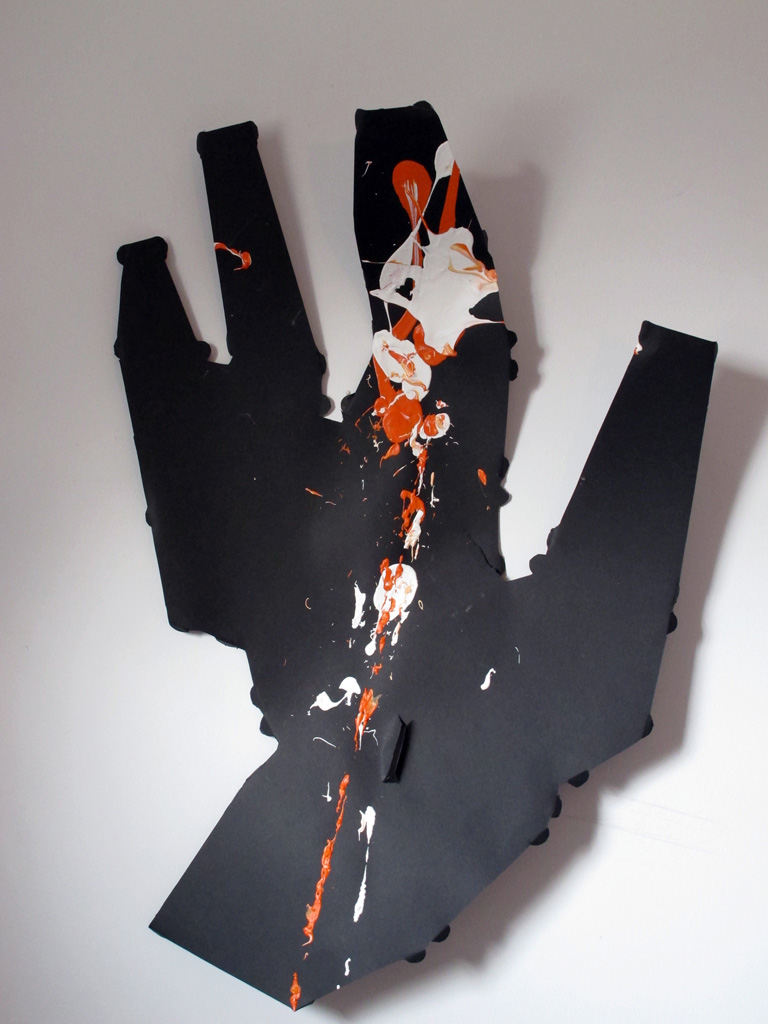
Drawing Instrument Five (Nat Chard)

When light casts a shadow, the figure that lands on whatever makes the screen is a predictable combination of the angle of the light, the form of the objects and the nature of the screen. Instruments one, two and three played with the of manipulating such a projection as a critical reception of ideas. Every move was contained by the relentless obedience of light’s behaviour. Instrument fout tested out the idea that instead of projecting light, if paint were thrown at an object the shadow would not just be the figure of the object but also the dynamic conversation of one material hitting another. This visceral event would not be reliable and repeatable. Each time the paint were thrown the objects would be different, due to the accumulation of paint. Further more, as some of the objects had special figures to play with the paint in different ways,  they would would provide a range of ways in which the flying paint would behave during and after a collision of paint on drawing piece.

Set fo Four versions of Drawing Instrument Five (Nat Chard)

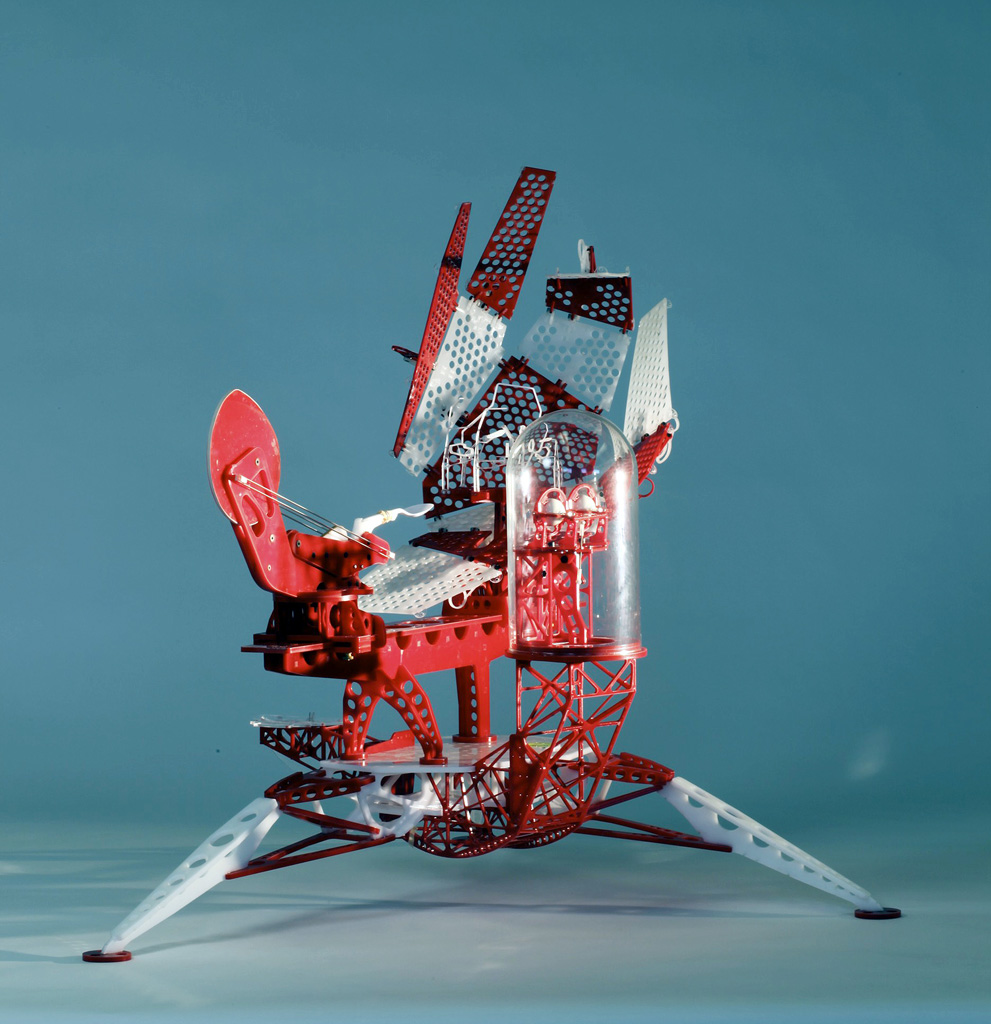
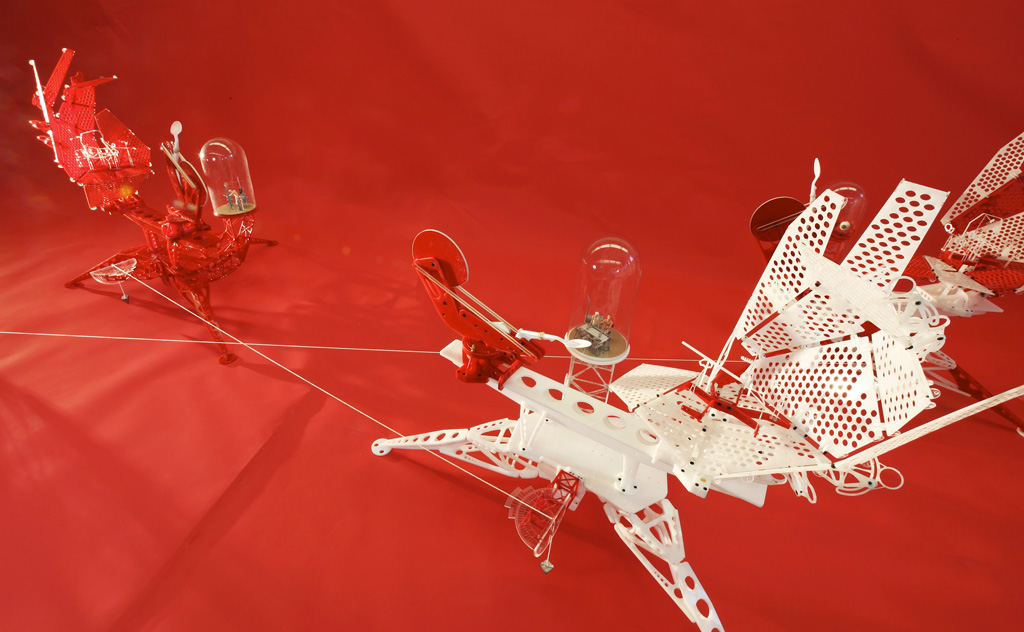
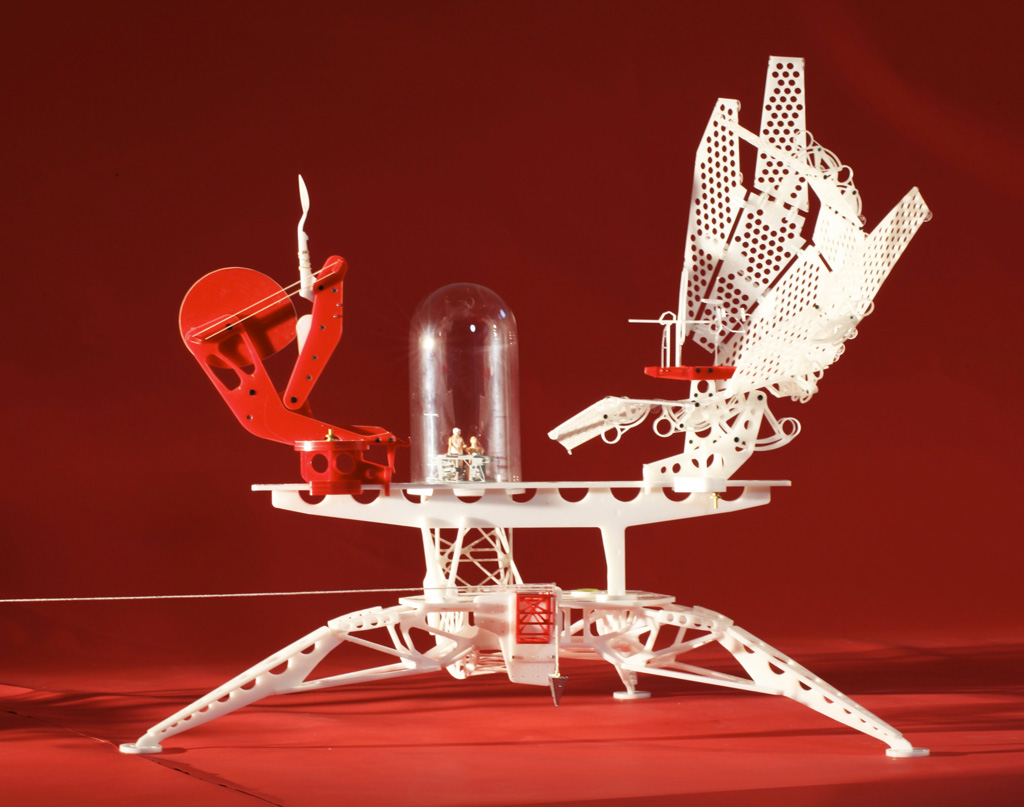
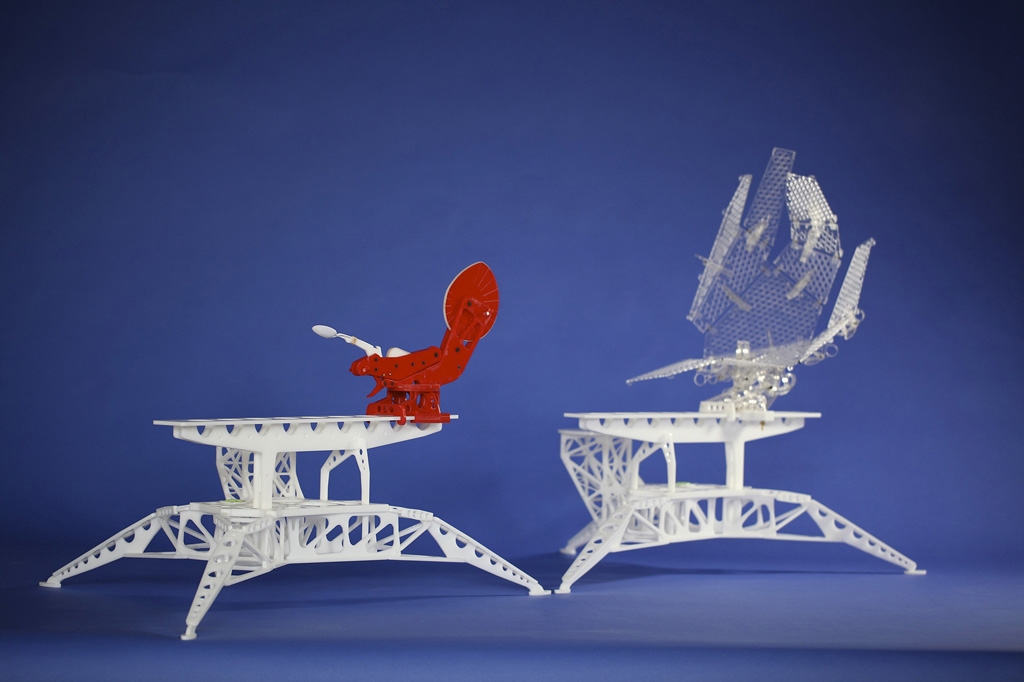
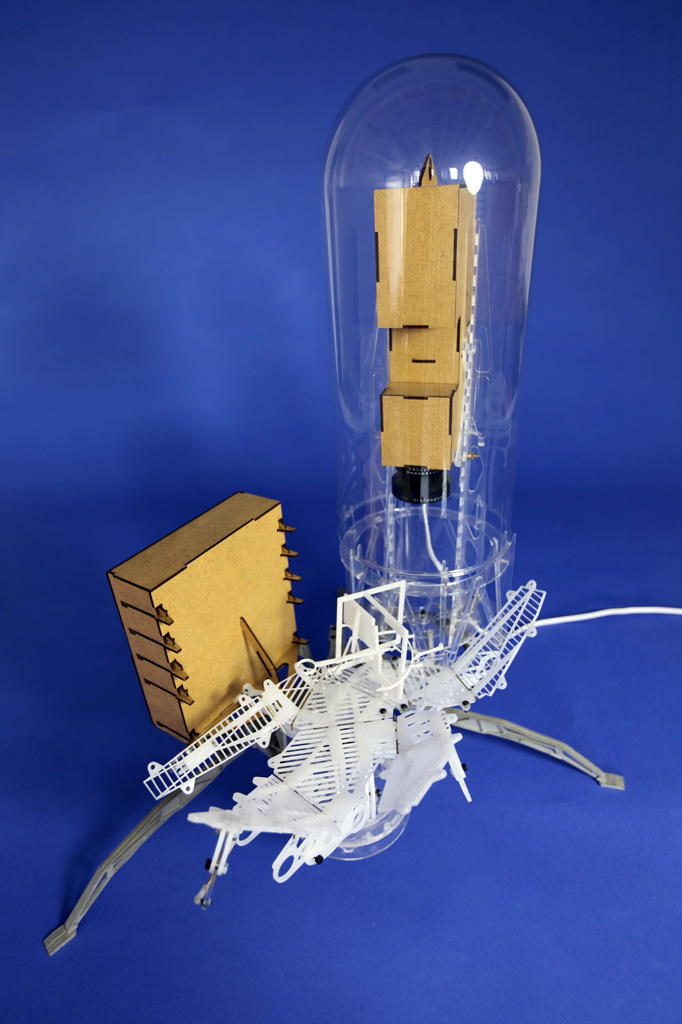
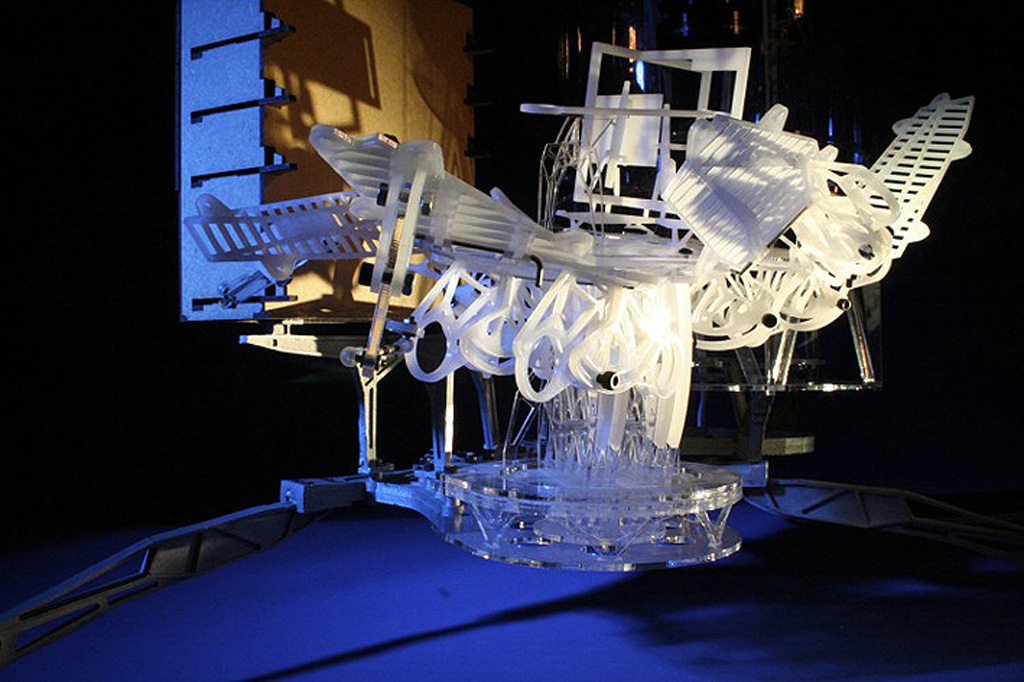
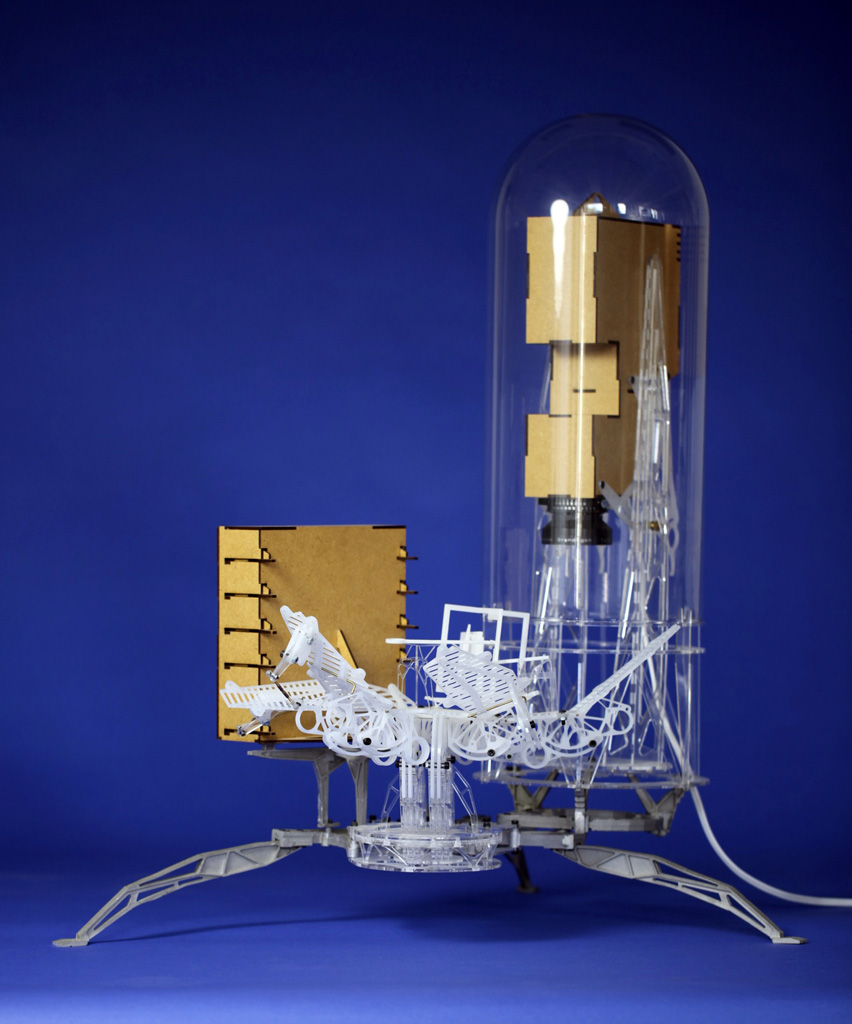
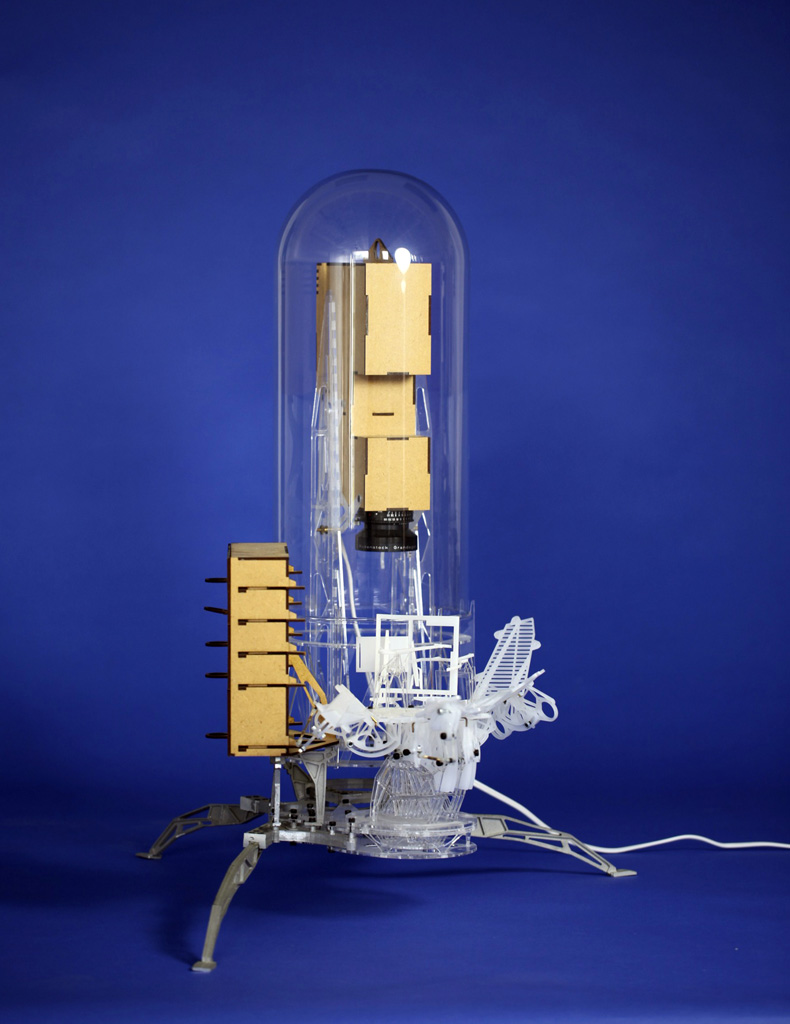
Each instrument has a number of parts. A three egged chassis holds a beam like an optical bench to hold a paint catapult, a picture plane and a set of drawing pieces. A side frame hold a model scene that is protected from flying paint by a glass dome. The scene reminds the person who is drawing of the content under discussion in the drawings they are making. As with the light projections, the form of the folding picture plane has a consequence on how the paint is accepted. Several other measuring instruments calibrate the relative positions of the instruments.

Some Versions of Drawing Instrument Five (Nat Chard)
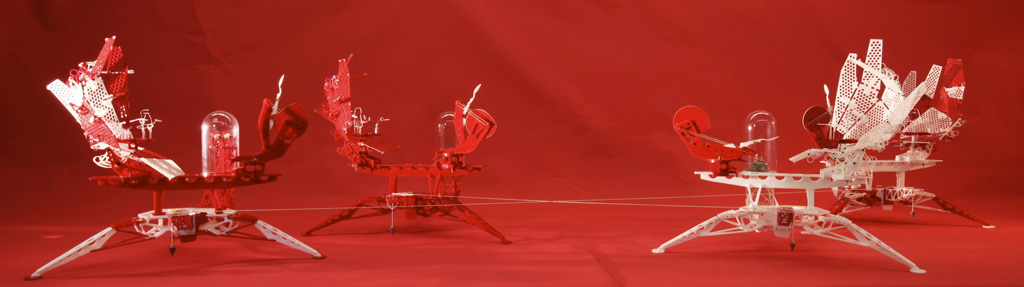
There are four versions of Instrument Five. One is red, one white and the other two a combination of the two – where one has red legs, for instance, the other has white.

Two Versions of Drawing Instrument Five (Nat Chard)
Each instrument has all the parts and can throw paint at any of the other instruments. The accumulation of paint on the drawing pieces may be from several other instruments.

Drawing Instrument Five (Nat Chard)Drawing Instrument Five (Nat Chard)
The pleasure in this instrument was the discovery that it can nurture the very condition that it tries to draw  in the person working with it. To get to that stage though, there is a further development that makes much more sense of the instrument. This is a series of high speed flash photographs of the paint flying though the air. I will show some of these in the next few posts.

Drawing Instrument Five (Nat Chard)
Drawing Instrument Five (Nat Chard)

Instrument Four (Nat Chard)
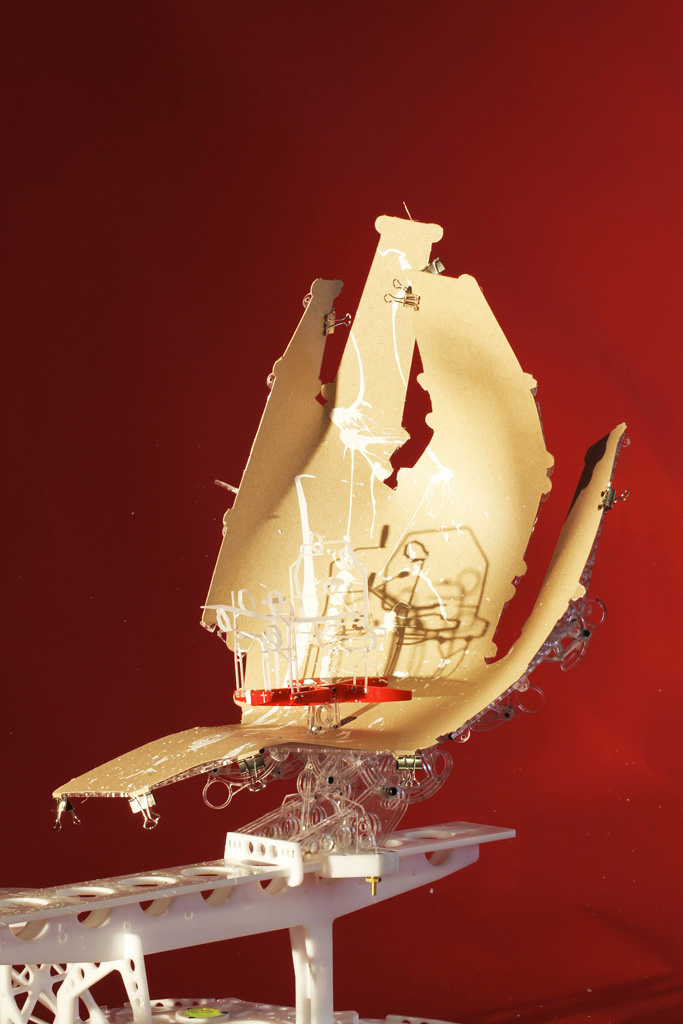
Instrument Four is a departure and is a test bed for instruments Five and Seven. The previous drawing instruments projected light. In terms of working with uncertainty and indeterminacy the physics of light was too predictable and too much under my control. Instrument Four projects paint rather than light. There are two instruments that talk to each other, rather than the monologue of the previous instruments. I will explain the ideas more fully when discussing instrument Five, but the paint hits a series of objects and through that collision splatters onto the picture plane. Instead of a figurative shadow it is a shadow of the play between the action of the paint on the drawing pieces.

Instrument Four (Nat Chard)

Of all the instruments they are the least elegant as objects as I tried to find the measure of the new material i was working with.

Instrument Four (Nat Chard)

They did, however, provide enough encouragement that such a form of projection could provide a means of making indeterminate drawings and more importantly, an indeterminate relationship with the instrument.

Instrument Four (Nat Chard)

The drawing pieces are the white plastic pieces sitting above the picture plane. I will explain them further when showing Instrument Five.

Instrument Four drawing (Nat Chard)

The test drawing (above) shows one of the key problems with instrument four (and five). The folding picture plane is behind the drawing pieces so that the subtle splatters from the thrown paint hitting the drawing pieces are obliterated by the main thrust of the flying paint. At this stage the paint is standard interior house paint. In subsequent drawings it is thickened with acrylic thickening gel.

Instrument Four is very much a test –  the benefits reveal themselves in the subsequent instruments.

Pattern1 (Nat Chard)

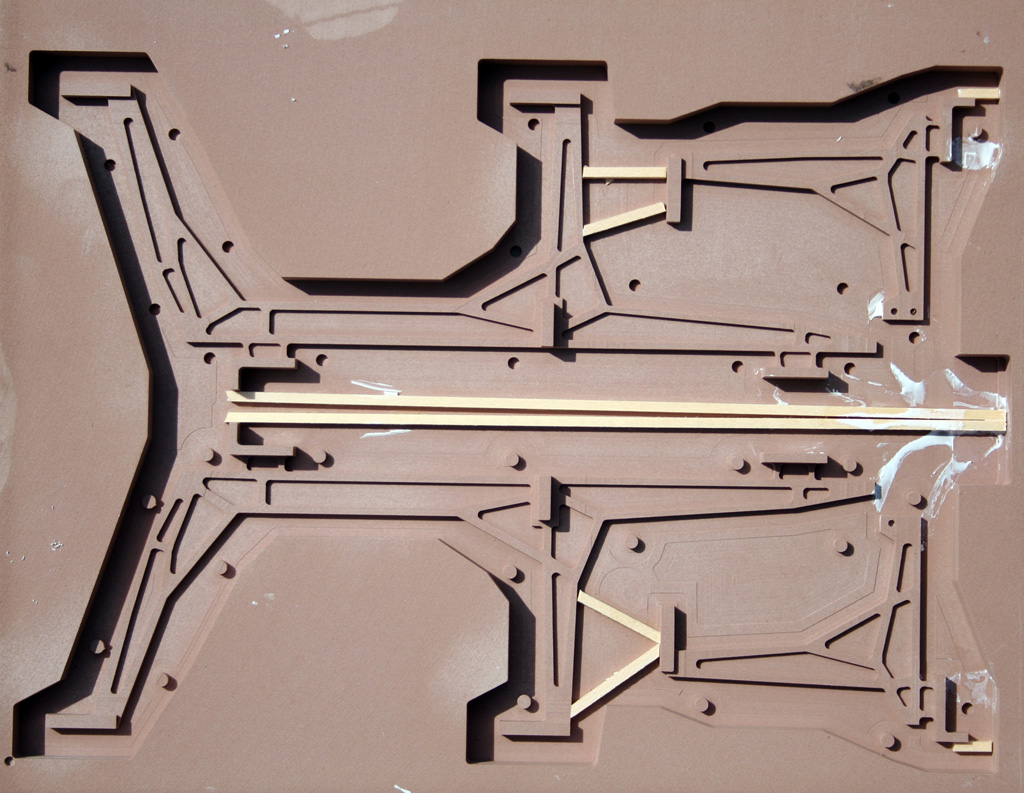
These are some of the patterns made to manufacture drawing instruments one to three. The following four types of instrument are made on laser cutters (and the subsequent ones have reverted to aluminium using a waterjet cutter). The patterns are made of cibatool, a homogenous and isotropic material designed to have no variation in character and to machine easily. I cut them on my small cnc mill.

Pattern 2 (Nat Chard)

The pieces of wood are added as air vents when making the silicon rubber mould so that whatever is poured into them can displace the air in the void. The parts for drawing instrument one were cast in plastic and for instruments two and three (and the incomplete instrument) in aluminium. For these I cast wax into the moulds that the foundry covered with a ceramic case and then melted the wax out to make the mould for the aluminium.

Pattern 3(Nat Chard)

Pattern three (above) was the first piece I machined. There are no drawings of the whole thing and no complete drawings any of the parts. They were designed incrementally, even within each part, so the only thing known about the next component was the dimension and geometry of the fixing to the previous piece.

Underside of chassis (Nat Chard)
Leg pattern (Nat Chard)

Dome brackets (Nat Chard)
Frame for drawers (Nat Chard)
Various components (Nat Chard)

Drawing Instrument 3 (Nat Chard)

Instrument Three is a linear development of Instrument Two, which was destroyed in transit while returning from an exhibition. The picture plane is a little different, but in most other respects it is a remake of Instrument Two.

Drawing Instrument 3 (Nat Chard)

Drawing Instrument 3 (Nat Chard)


Drawing Instrument 3 (Nat Chard)

Instrument Two in Action 1 (Nat Chard)

Instrument Two in Action 2 (Nat Chard)

Instrument Two in Action 3 (Nat Chard)

Instrument Two in Action 4 (Nat Chard)

Instrument Two in Action 5 (Nat Chard)

Instrument Two in Action 6 (Nat Chard)

A sequence of adjustments to the picture plane as well as to the model in the projector. You can see the shadows of the model on the picture plane. If this is your first view of the blog, the rest of the instrument can be seen in a post further down the page, as can the drawings that result from working with the instrument. The nature and geometry of the folds in the picture plane were developed to provide a range of subtle to developed adjustments within the area covered by the projection lens.

In a later post I will put up some films of the picture plane moving to show its range of folds.