
Anatomical Torsos
I have been sharing my attic studio with these characters recently. The house has been on the market in anticipation of a return to the UK in January and they have been moved to my studio so as not to scare off potential buyers. It seems the people who bought the house liked them anyway. They normally hang out in the living room (with a few others), as seen below (also with the author).
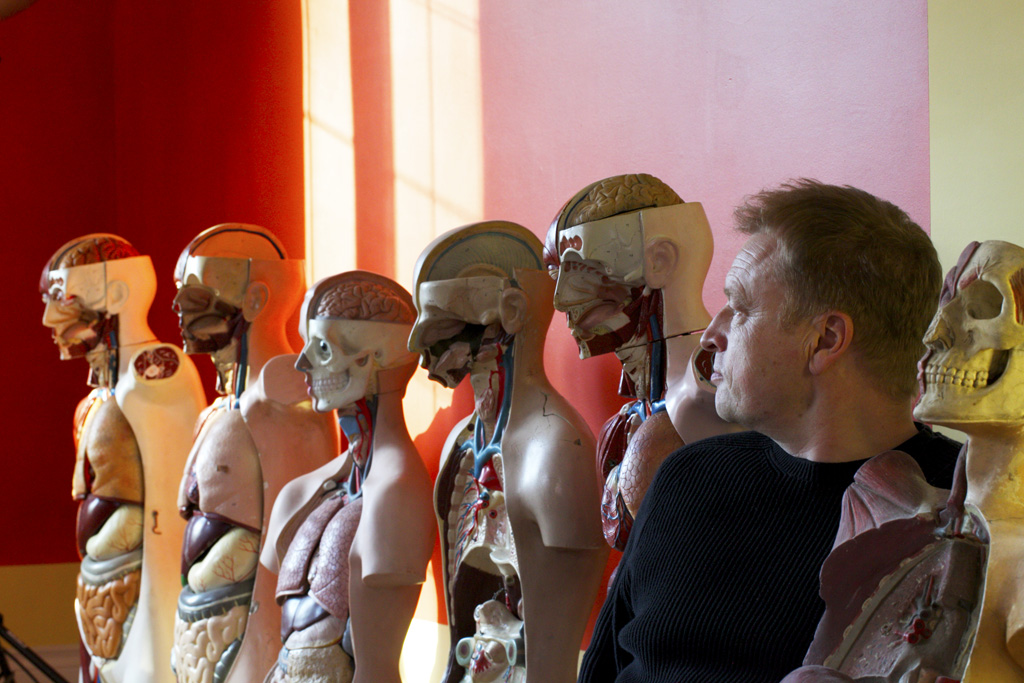 Medical models appear so much more critical than their architectural equivalent. The section lines are content driven and understand the general symmetry of the body, so they tease your imagination to carry what exists at one layer on one side over to that other, where greater depths are then revealed. I purchased my first one (that I keep at work) when I moved to Copenhagen. In London I would borrow one from the anatomical lab at UCH, who were very helpful as I was teaching at the Bartlett, also part of UCL. In Copenhagen the Academy had no affiliations with medical schools, so I would borrow the Academy’s van and drive all my equipment to the alcohol dependency unit of a nearby hospital who were happy for me to work with it there but not to borrow it. As there were so many knowing looks by people seeing the school of architecture van outside the alcohol dependency clinic, and also the inconvenience of having to move all my lights and large format camera, I bought my own figure. I have not done any body drawings for a while, pertly due to the demise of Polaroid film which I used to use to make transfers, but with some distance it would be good to rethink the project some time, with one of the other figures.









 Nat Chard